
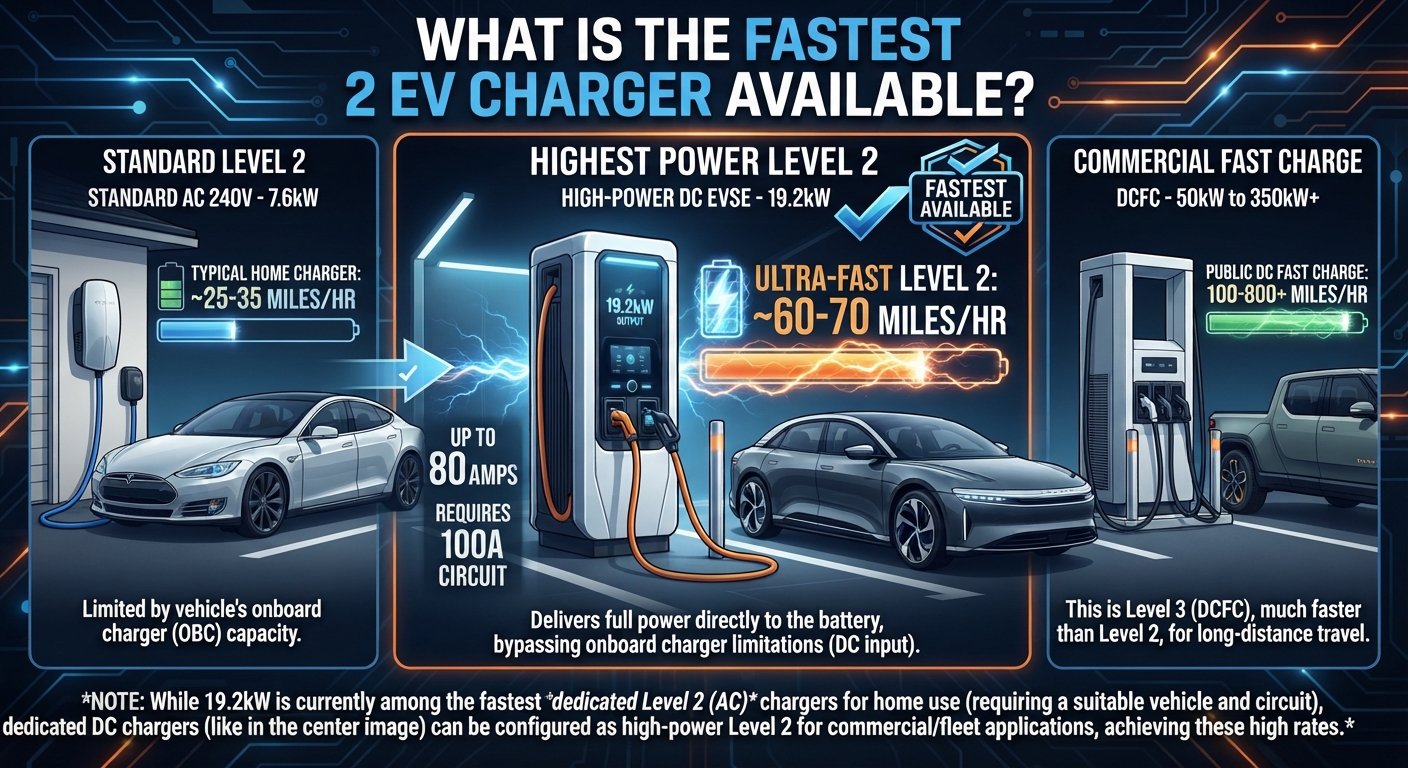
The fastest Level 2 EV chargers available for homes are 80-amp, 19.2 kW units. They can add roughly 55 to 70 miles of range per hour, which is about 70% faster than the common 48-amp (11.5 kW) chargers. But there is a big catch: only a few EVs can accept 19.2 kW on AC power. For most cars, the fastest charger you can actually use tops out at 11.5 kW or lower.
This guide explains what “fastest” really means, which EVs can use it, what it takes to install one, and how to decide whether the fastest option is worth it for you.
The Fastest Level 2 Chargers: 80A and 19.2 kW
Level 2 charging runs on 240 volts, and speed depends on amperage. The top of the range looks like this:
| Charger class | Power | Approx. range per hour |
|---|---|---|
| 80A (19.2 kW) | 19.2 kW | ~55–70 miles |
| 48A (11.5 kW) | 11.5 kW | ~33–40 miles |
| 40A (9.6 kW) | 9.6 kW | ~27–33 miles |
| 32A (7.7 kW) | 7.7 kW | ~22–27 miles |
Several brands sell hardwired 80-amp home chargers with a J1772 connector. Examples that appear in current buying guides include the Autel MaxiCharger 80A, the Grizzl-E Ultimate 80A and the Enphase (ClipperCreek) HCS-80. Models, specs and availability change often, so confirm the current rating and connector with the manufacturer before you buy.
Can Your EV Use the Fastest Level 2 Charger?
This is the most important question. Your car’s onboard charger sets the maximum AC speed. A 19.2 kW charger on a car limited to 11.5 kW still charges at 11.5 kW.
- Can use 19.2 kW (80A): a small number of vehicles with large onboard chargers, such as certain Ford F-150 Lightning trims, the Lucid Air and the GMC Hummer EV. Always check your exact model, trim and year.
- Commonly limited to 11.5 kW (48A): many newer EVs, such as the Chevy Equinox EV and Hyundai Ioniq 6.
- Commonly limited to 7.7 kW (32A) or less: many popular EVs and most plug-in hybrids.
Look up your vehicle’s maximum AC charging rate in the owner’s manual or the manufacturer’s specs. If you want a quick sanity check, check which charger speed your EV can actually use before you spend money on hardware or wiring.
What the Fastest Level 2 Charger Requires at Home
An 80-amp charger asks much more of your home than a standard unit:
- A dedicated 100A breaker. EV charging is a continuous load, so the breaker is sized at 125% of the charger’s amperage.
- Heavier wiring. The cable between your panel and the charger is thicker and costs more to run.
- Hardwired installation. Plug-in outlets such as NEMA 14-50 do not support 80A.
- Enough panel capacity. Many homes need a load calculation, and some need a panel or service upgrade.
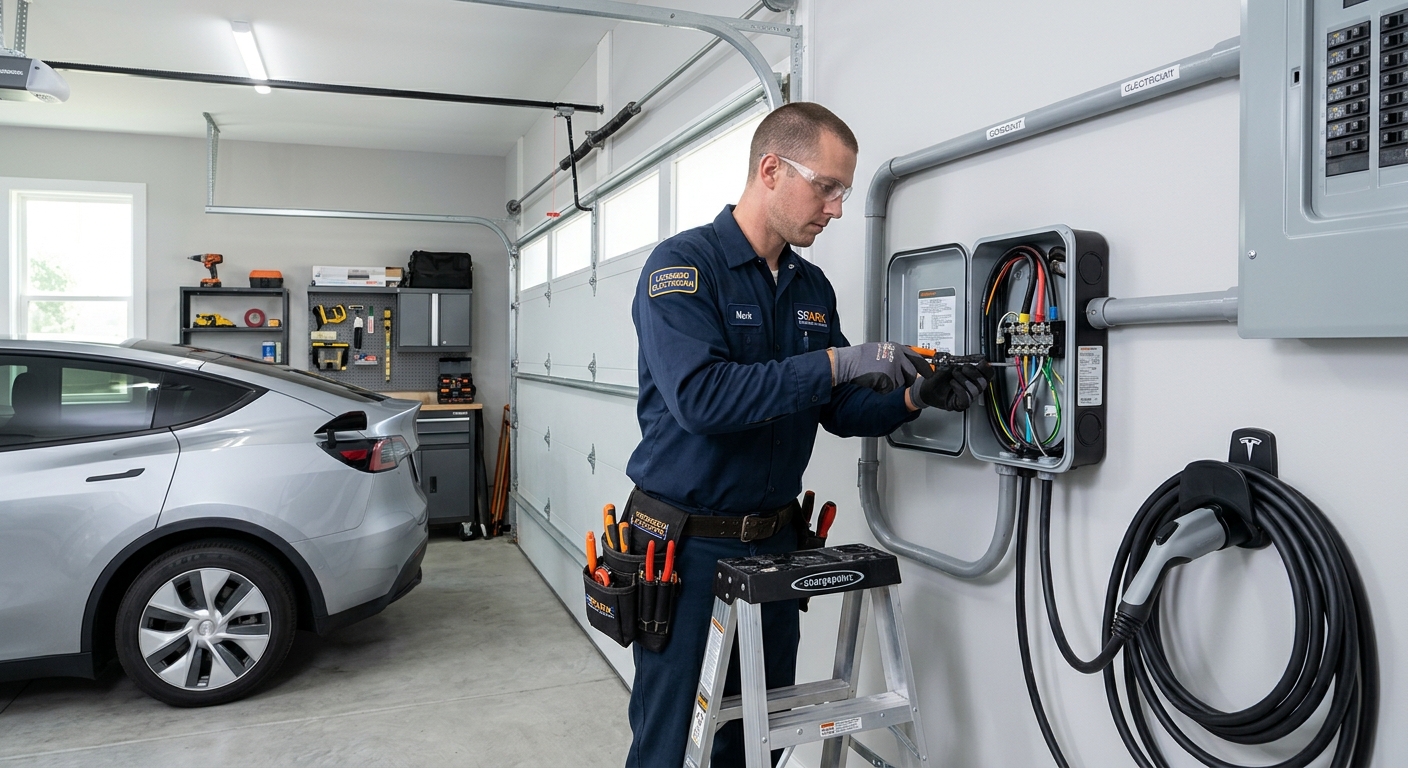
- A licensed electrician and permits. Rules vary by city and utility.
| Charger amperage | Breaker size |
|---|---|
| 32A | 40A |
| 40A | 50A |
| 48A | 60A |
| 80A | 100A |
How Much Faster Is It in Real Life?
Here is the time to add about 40 kWh (roughly 140 miles for many EVs):
| Charger | Approx. time |
|---|---|
| Level 1 (1.4 kW) | ~28 hours |
| 32A Level 2 (7.7 kW) | ~5 hours |
| 48A Level 2 (11.5 kW) | ~3.5 hours |
| 80A Level 2 (19.2 kW) | ~2 hours |
Use this formula for your own numbers: hours ≈ kWh needed ÷ charger kW, plus about 10% for losses. For a truck with a 100+ kWh battery that can accept 19.2 kW, the difference over a full charge is a few hours, and that is where an 80A charger earns its cost.
Is the Fastest Level 2 Charger Worth It?
It can be worth it if:
- Your EV can accept 19.2 kW on AC
- You have a large battery and a long daily range
- You run more than one EV or charge a work vehicle
- Your panel already has spare capacity, or you plan an upgrade anyway
It is probably not worth it if:
- Your car accepts 11.5 kW or less, because you pay for speed you cannot use
- You drive under 40 to 60 miles a day, because even a 32A charger refills that overnight
- Your panel would need an expensive upgrade just to support the charger
- You mostly charge at night with a long parking window
For most drivers, a 32A to 48A charger is the practical sweet spot. It is fast enough to refill most EVs overnight, it is cheaper to install and it works with more homes.
Fastest Level 2 vs DC Fast Charging
| Fastest Level 2 | DC Fast Charging | |
|---|---|---|
| Type | 240V AC | High-power DC |
| Power | Up to 19.2 kW | 50–350 kW |
| Where | Home or workplace | Public stations |
| Best for | Daily charging | Road trips |
Even the fastest Level 2 charger is much slower than public DC fast charging. Level 2 wins on cost and convenience, because you plug in at home and leave with a full battery.
How to Choose the Fastest Charger That Makes Sense
- Check your car’s maximum AC rate in the manual or manufacturer specs.
- Check your electrical panel’s spare capacity with a licensed electrician.
- Match the charger to the lower of the two limits, your car or your circuit.
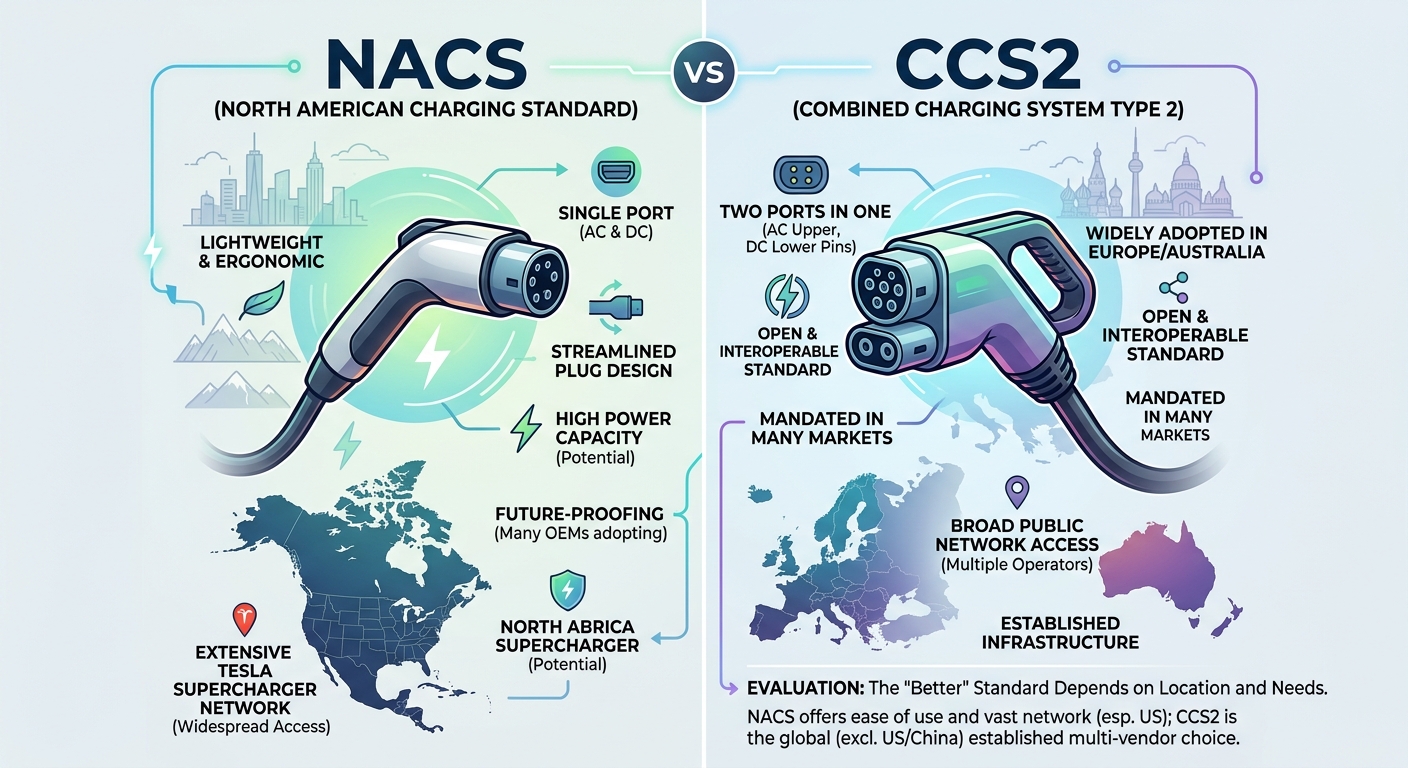
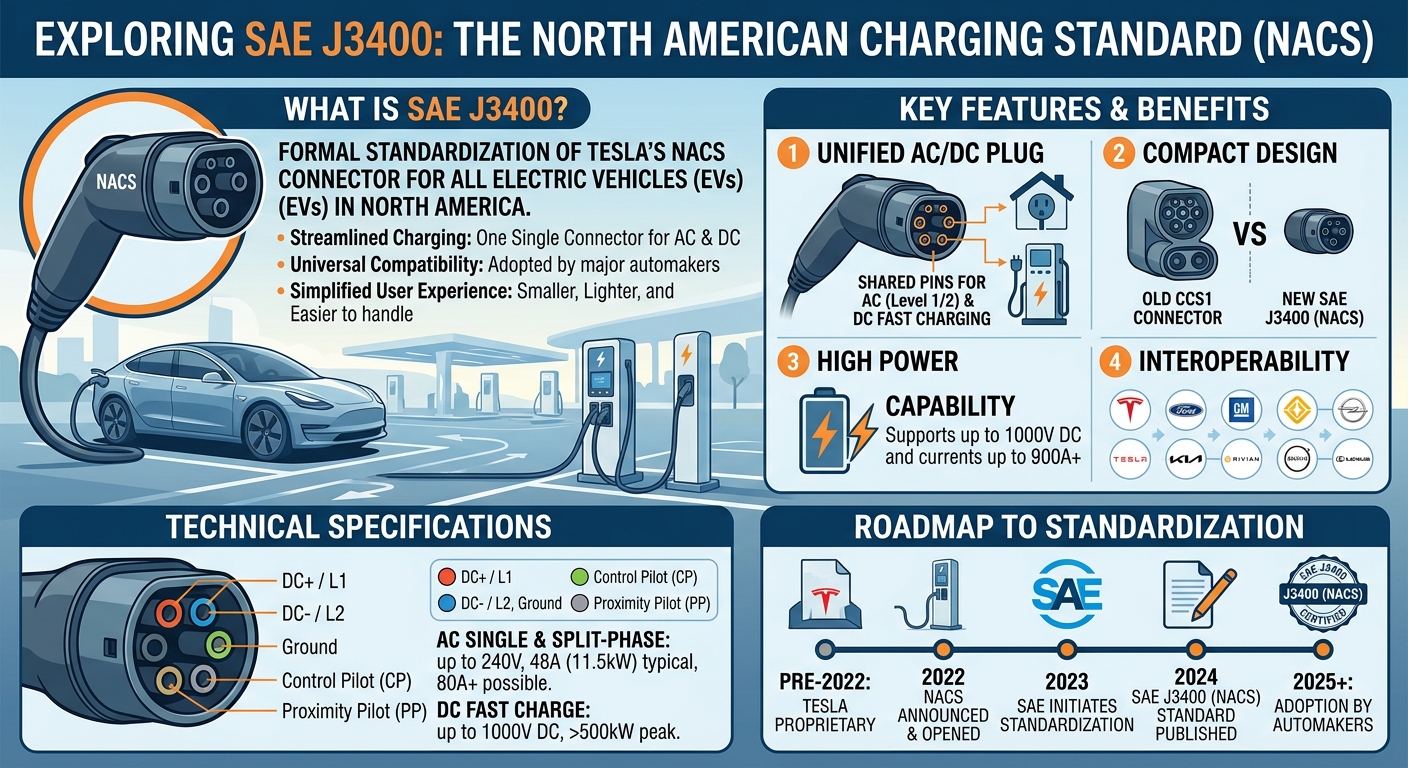
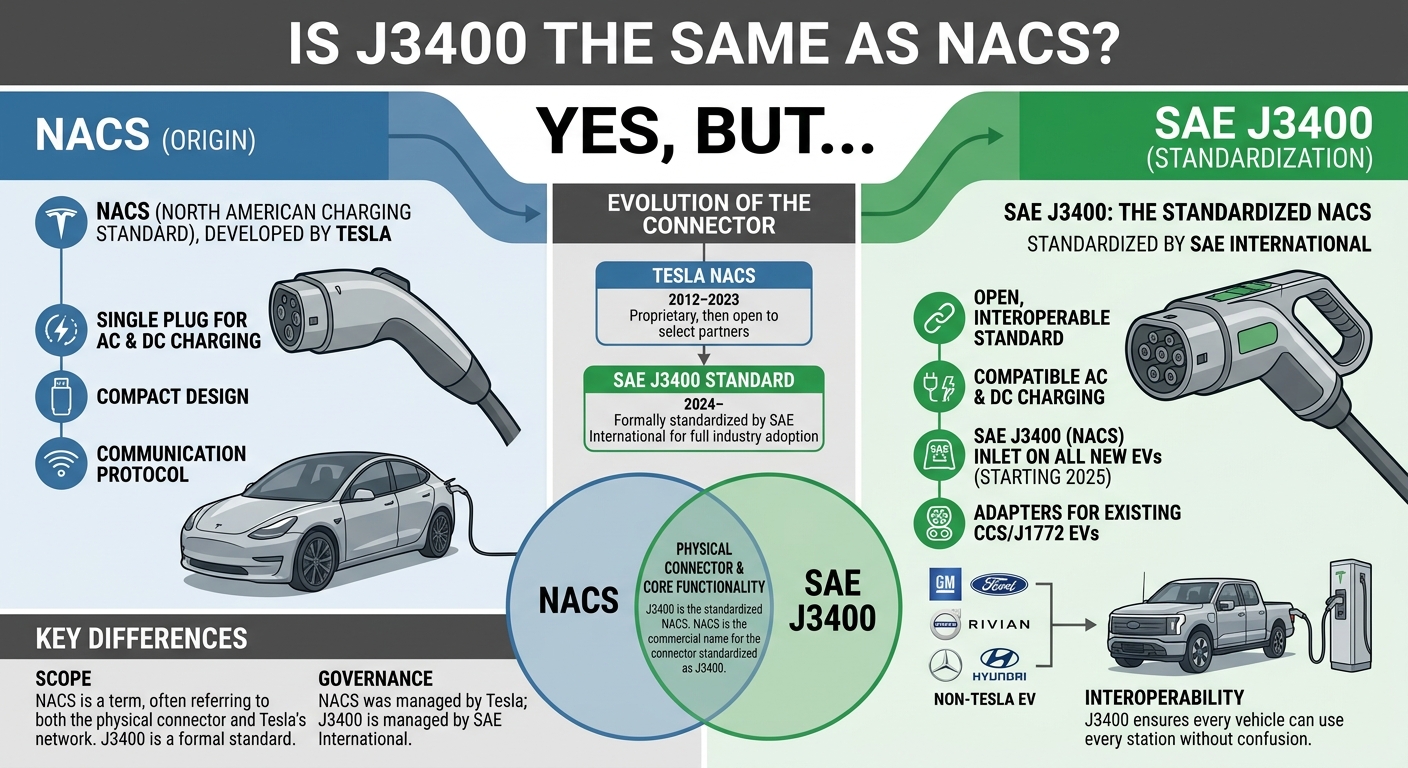
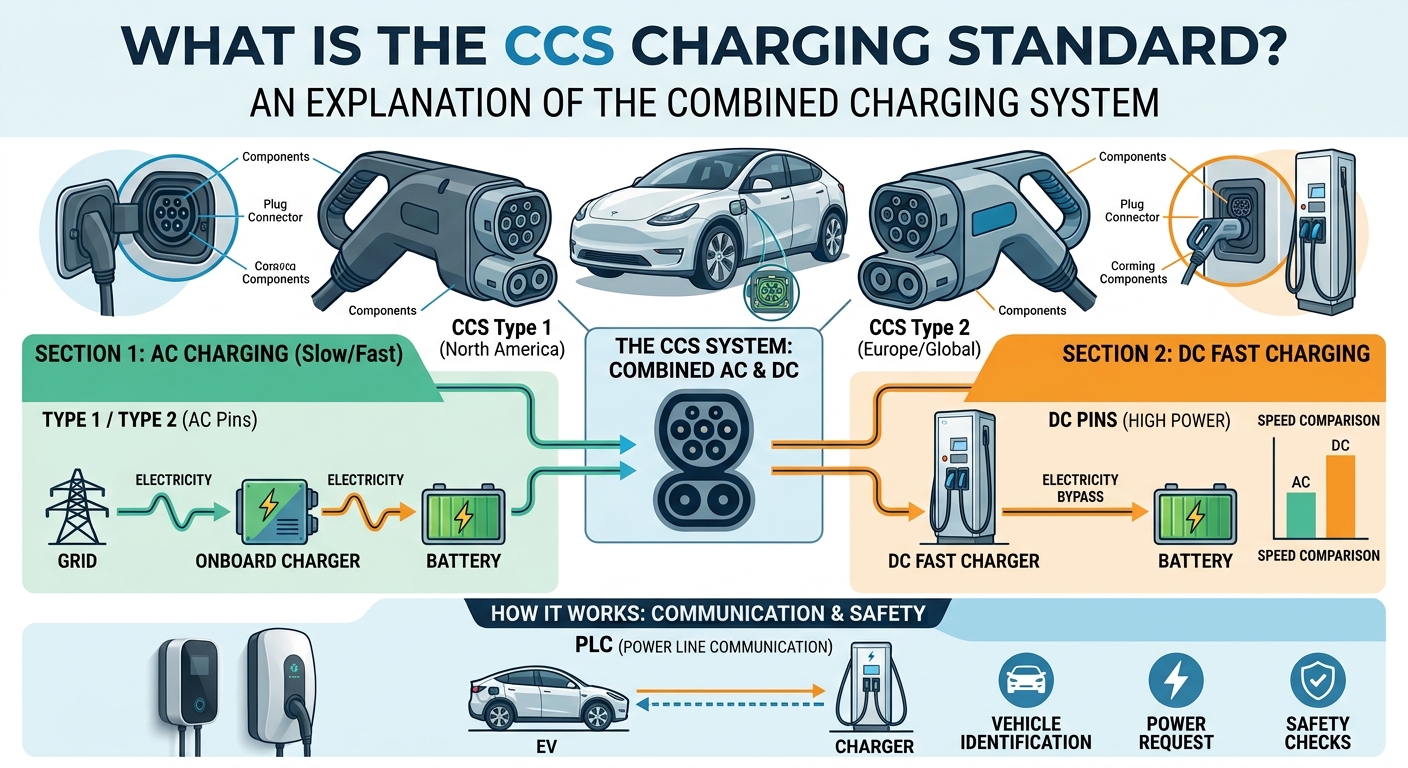
- Confirm the connector. J1772 is common, and some newer EVs use a NACS port and may need an adapter.
- Look for safety certification, such as UL or ETL, and an outdoor rating if it will be exposed.
- Get a written installation quote before you buy the hardware.
Not sure how much speed you really need? You can get help choosing the right fast Level 2 charger before you commit to a bigger install.
Frequently Asked Questions
What is the fastest Level 2 EV charger?
The fastest home Level 2 chargers are 80-amp units rated at 19.2 kW.
How many miles per hour does an 80-amp charger add?
Roughly 55 to 70 miles per hour, if your EV can accept the full 19.2 kW.
Which EVs can use a 19.2 kW Level 2 charger?
Only some models with large onboard chargers, such as certain Ford F-150 Lightning trims, the Lucid Air and the GMC Hummer EV. Check your exact model and trim.
Will an 80-amp charger charge my car faster than a 48-amp charger?
Only if your car can accept more than 11.5 kW on AC. Otherwise both charge at the same speed.
What breaker does an 80-amp EV charger need?
A 100-amp breaker on a dedicated circuit, with a hardwired installation.
Can I plug an 80-amp charger into a regular outlet?
No. 80-amp chargers are hardwired and need heavier wiring than a NEMA 14-50 outlet supports.
Is a faster Level 2 charger worth the extra cost?
Only if your EV can use the speed and your home can support it. Otherwise a 32A to 48A charger is usually enough.
Is the fastest Level 2 charger as fast as a DC fast charger?
No. DC fast chargers deliver far more power, but Level 2 is cheaper and more convenient for daily home charging.
Does the fastest Level 2 charger work with Tesla vehicles?
Many Teslas use a NACS port, so you may need an adapter for a J1772 charger. Most Teslas also cannot accept 19.2 kW, so check your model’s AC limit.
Do I need a panel upgrade for an 80-amp charger?
Often yes, or at least a load calculation. An electrician can tell you what your home can safely support.
Final Thoughts
The fastest Level 2 EV charger is an 80-amp, 19.2 kW unit, but the fastest charger is not always the best choice. The right speed is the one your car can accept and your home can safely supply. If you want a clear recommendation, get help choosing the right fast Level 2 charger and avoid paying for power you cannot use.





Leave a Reply