
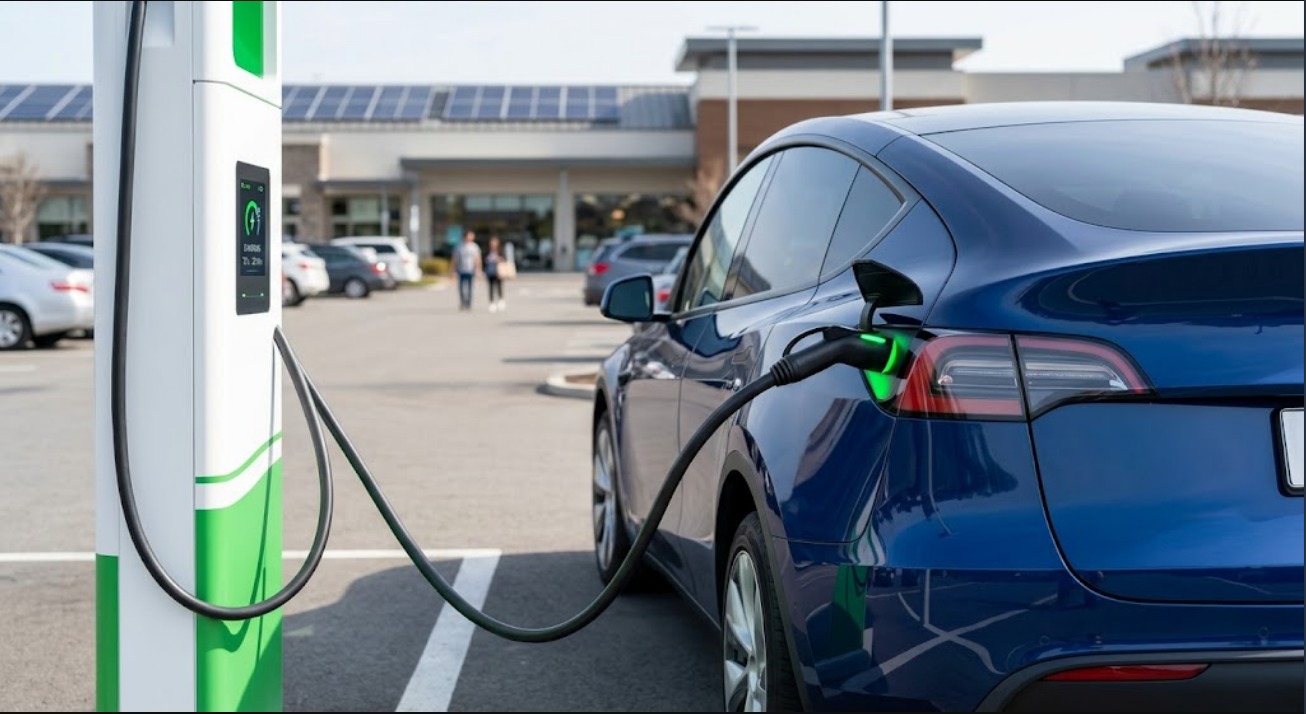
A charger can’t force more power into your car than it can accept. Your car’s onboard charger sets the limit, and the charger and car communicate to agree on a safe rate. The real risks of buying a bigger charger are wasted money and overloading your home’s electrical system, not harming your car.
Why a more powerful charger can’t overpower your EV
Your car’s onboard charger converts AC power from your home into DC power for the battery. It also controls how much current the battery can accept. The charging equipment (EVSE) tells the car how much power is available, and the car then draws only what it can safely take.
For fast DC charging, the car’s battery management system plays the same protective role. However much power the supply can deliver, the battery only receives what it can handle.
Think of a wide water main feeding a kitchen tap. The tap, not the main, decides how fast water flows.
What a bigger charger can cost you
If your car’s onboard charger tops out at 7.7 kW (32 amps), a 48-amp home charger won’t charge it any faster. In that case you’ve paid for power the car can’t use. A Level 2 unit may be able to deliver over 19 kW, but the car still limits it to its own rating.
The other cost is on the electrical side:
- Higher circuit demands: A 48-amp charger is about 15-20% faster than a 40-amp one, but usually needs a 60-amp circuit and a hardwired installation. A 40-amp charger can typically plug into a NEMA 14-50 outlet on a 50-amp circuit.
- Panel risk: A high-amp charger can overload an electrical panel that isn’t built for the extra load.
Charger amps, power and breaker size
Chargers should run at no more than 80% of the breaker rating, which is why the breaker is always larger than the charger.
| Charger rating | Power | Breaker needed |
|---|---|---|
| 32A | ~7.7 kW | 40A |
| 40A | ~9.6 kW | 50A |
| 48A | ~11.5 kW | 60A |
Plug-in Level 2 chargers are limited to 40 amps. Hardwired units go much higher, up to 80 amps, but few cars can use that.
How to find your car’s limit
Check your owner’s manual or manufacturer spec sheet for the maximum AC charging rate, listed in kW or amps. Many EVs accept 32 or 40 amps, and some newer models take 48 amps or more. Your charger should match the lower of what your car and your home circuit can support.
What about DC fast charging?
DC fast chargers bypass your car’s onboard charger and deliver power straight to the battery. The battery management system still controls the rate, so the battery only gets what it can handle.
Should you future-proof your charger?
If you might change cars, an adjustable-amperage charger is a sensible hedge. Some models let you run at 40 amps now and raise the setting to 48 amps later, as long as your electrical service supports it. A licensed electrician can tell you whether your panel has the capacity.
How to choose the right charger
- Find your car’s maximum AC charging rate in the manual or spec sheet.
- Ask a licensed electrician to check your panel and available capacity.
- Match the charger to the lower of the two limits.
- Choose an adjustable-amperage model if you plan to change vehicles.
- Confirm breaker and wire sizing follow the 80% rule.
Next step: Compare Level 2 chargers: https://evchargeradvisor.online/
FAQs
Can an EV charger damage my car?
A properly working charger communicates with the car, and the car draws only the power it can accept. The onboard charger and battery management system protect the battery.
Will a 48-amp charger charge my car faster than a 32-amp one?
Only if your car’s onboard charger can accept 48 amps. If it maxes out at 32 amps, you’ll see no speed gain.
Is a higher-amp charger worth buying?
Only if your car and your electrical circuit can both support it. Otherwise you pay more for equipment and installation than you can use.
Can a charger overload my home’s electrical panel?
Yes, if the panel isn’t designed for the additional load. Have an electrician assess it before installing.
What’s the maximum amperage for a plug-in Level 2 charger?
Plug-in units are limited to 40 amps. Hardwired chargers can be rated much higher.
Should my home charger match my car’s onboard charger?
Yes, as closely as practical. Matching avoids overspending on capacity your car can’t fully use.
Final thoughts
No charger is too powerful for your car, but it can easily be too powerful for your wallet or your panel. Match the charger to your car and your home, and you’ll get the full speed you pay for.
Ready to choose? See our top Level 2 chargers https://evchargeradvisor.online/
General information only. Have a licensed electrician assess your home before installing a charger.

















Leave a Reply