
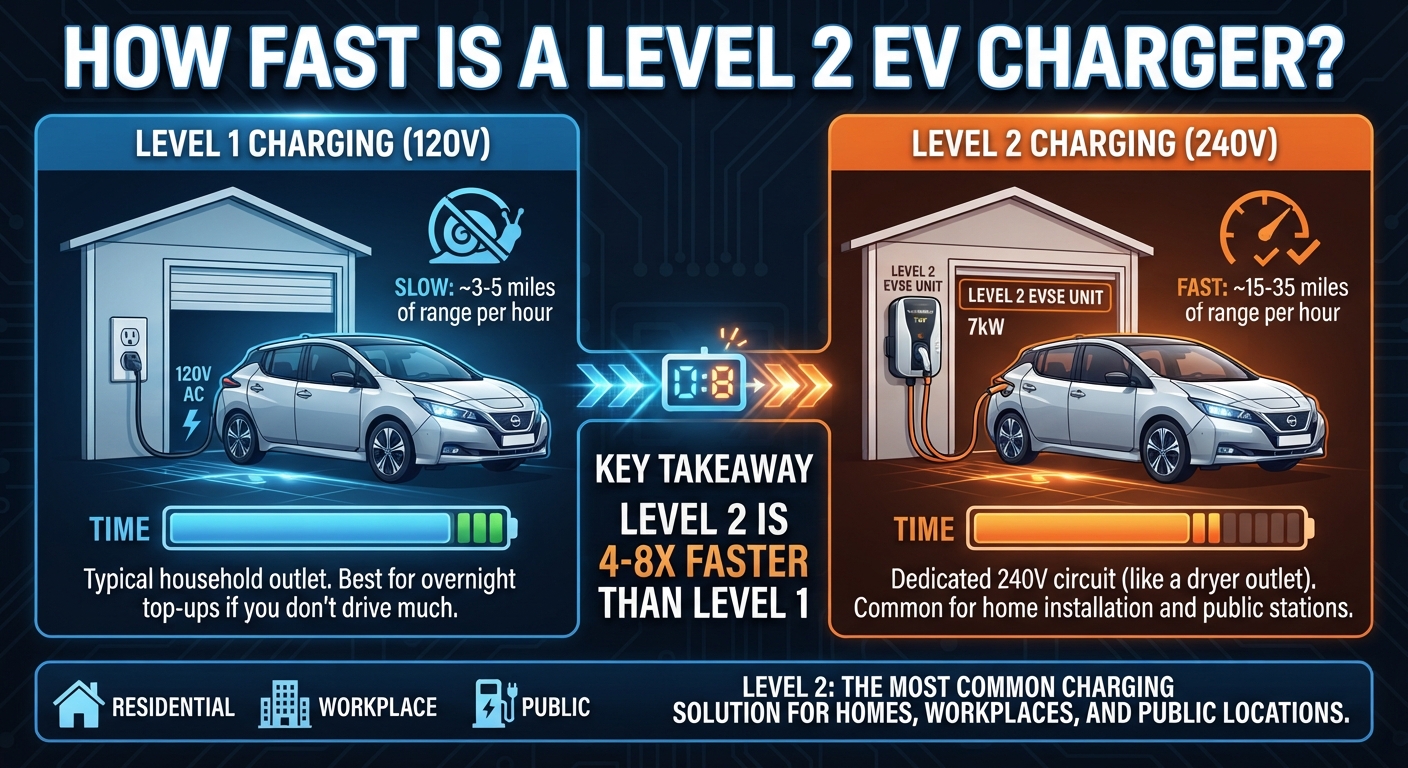
Most home Level 2 EV chargers add about 12 to 36 miles of range per hour. Power runs from 3.8 kW on a 16-amp unit to 11.5 kW on a 48-amp unit, so a full charge usually takes about 4 to 10 hours. That is roughly 5 to 10 times faster than a standard 120V wall outlet. The exact speed depends on two things: how much power the charger can deliver and how much your car can accept.
This guide shows what to expect in real numbers, why your speed may be lower than the charger’s rating, and how to work out your own charging time.
Level 2 Charging Speed by Amperage
A Level 2 charger runs on 240 volts. Its speed depends mostly on amperage. The table below shows typical output and range added per hour, assuming an efficiency of about 3.5 miles per kWh and roughly 10% charging losses.
| Charger amperage | Power (kW) | Range added per hour |
|---|---|---|
| 16A | 3.8 kW | ~12 miles |
| 24A | 5.8 kW | ~18 miles |
| 32A | 7.7 kW | ~24 miles |
| 40A | 9.6 kW | ~30 miles |
| 48A | 11.5 kW | ~36 miles |
Some high-amp units reach up to 19.2 kW, but few EVs can accept that much on AC power, and most homes cannot support it.
How Long Does a Level 2 Charger Take?
Here is how long it takes to add 100 miles of range at each speed:
| Charger | Time to add ~100 miles |
|---|---|
| Level 1 (120V, ~1.4 kW) | ~23 hours |
| Level 2, 16A (3.8 kW) | ~8.5 hours |
| Level 2, 24A (5.8 kW) | ~5.5 hours |
| Level 2, 32A (7.7 kW) | ~4 hours |
| Level 2, 40A (9.6 kW) | ~3.3 hours |
| Level 2, 48A (11.5 kW) | ~2.8 hours |
For a full battery, use this formula: hours ≈ kWh needed ÷ charger kW, then add about 10% for losses. A 60 kWh battery charged from 20% to 100% needs about 48 kWh, which takes roughly 6.5 hours on a 7.7 kW charger.
Most drivers never charge from empty. If you drive 30 to 40 miles a day, you only need to replace that, which takes an hour or two on most Level 2 chargers.
Why Your Car May Charge Slower Than the Charger’s Rating
This is the part most guides skip. Your car’s onboard charger sets the maximum AC charging speed. It converts the AC power from the wall into DC power for the battery, and it has its own limit.
- Many EVs accept about 7 to 11 kW on AC.
- Some older or smaller EVs and plug-in hybrids accept only about 3.3 to 6.6 kW.
- A 48-amp charger on a car limited to 7.2 kW will still charge at 7.2 kW.
Before you buy, check your vehicle’s maximum AC charging rate in the owner’s manual or the manufacturer’s specs. Paying for a bigger charger than your car can use only raises the cost of the charger and the wiring.
What Else Changes Level 2 Charging Speed?
- Cold weather: a cold battery charges more slowly, and the car may use some power to warm the battery.
- Battery level: speeds can ease off as the battery gets close to full.
- Circuit capacity: the charger can only draw what the circuit and breaker allow.
- Charger settings: some chargers let you lower the amperage, and smart chargers may limit power during peak hours.
- Voltage: real-world voltage can sit slightly below or above 240V, which changes output a little.
- Cable and connector condition: damaged or worn equipment can reduce charging or trigger a safety shutdown.
Level 2 vs Level 1 vs DC Fast Charging
| Level 1 | Level 2 | DC Fast Charging | |
|---|---|---|---|
| Voltage/type | 120V AC | 240V AC | High-power DC |
| Typical power | ~1.4 kW | 3.8–11.5 kW | 50–350 kW |
| Range per hour | ~3–5 miles | ~12–36 miles | Hundreds of miles |
| Best for | Occasional top-ups | Daily home charging | Road trips |
Level 2 is not as fast as DC fast charging, but it is the practical choice for daily life. You plug in when you get home and leave with a full battery, without a trip to a public station.
Is Level 2 Fast Enough for You?
For most drivers, yes. Use these rules of thumb:
- Under 40 miles a day: even a 16A to 24A charger is plenty.
- 40 to 80 miles a day: a 32A charger covers it comfortably overnight.
- Large battery, long commute or two EVs: consider 40A to 48A, if your car and panel support it.
You can find a rough overnight capacity by multiplying the range per hour by the hours the car sits parked. Ten hours on a 7.7 kW charger adds about 240 miles, which is more than most people drive in a day.
How to Get the Fastest Safe Level 2 Charging
- Match the charger to your car. Check its maximum AC rate first.
- Confirm your electrical panel can handle it. A licensed electrician can run a load calculation.
- Size the breaker correctly. EV charging is a continuous load, so the breaker should be 125% of the charger amperage. A 40A charger needs a 50A breaker, and a 48A charger needs a 60A breaker.
- Use a hardwired or properly rated outlet. Never use an extension cord.
- Precondition in cold weather. Warm the cabin and battery while still plugged in, if your car allows it.
Not sure what speed makes sense for your car, panel and routine? You can find the right charger speed for your car before you spend money on hardware or wiring.
Frequently Asked Questions
- How fast is a Level 2 EV charger?
Most add about 12 to 36 miles of range per hour, depending on amperage and your car’s onboard charger. - How many miles per hour does a Level 2 charger add?
Roughly 12 miles per hour at 16A and about 36 miles per hour at 48A, using typical EV efficiency. - How long does it take to fully charge an EV on Level 2?
Usually about 4 to 10 hours, depending on battery size and charger power. - Is Level 2 charging fast enough for daily use?
Yes. A 7.7 kW charger can add around 240 miles in 10 hours, which is more than most daily driving. - Why is my Level 2 charger slower than advertised?
Common reasons are a limited onboard charger, cold weather, a lower amperage setting, a near-full battery or limited circuit capacity. - Is a 48-amp charger faster than a 32-amp charger?
Only if your EV can accept the extra power. If its onboard charger is limited to 7.2 kW, both charge at about the same speed. - How much faster is Level 2 than Level 1?
Typically 5 to 10 times faster, depending on the charger and the vehicle. - Is Level 2 faster than DC fast charging?
No. DC fast charging is much faster, but Level 2 is cheaper and more convenient for daily home charging. - Does cold weather slow Level 2 charging?
It can. A cold battery charges more slowly, and some energy may go to warming the battery. - Can I make my Level 2 charger faster?
Only up to your car’s AC limit and your circuit’s capacity. Check both before upgrading.
Final Thoughts
For most drivers, a Level 2 charger is fast enough to refill an EV overnight. The best speed is the one your car can actually use and your home can safely supply. If you want help picking the right setup, ask us which Level 2 charger fits your EV and we will help you narrow it down.





Leave a Reply