
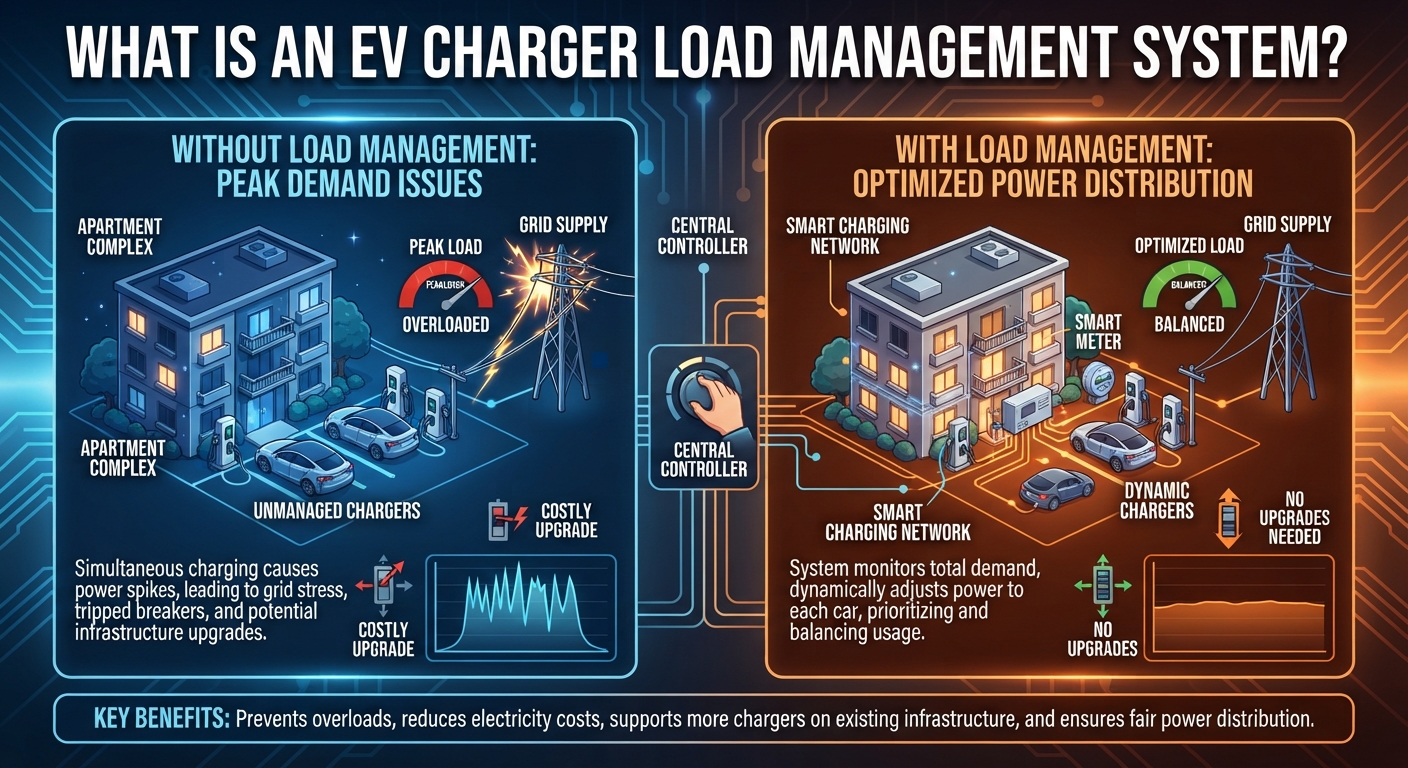
An EV charger load management system is a set of controls that limits and shares electrical power among one or more EV chargers so the total never overloads your panel or service. It monitors how much power is being used, then raises, lowers or pauses charging as needed. The main benefit is that you can often add chargers to an existing electrical system without paying for a costly panel or service upgrade.
How Does an EV Charger Load Management System Work?
- It sets a limit. This is the maximum power the system can safely draw, based on your panel, service or breaker size.
- It monitors usage. Sensors or software track how much power the chargers, and sometimes the rest of the building, are using.
- It adjusts charging. When demand rises, the system lowers the charging current. When demand falls, it raises it again.
- It shares power fairly. With several chargers, it divides the available power between them.
- It resumes at full speed when possible. When other loads drop or a car finishes charging, the remaining chargers speed up.
You still get a full battery. Charging simply happens at a speed your electrical system can support at that moment.
Static vs. Dynamic Load Management
| Type | How it works | Best for |
|---|---|---|
| Static | Sets a fixed power cap for the chargers, based on the size of the electrical service | Simple sites with predictable demand |
| Dynamic | Adjusts charging in real time based on live current readings and how many cars are plugged in | Homes with big appliances, multi-charger sites, apartments |
Many systems combine both: a fixed overall limit, plus real-time adjustments inside it.
How Do Multiple Chargers Share Power?
Systems usually use one of two methods:
- Equal sharing. All active chargers split the available power. If 80 amps are available and four cars are charging, each gets 20 amps. When one car leaves, the rest get more.
- First in, first charged. The first charger gets priority, and others share what’s left. When the first car finishes, the next in line takes over.
Why Use Load Management?
- Avoid a panel or service upgrade. This is often the biggest cost saving.
- Install more chargers. Apartments, workplaces and homes with two EVs can add chargers on limited capacity.
- Prevent tripped breakers. The system backs off charging when other loads spike.
- Protect your electrical system. Power stays within safe limits.
- Use power more efficiently. Chargers share capacity instead of each needing its own full-size circuit.
A Simple Home Example
Imagine a home with a 100-amp panel and a 48-amp EV charger. When the oven, dryer and air conditioner all run at once, the system can reduce the charger to a lower current, or pause it. When the other loads turn off, charging returns to full speed. You avoid a bigger service upgrade, and the car is ready by morning.
What Is Inside a Load Management System?
Setups vary, but typically include:
- Current sensors that measure power use on the main feed or a branch circuit.
- A controller or energy management system (EMS) that decides how much each charger can draw.
- Smart, networked chargers that can change their charging current on command.
- Software or an app to set limits, schedules and priorities.
Some chargers have load management built in. Others pair with a separate energy monitor.
What Do the Electrical Codes Say?
In the US, the National Electrical Code (NEC) generally treats EV charging as a continuous load, which usually means sizing circuits and service for the chargers’ full rating. The code does allow an energy management system to limit the maximum load, so the electrical service can be sized around the system’s limit rather than the sum of every charger’s rating. Rules vary by code edition and local authority, and some places have specific requirements for how the system is installed and approved. Look for equipment certified for this purpose, and have a licensed electrician and your local authority confirm what applies to you.
Load Management vs. Load Balancing
The terms are often mixed up:
- Load balancing usually means dividing power among multiple chargers.
- Load management is the broader idea. It includes balancing, but also overall limits, scheduling and sometimes responding to utility signals or time-of-use rates.
In the UK and Europe, you’ll often see “dynamic load management” used for systems that keep multiple chargers within a site’s supply limit.
Do You Need One?
You may benefit from load management if:
- Your panel has little spare capacity and you want a Level 2 charger.
- You plan to install two or more chargers.
- You live in an apartment, condo or business with shared electrical capacity.
- You want to avoid an expensive service upgrade.
- You want to cap your demand during peak times.
You may not need one if your panel has plenty of capacity for a single charger. For help sizing a charger, see how many amps you need for a Level 2 EV charger in our guide.
Limitations to Know About
- Charging may be slower when other loads are running or many cars are plugged in.
- Equipment costs extra. Compare the price against a panel upgrade quote.
- Compatibility varies. Not every charger works with every system.
- Approvals differ by location. Check with your electrician and local authority first.
To understand typical costs, read how much it costs to install an EV charger.
Frequently Asked Questions
What is an EV charger load management system?
It’s a system that limits and shares electrical power among EV chargers so the total never exceeds what your panel or service can handle.
How does EV load management work?
It monitors power use and adjusts charging current up or down in real time, sharing power between chargers.
What is the difference between static and dynamic load management?
Static sets a fixed power cap. Dynamic changes charging in real time based on live conditions.
Can load management help me avoid a panel upgrade?
Often, yes. Because the system limits total demand, you may be able to add a charger without upgrading your panel, though your electrician must confirm this for your home.
Will my EV charge slower with load management?
Sometimes, when other loads are running or several cars share the power. Most EVs still finish charging overnight.
Is load management required by code?
Generally no, but codes may allow it to reduce service sizing. Rules vary by location and code edition.
Is load management the same as load balancing?
They overlap. Load balancing shares power between chargers, while load management is the broader system.
Do I need a smart charger for load management?
Usually yes. The charger must be able to change its charging current when told to.
Final Takeaway
An EV charger load management system keeps your charging within your electrical limits by throttling and sharing power in real time. It can help you add chargers on limited capacity and avoid a panel upgrade. Check compatibility and local rules, and ask a licensed electrician whether it makes sense for your setup.
Considering more than one charger? Contact us, or browse our charger guides and Level 2 charging articles.
Disclaimer: Electrical codes and approvals vary by location and code edition. Have a licensed electrician confirm what applies to your installation.





Leave a Reply