
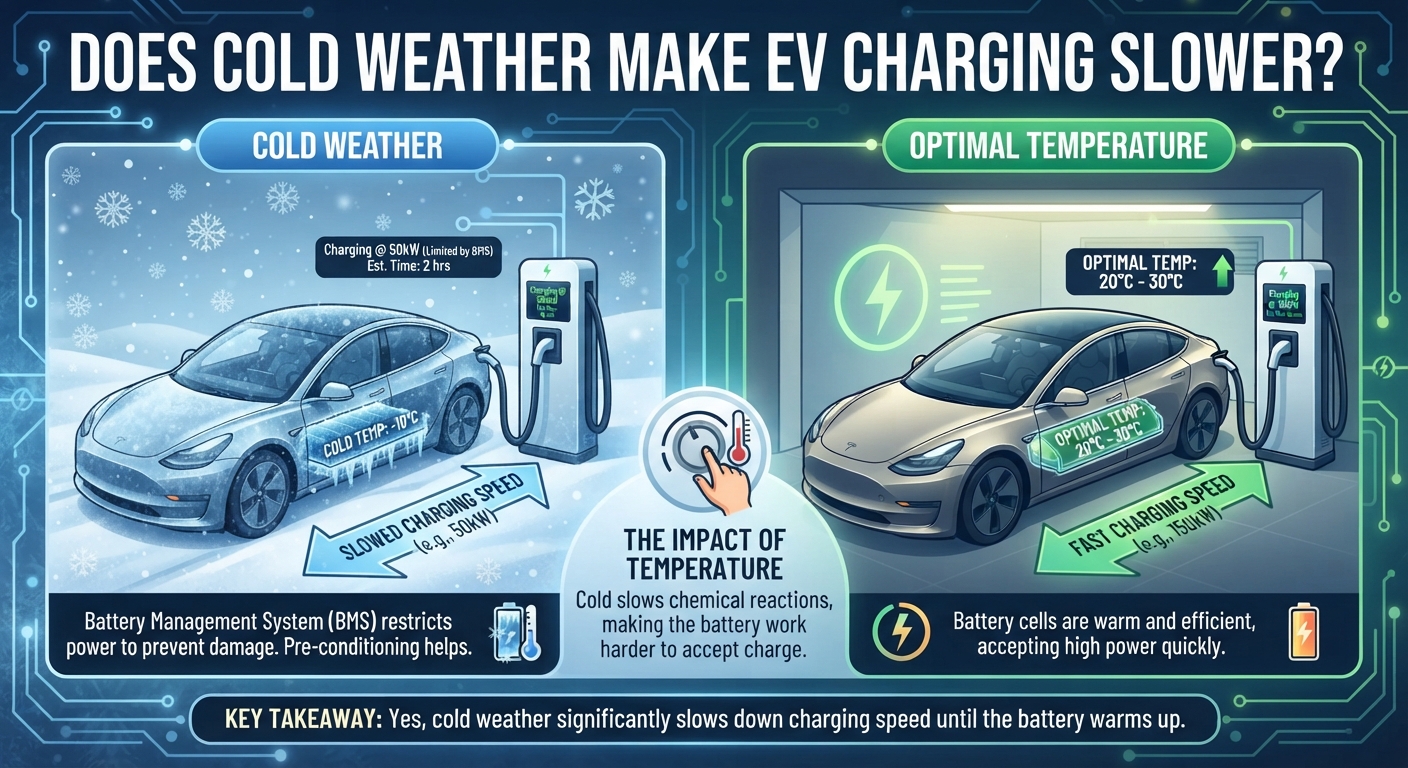
Yes, but how much depends on the charger. Cold weather slows DC fast charging the most, often making a stop take roughly twice as long. Home Level 2 charging is usually affected only slightly, because it asks far less of the battery and runs for hours. Level 1 is less temperature-sensitive but is too slow to rely on in winter.
Quick answer by charger type
| Charger | Effect of cold | What to do |
|---|---|---|
| Level 1 (120V) | Little effect from temperature, but too slow for reliable winter top-ups | Upgrade to Level 2 if you can |
| Level 2 (240V) | Slight in most conditions; larger in deep cold | Keep the car plugged in and schedule charging |
| DC fast charging | Large. Often 2x longer or more | Precondition the battery before you arrive |
Why cold slows charging
Cold temperatures slow the chemical reactions inside lithium-ion batteries and make it harder for ions to move through the electrolyte. A cold battery can’t safely accept high current, so the car’s battery management system (BMS) limits charging power until the pack warms up. This is a protection feature, not a fault.
How much slower?
- There’s no single “X% slower” figure, because it depends on the vehicle, battery temperature, state of charge and whether the battery is preconditioned.
- DC fast charging: This is hit hardest. Estimates range from a 40-80% reduction in freezing temperatures to stops that take twice as long. Idaho National Laboratory testing found cold weather can slow DC fast charging by nearly threefold.
- Level 2: Sources disagree. Several say it’s barely affected, because home charging at 7-11 kW is a trickle compared with what the pack can accept. One guide reports a drop of 40-60% at -4°F (-20°C), so deep cold can matter. Around freezing, the effect is usually small.
Home Level 2 charging in winter
Home charging is the easy case. A session runs for hours rather than 20-40 minutes, so a cold battery’s slower start is absorbed by the overnight window. The battery also warms gradually while it charges.
To get the best results:
- Keep your EV plugged in when parked, so the car can manage its own temperature.
- Schedule charging to finish just before you leave.
- Park in a garage if you can.
Want a reliable Level 2 setup for winter? Compare Level 2 home chargers https://evchargeradvisor.online/
Level 1 charging in winter
Level 1 charging isn’t much affected by temperature, but it’s slow at any temperature. In cold weather, it may not keep up with your daily needs at all, because the car also uses energy to heat the battery and cabin.
DC fast charging in winter
If you arrive at a fast charger with a cold battery, expect slower speeds for the first several minutes. The rate ramps up as the pack warms.
The fix is preconditioning, which warms the battery before you plug in:
- In many cars, route to the charger through the built-in navigation so the car heats the battery on the way.
- With some brands, you may need to activate it through the climate controls.
- One source says a preconditioned battery can turn a 45-minute stop into a 20-minute one.
Not all carmakers allow preconditioning while charging on Level 2, so check your manual.
Winter charging tips
- Precondition before fast charging, using navigation if your car supports it.
- Plan extra time for charging stops on cold days.
- Slow down. Speed is a major range factor, and it compounds with cold.
- Keep your car plugged in at home.
- Use Level 2 for daily winter charging.
Is it safe to charge in cold weather?
Yes. The BMS protects the battery automatically, so charging at any temperature is safe, though it may be slower. Ordinary winter use doesn’t cause permanent battery damage.
Winterising your charger
If your charger is outdoors, check its operating temperature range. Some good outdoor models are rated to -22°F, which covers almost all of North America. Mount it where snow and ice won’t pile up on the cable, and consider a garage or carport.
Does winter raise charging costs?
A little. Cold reduces range, often by 20-30% near freezing, so you use more kWh for the same distance. At home electricity rates, the increase is modest.
Quick checklist
- Use Level 2 for winter driving.
- Keep the car plugged in and schedule charging.
- Precondition before DC fast charging.
- Check your charger’s temperature rating.
- Allow extra time on cold-weather trips.
Next step: Get a licensed installer quote https://evchargeradvisor.online/
FAQs
- Does cold weather slow EV charging?
Yes, mostly at DC fast chargers. Level 2 is usually less affected. - How much does cold weather slow DC fast charging?
Estimates range from 40-80% slower to stops taking about twice as long, depending on the car and battery temperature. - Is Level 2 charging affected by cold?
Slightly in most conditions, though deep cold can have a larger effect. - What is battery preconditioning?
Warming the battery before charging so it can accept power faster. - Is it safe to charge an EV in freezing weather?
Yes. The battery management system protects the battery. - Should I keep my EV plugged in during winter?
Yes, so the car can manage its battery temperature. - Can I use Level 1 charging in winter?
Only if your daily needs are small. Many drivers find it isn’t enough in cold weather.
Final thoughts
Cold weather slows charging, but you can work around it. Use Level 2 at home, keep your car plugged in, and precondition before fast charging.
Ready for a winter-proof setup? See our top Level 2 chargers https://evchargeradvisor.online/
General information only. Cold-weather behaviour varies by vehicle. Follow your manufacturer’s guidance.

















Leave a Reply