
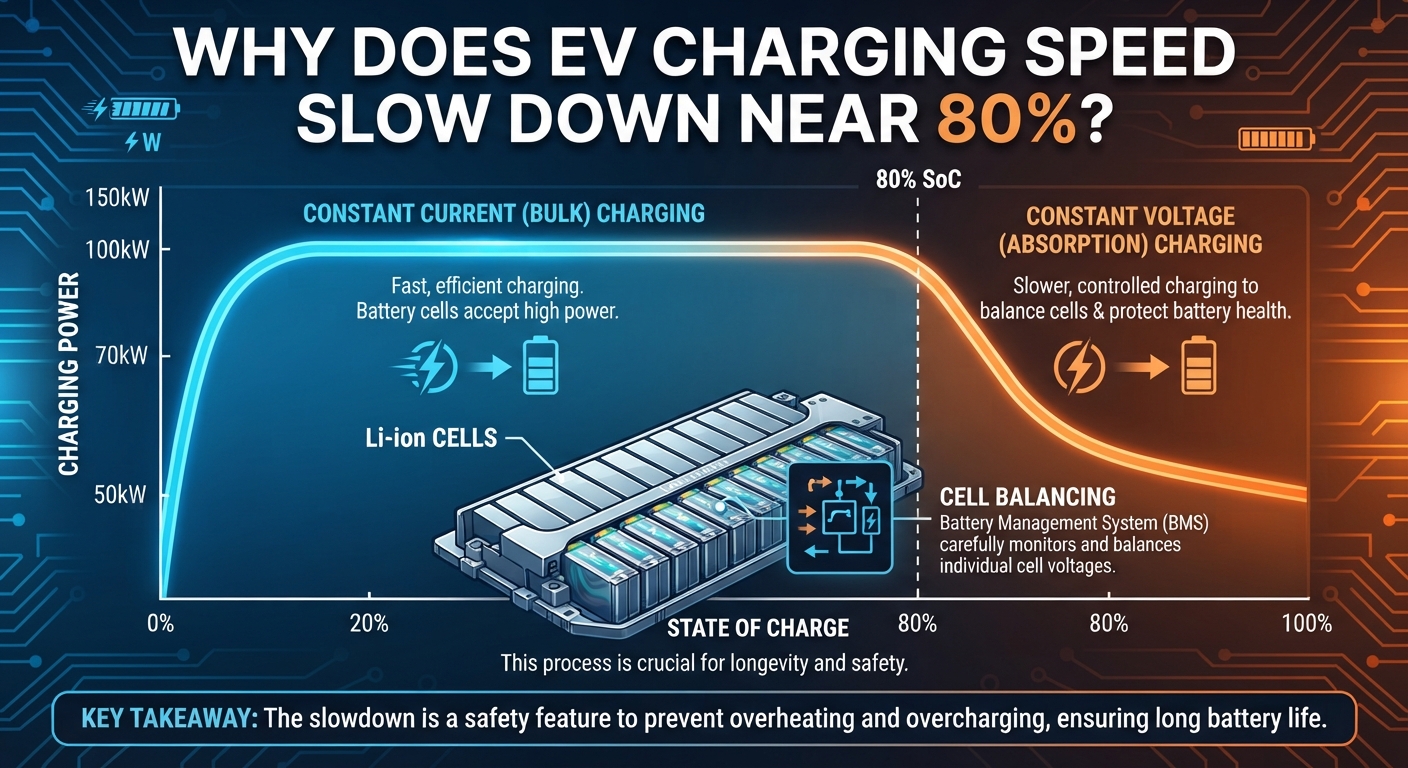
Because your car’s battery management system (BMS) deliberately tapers the charging current as the cells fill up. Near full, cell voltage rises and there’s less room for lithium ions, so pushing power in too fast creates heat and can damage the cells. The result is that the final 20% can take as long as the first 80%.
The charging curve at a glance
| Battery level | Charging speed | What’s happening |
|---|---|---|
| Low (about 10-50%) | Fastest | The battery accepts high power easily |
| Mid (about 50-80%) | Moderate | Thermal management starts to matter |
| High (about 80-100%) | Slowest | The BMS tapers current to protect the cells |
The charging rate follows a curve rather than a flat line. Many cars start easing off before 80%, and the exact shape varies from model to model.
What’s happening inside the battery
When you charge, lithium ions move through the electrolyte and slot into the graphite anode. Near empty, there are plenty of free spots. As the anode fills up, the ions have fewer places to go.
If the charger forces ions in too fast at that stage, they can build up on the anode’s surface as metallic lithium, an effect called lithium plating. It permanently reduces capacity and creates safety risks. To avoid it, the BMS lowers the current as the state of charge climbs.
Constant current, then constant voltage
Most lithium-ion charging has two phases:
- Constant current (CC): From empty to roughly 80%, the charger supplies a steady high current.
- Constant voltage (CV): The voltage is then held steady while the current gradually drops. This is the taper you notice.
As the cell voltage rises, the gap between the charger and the battery shrinks, so less current can be pushed through safely.
Heat is a big part of the story
Fast charging generates heat, and heat climbs faster than the current itself. That makes the highest-power charging the hottest, so the thermal management system slows charging when temperatures rise. The cells also have a safe voltage ceiling, so the BMS eases the current as it gets closer.
Want to avoid the fast-charging taper in daily life? Compare Level 2 home chargers https://evchargeradvisor.online/
Why some EVs hold their speed longer
Every EV tapers, but not at the same point. A pack that sheds heat well can hold a high rate further up the curve. Higher-voltage packs also help: an 800-volt system carries the same power at lower current, producing less heat, which is why they tend to hold their rate longer than 400-volt ones.
What else slows charging?
- Cold batteries: They charge slowly, which is why many newer EVs precondition the battery before a planned fast charge.
- Hot batteries: The car reduces power to manage heat.
- Power sharing: Some stations split power between stalls.
- A weak 12V battery: It can cause charging errors.
Real-world numbers
Charging from 10% to 80% can take about 34 minutes in one example. For a 75 kWh battery, going from 80% to 100% might take as long as 0% to 50% even though it adds far less energy. Above 80%, many fast chargers end up delivering 30-50% of their headline rate, and on most modern EVs the rate at 90% is around 30% of peak.
What this means for road trips
Two shorter stops to around 70-80% are usually faster overall than one long stop to 100%. Arrive at the charger with a low state of charge, precondition the battery if your car supports it, and move on at 80% unless your next stop is too far away.
Does this apply at home?
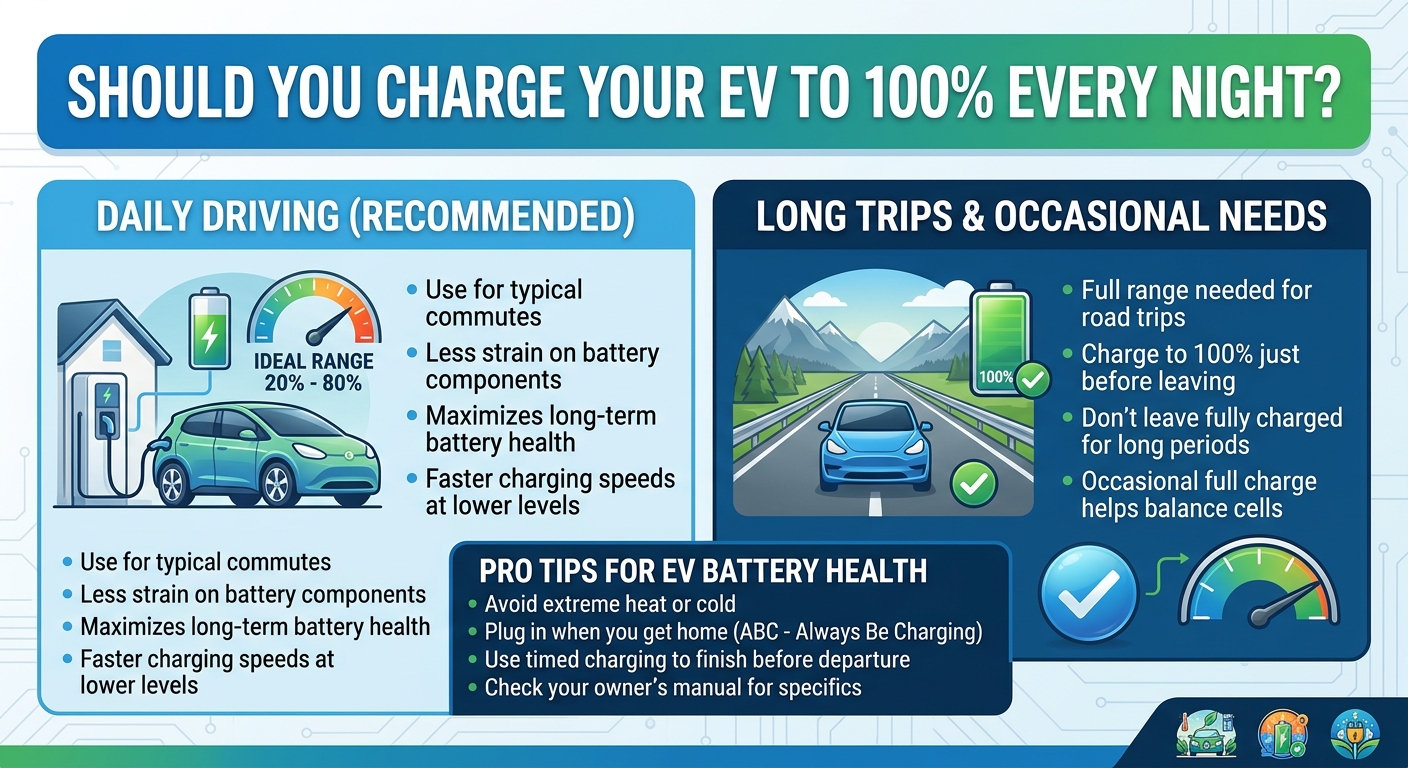
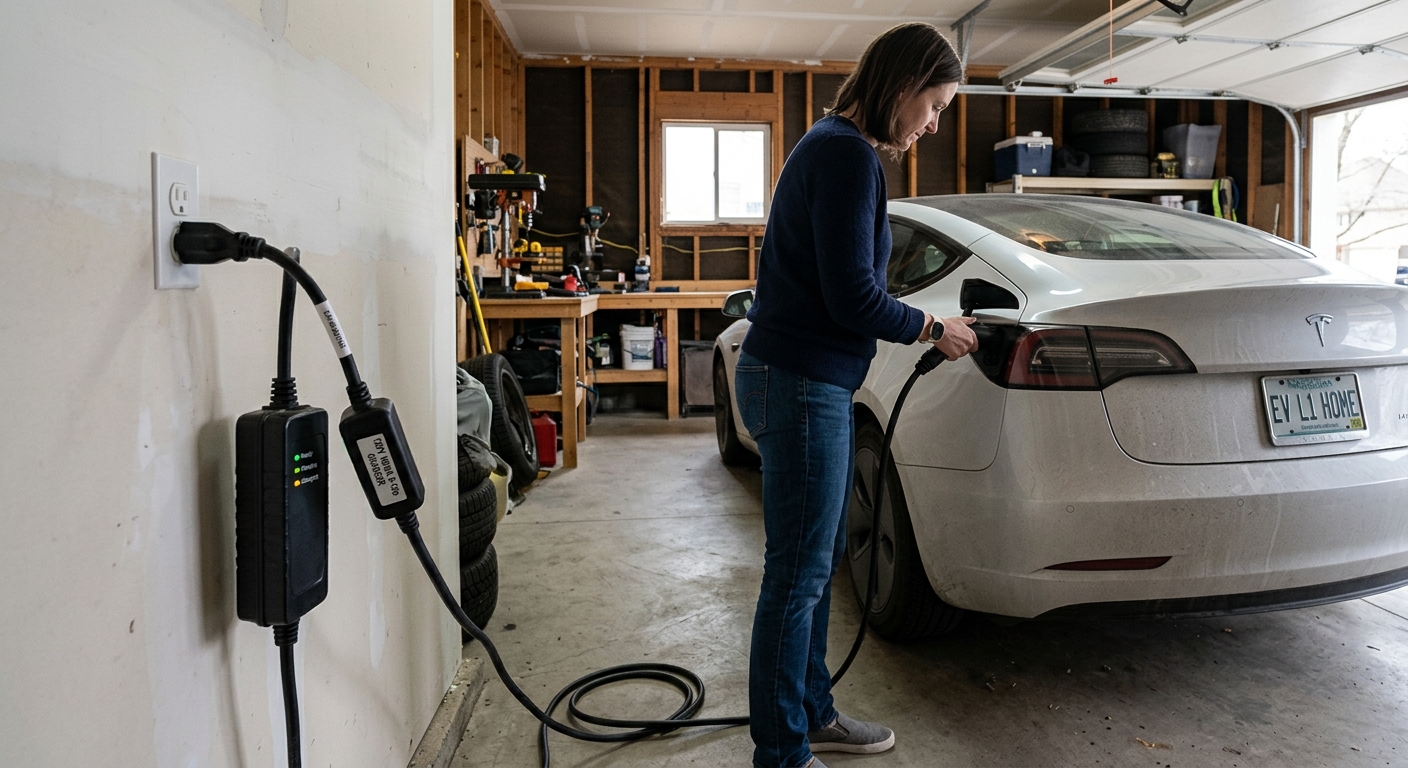
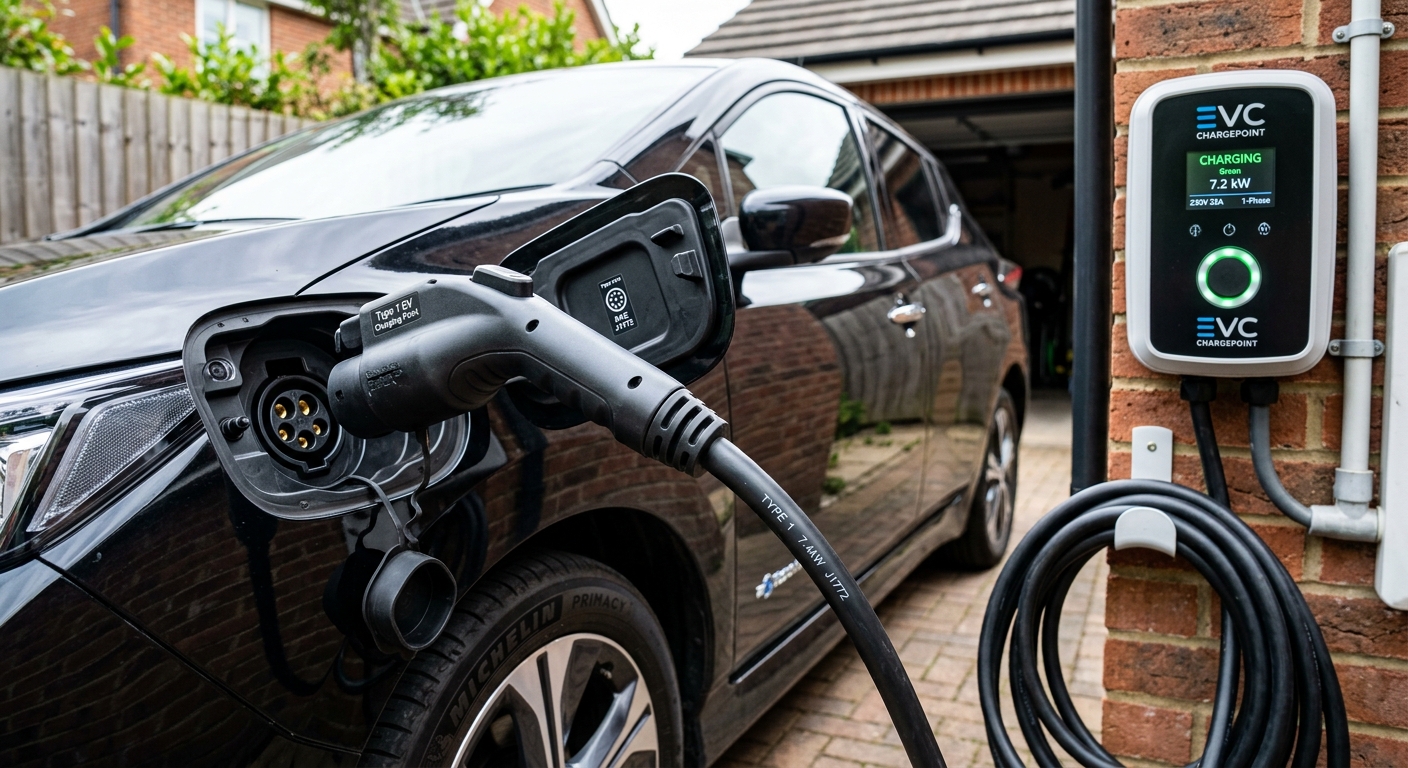
The taper is most noticeable on DC fast charging, where the charger’s power is high enough to hit the battery’s limits. On home AC charging, your car’s onboard charger caps the rate well below the battery’s limit, so you notice the final stretch less. Setting a daily limit around 80% also reduces wear on most batteries, because charging beyond 80% more frequently increases degradation.
Is it a fault?
No. Every lithium-ion EV does it. But if charging is slow at a low state of charge, check for a cold battery, power sharing at the station or a faulty charger.
Quick checklist
- Plan trips around 10-80% stops.
- Precondition the battery if your car allows it.
- Pick a charger that matches your car’s peak rate.
- Avoid shared-power stalls when possible.
- Charge at home overnight for daily needs.
Next step: Get a licensed installer quote https://evchargeradvisor.online/
FAQs
- Why does EV charging slow down after 80%?
The BMS tapers the charging current to protect the cells from heat and lithium plating. - Is it bad to charge an EV to 100%?
Not harmful in occasional use, but regular 100% charges can increase degradation on many batteries. - Why is the last 20% so slow?
The cell voltage is high and the anode is nearly full, so less current can be pushed through safely. - Does every EV slow down at 80%?
Every lithium-ion EV tapers, but the point where it starts varies. - Should I stop fast charging at 80%?
On trips, usually yes. It’s typically faster to charge briefly twice than wait for 100%. - Why is my EV slow before 80%?
Common causes include a cold battery, power sharing at the station or a fault. - Does Level 2 home charging slow down at 80%?
You’ll notice it less, because your car’s onboard charger limits the rate well below the battery’s maximum. - Final thoughts
The slowdown near 80% is your car protecting its most expensive component. Plan around it on trips, and charge at home for everything else.
Ready to charge at home? See our top home EV chargers https://evchargeradvisor.online/
General information only. Charging behaviour varies by vehicle. Check your owner’s manual.





Leave a Reply