
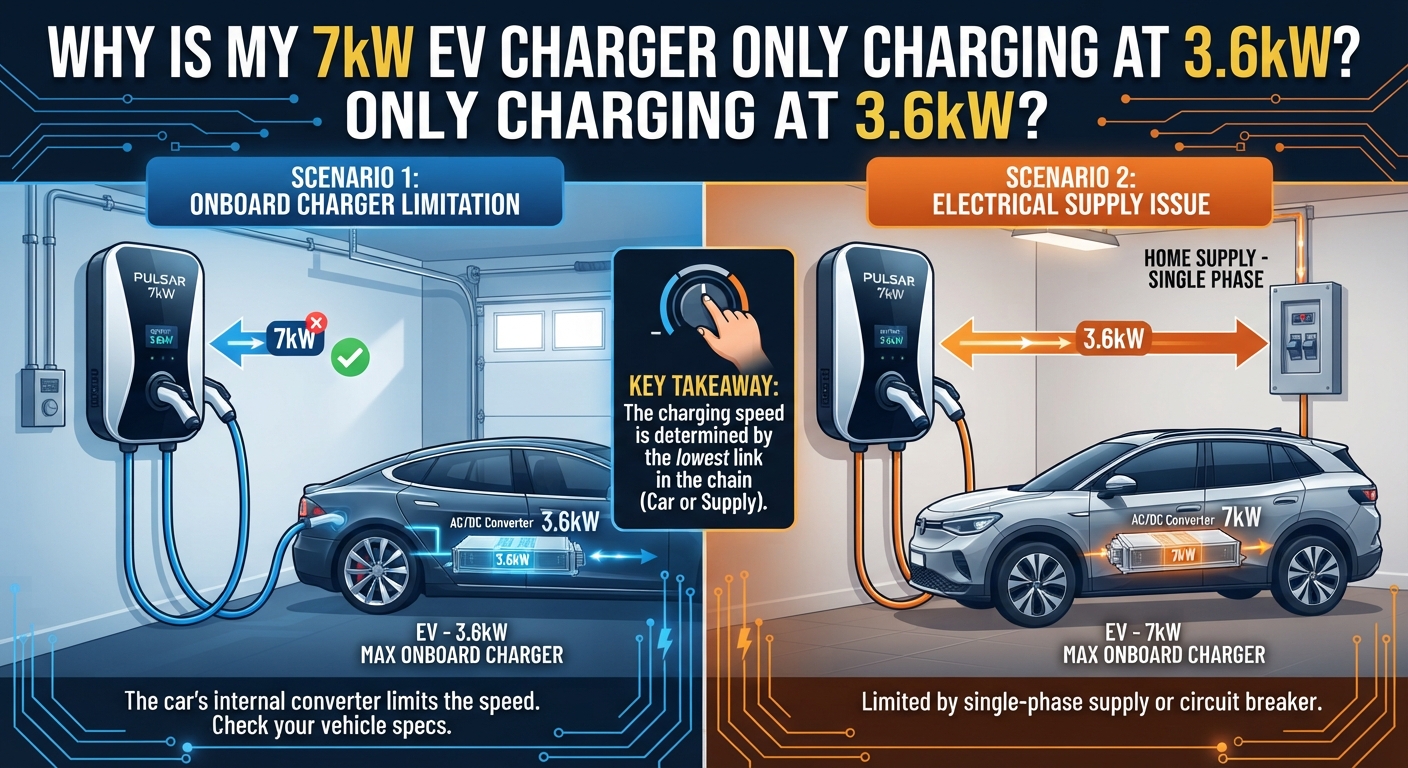
Your charger is almost certainly delivering 16 amps instead of 32. On a 230V supply, 16A gives about 3.7 kW, which is half of a 7kW charger’s maximum. The limit usually comes from a charger setting, a 16A cable, your car’s own current limit, or a restriction on your supply. Checking those, in that order, usually finds the cause.
The maths behind 3.6kW vs 7kW
| Current | Power at 230V | What you see |
|---|---|---|
| 16A | ~3.7 kW | “3.6kW” charging |
| 32A | ~7.4 kW | “7kW” charging |
Charging only goes as fast as the slowest element in the chain, so something is capping your current at 16 amps.
The 6 most common causes
1. The charger is set to 16A
Many home chargers have a current limit set by the installer. Sometimes it’s deliberate: on a shared or looped supply, the network operator may require the installer to limit a charger to 16A. In other cases, a charge point can revert to a lower setting after a remote update or recommissioning. In one owner’s case, a provider’s remote update reset a charger to 3.6 kW, and a call to the provider restored it to 7.2 kW.
Fix: Check the charger’s app or settings for a current limit, and ask your installer or the manufacturer to confirm it.
2. The cable is rated for 16A
If your charger is untethered, the Type 2 cable carries a small resistor that tells the charger its current rating. A 16A cable will cap you at about 3.7 kW, however powerful the charger. Dealers sometimes supply a 16A cable with plug-in hybrids and similar cars.
Fix: Look for the rating printed on the cable, and try a 32A cable.
- 3. Your car’s AC current limit is set low
- Some cars have a setting that limits AC charging current. Check that it’s set to maximum, usually 32A, in the car’s charging menu or app.
- 4. Your car’s onboard charger is the limit
- Not every car can accept 7kW. If your onboard charger is rated lower, or the car only uses a single phase, that’s the cap. Check your car’s maximum AC charging rate in the manual.
- 5. Load management or a supply restriction
- Some chargers reduce their output to protect your main fuse when other appliances are running, or to leave headroom on your supply. On smaller main fuses or shared supplies, the installer may configure a lower limit. Check whether your charger has load management, solar or eco modes that cap the current.
- 6. A 16A circuit or a fault
- If the circuit feeding the charger is only 16A, the charger will behave exactly as you describe. A genuine 7kW installation needs a 32A circuit.
Want an engineer to check your installation? Book a qualified EV charger installer https://evchargeradvisor.online/
Step-by-step diagnosis
- Read the number. Check your car or charger app for the actual amps. 16A confirms the cap.
- Check the car’s AC limit and set it to maximum.
- Check the cable rating printed on the cable.
- Test another cable, or try a different 7kW public charger. If the car charges faster there, the problem is your home setup.
- Review your charger settings for a current limit, load management or an eco mode.
- Ask your installer whether the supply operator imposed a limit.
- Contact the manufacturer if the charger itself looks faulty.
Is 6.6-7.2 kW normal for a 7kW charger?
Yes. Real-world output often reads around 6.6-7.2 kW, because voltage and cars vary slightly. One owner reported about 6.8 kW (30A) on a 7kW charger after a reset, which is normal. A reading near 3.6 kW is the sign of a 16A limit.
When to call an installer
Don’t open the charger, change the wiring or alter the breaker yourself. If the settings and cable check out, contact a qualified installer or the manufacturer. A genuine limit from the supply operator is something your installer will know about and can discuss with them.
A note for US readers
On a US 240V supply, the equivalent split is around 16A (about 3.8 kW) vs 32A (about 7.7 kW). The same causes apply, such as a low charger current setting, a car-side limit and a 20A circuit. See our breaker size guide for what circuits support.
Quick checklist
- Confirm the amps in your app.
- Set your car’s AC limit to maximum.
- Check the cable rating.
- Review charger settings and load management.
- Call your installer if you still see 16A.
Next step: Compare 7kW home chargers https://evchargeradvisor.online/
FAQs
- Why is my 7kW charger only giving 3.6kW?
It’s most likely limited to 16A by a charger setting, a 16A cable, your car’s limit or your supply. - Is 3.6kW the same as 16A?
Yes. 16 amps at 230V is about 3.7 kW. - Can a cable limit my charging speed?
Yes. A 16A Type 2 cable caps charging at about 3.7 kW. - Can my car limit AC charging?
Yes. Check the car’s AC current limit setting and its onboard charger rating. - Why would an installer limit my charger to 16A?
On a shared or looped supply, the network operator may require it. - Is 6.8kW normal for a 7kW charger?
Yes. Real-world output is usually slightly below 7.4 kW. - Can I fix it myself?
You can check settings, the cable and the car. Leave any wiring or breaker changes to a qualified installer.
Final thoughts
A 7kW charger stuck at 3.6kW is usually a fixable limit rather than a faulty unit. Work through the causes in order, and you’ll often find the answer in a setting or a cable.
Ready to get it sorted? Get a qualified installer quote https://evchargeradvisor.online/
General information only. Always use a qualified installer for wiring and settings changes.

















Leave a Reply