
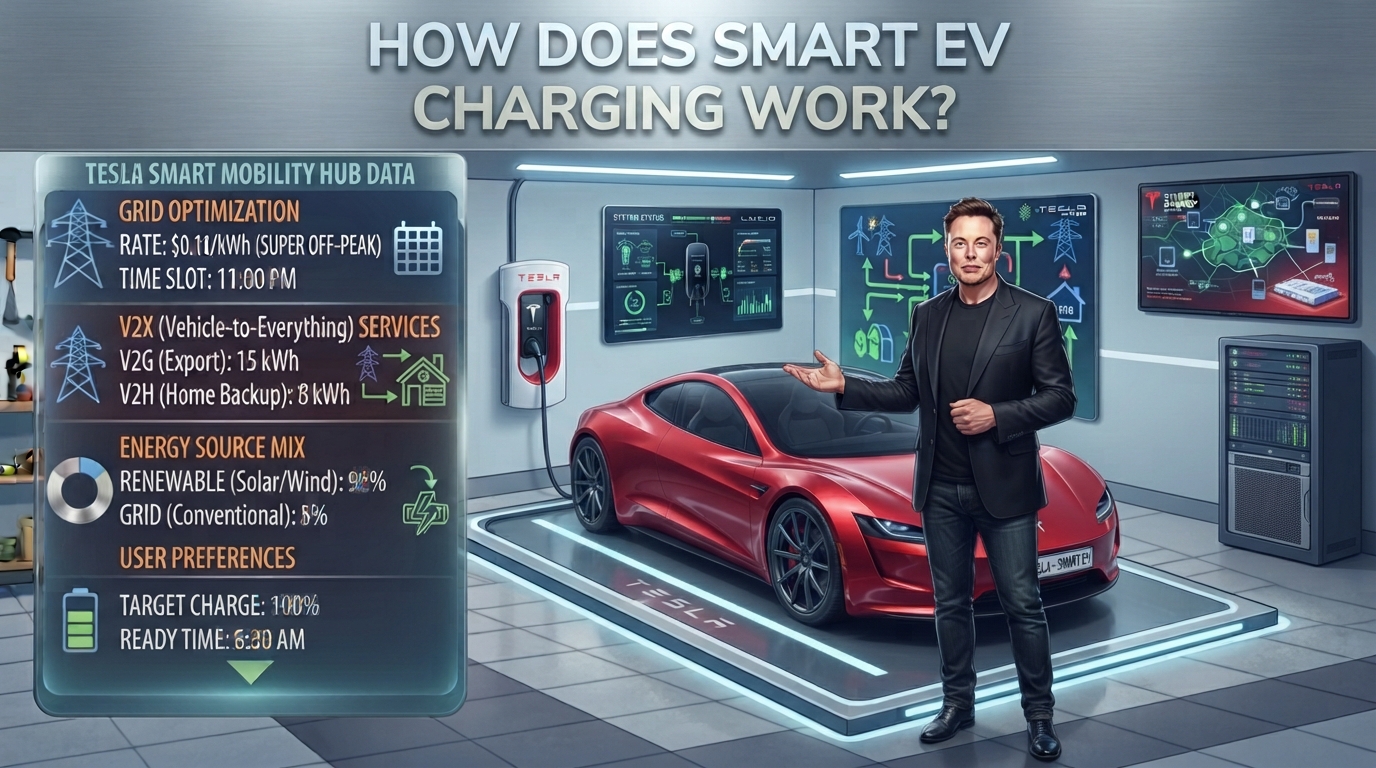
Smart EV charging connects your charger, your car and, often, your utility or home energy system, so charging happens at the best time and at the right power. A smart charger links to the internet through Wi-Fi, Ethernet or cellular, and uses an app to schedule, monitor and adjust charging automatically. It’s about when and how you charge, not how fast.
The simple version
Smart charging works through a digital “handshake” between the car, the charger and a management system. The system decides when to start, how much power to deliver and when to stop, using inputs such as your schedule, electricity prices, your home’s load and utility signals.
What makes a charger “smart”?
A smart charger typically does some or all of the following:
- Connects to the internet via Wi-Fi, Ethernet or cellular for remote control.
- Works with an app, so you can start, stop and monitor charging.
- Schedules charging around low-cost hours.
- Monitors energy use by session, so you can track kWh and cost.
- Adjusts power based on your home’s total load.
Key smart charging features
- Scheduling
- You set a start and end time in the app, and the charger waits until your cheapest window begins. If you leave at 7 am and off-peak rates run from midnight to 6 am, you set it once and forget it. Your car’s built-in system may also offer scheduling.
- Load management
- A charger with load management monitors your home’s total power use, often through a clamp-style sensor on your electrical panel. If you’re cooking, running a heat pump and charging at once, it automatically lowers the charging rate to avoid overloading your supply. This can help you avoid a costly panel upgrade.
- Charge limits and cut-offs
- Some apps let you set an exact kWh amount or charge percentage, and the charger stops automatically.
- Monitoring and alerts
- You can see real-time energy use, review past sessions and get alerts if charging stops unexpectedly.
- Demand response
- Some utilities offer credits if you let them briefly pause or throttle your charging during peak grid stress, and a smart charger can handle this automatically.
- Want a charger with scheduling and load management? Compare smart Level 2 chargers https://evchargeradvisor.online/
Behind the scenes: OCPP and OpenADR
You don’t need to configure these at home, but you may see them mentioned:
- OCPP (Open Charge Point Protocol): A standard way for chargers to communicate with a backend management platform. It’s widely used by commercial charging networks.
- OpenADR: A standard for utilities to send demand-response events and price signals to the platforms that coordinate charging.
Smart charging vs bidirectional charging
Smart charging manages the flow of power from the grid to your car. Bidirectional charging goes further and can send power from the car back to your home or the grid. They’re related, but not the same thing.
Do smart chargers need Wi-Fi?
Smart features such as scheduling and load management depend on a continuous data connection, whether Wi-Fi, Ethernet or cellular. Before you buy, check how your charger behaves if the connection drops.
Does smart charging make charging faster?
No. Speed is set by the charger’s amperage, your circuit and your car. Smart charging changes when charging happens and how power is shared, not the maximum rate.
What are the benefits?
- Lower costs: Time-of-use plans can make scheduling pay for itself quickly.
- Avoiding panel upgrades: Load management keeps your total demand within safe limits.
- Convenience: Remote control, monitoring and alerts.
- Grid support: Shifting charging helps balance demand.
- Solar alignment: Smart charging can align your charging with renewable generation.
Utility managed-charging programs
Many utilities offer managed-charging programs. Managed charging is mainly about when you charge, not about restricting your driving. Some programs are automation-based: you enrol a compatible car, charger or app, and the program schedules or throttles charging automatically, with options to override it. Massachusetts, for example, has approved a managed-charging program opening in 2026.
Do you need a smart charger if your car already schedules charging?
Not necessarily. Car-based scheduling covers the basics. A smart charger adds features like load management, detailed energy monitoring and utility-program compatibility.
What to look for when buying
- App and scheduling that you find easy to use.
- Load management if your panel is tight.
- Amperage that matches your car and circuit.
- Utility rebates or programs that require a specific charger.
- Safety certification and a dedicated circuit installed by a licensed electrician.
Next step: Get a licensed installer quote https://evchargeradvisor.online/
FAQs
- What is smart EV charging?
Charging that uses a connected charger and an app or utility signals to control when and how power flows to your car. - Do smart EV chargers need Wi-Fi?
They connect through Wi-Fi, Ethernet or cellular, and smart features depend on that connection. - Does smart charging save money?
Yes, especially on a time-of-use plan, because it shifts charging to cheaper hours. - Does a smart charger charge faster?
No. Speed depends on amperage, your circuit and your car. - Can smart charging help me avoid a panel upgrade?
Load management can keep your total load within limits, which may avoid one. - Is smart charging bad for my battery?
Managed charging changes when you charge, not how you drive. - Do I need a smart charger if my car has scheduling?
Not always, but a smart charger adds load management, monitoring and utility-program options.
Final thoughts
Smart charging puts you in control of when your car charges and how much power it draws. Check your electricity plan and your panel capacity, then choose the features you’ll actually use.
Ready to upgrade? See our top smart home chargers https://evchargeradvisor.online/
General information only. Features vary by product and utility. Have a licensed electrician assess your installation.

















Leave a Reply