
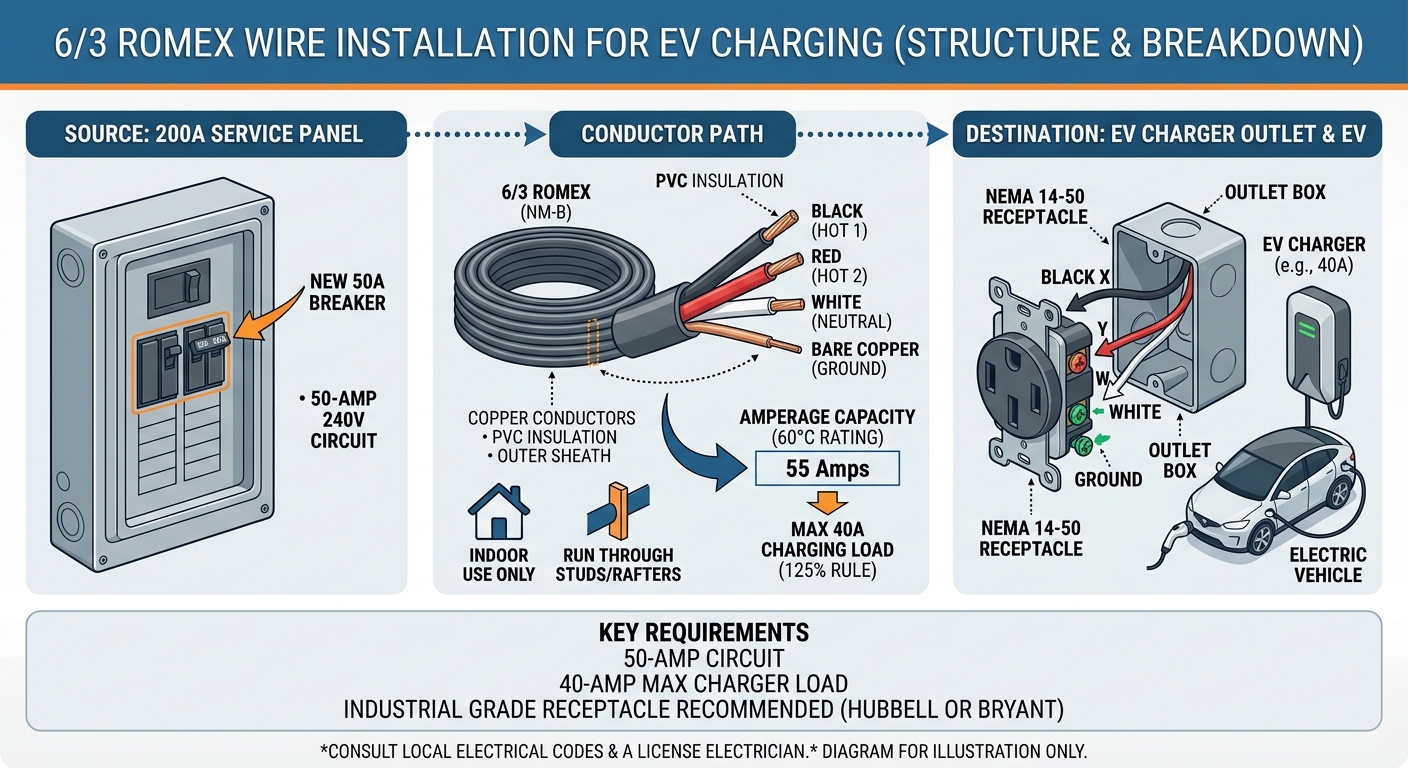
Yes, you can use 6/3 Romex (NM-B) for a Level 2 EV charger, but only if the charger runs at 40 amps or less on a 50-amp breaker. Under the National Electrical Code (NEC), 6 AWG copper Romex is limited to 55 amps. EV charging counts as a continuous load, which caps safe charging at 44 amps. A 48-amp charger needs heavier wire or a different cable type.
This guide explains why, shows which charger sizes work with 6/3 Romex, and covers what to do when it won’t work.
This guide covers North American (NEC) installations. Wiring rules differ elsewhere, so always follow your local code and a licensed electrician’s advice.
What Does “6/3 Romex” Mean?
“Romex” is a common brand name for NM-B cable, the plastic-sheathed wire used inside walls in most US homes.
- 6 is the wire gauge (6 AWG).
- 3 is the number of insulated conductors: black, red and white. A bare ground wire is also included, which is why you’ll see it sold as “6/3 with ground.”
Can 6/3 Romex Handle an EV Charger? The Short Answer
It depends on the charger’s amperage:
| Charger setting | Breaker needed (125% rule) | Minimum copper Romex | Does 6/3 work? |
|---|---|---|---|
| 16A | 20A | #12 | Yes (overkill) |
| 24A | 30A | #10 | Yes (overkill) |
| 32A | 40A | #8 | Yes (overkill) |
| 40A | 50A | #6 | Yes, best fit |
| 44A | 60A | #6 (55A limit) | Borderline; few chargers allow 44A |
| 48A | 60A | #4 | No |
The 40A charger on a 50A breaker is the sweet spot for 6/3 Romex.
Why Romex Has a Lower Limit Than Other Wire
Two NEC rules explain this.
1. Romex is limited to the 60°C rating.
The wires inside NM-B may be built for higher temperatures. NEC Article 334 still requires you to use the 60°C ampacity column of Table 310.16. For 6 AWG copper, that column gives 55 amps. Wire types like THHN/THWN-2, installed in conduit, can use higher ratings (typically 65 amps at 75°C for #6), which is why they can carry more.
2. EV charging is a continuous load.
Any load running three hours or more must be sized at 125%. Both the breaker and the wire must handle 125% of the charger’s current (NEC Article 625):
- 55A wire limit ÷ 1.25 = 44A maximum continuous charging
- 40A charging × 1.25 = 50A, which is a standard breaker size
That is why electricians pair #6 Romex with a 50A breaker and 40A charging.
Why a 48-Amp Charger Won’t Work on 6/3 Romex
A 48A charger (common for Tesla Wall Connectors and similar units) needs a 60A circuit (48 × 1.25 = 60). Six-gauge Romex tops out at 55A, so it falls short. You have three compliant options:
- #4 Romex (NM-B). Rated for 70A at 60°C. It works, but it’s stiff, harder to pull through framing and more expensive.
- #6 THHN/THWN-2 wires in conduit. The most common solution. It supports a 60A breaker and full 48A charging.
- A 75°C-rated cable type such as MC cable. This is easier to pull than conduit. Confirm the conductor and termination ratings with your electrician.
The easiest fix: many chargers can be set to 40A. Keep the 6/3 Romex, use a 50A breaker, and set the charger to 40A. You lose only a few miles of range per hour.
Does the 6/3 Romex vs. 6/2 Romex Choice Matter?
- Hardwired charger (Tesla Wall Connector, ChargePoint Home Flex and similar): needs two hot wires and a ground. No neutral is used, so 6/2 is enough and 6/3 isn’t necessary.
- NEMA 14-50 receptacle: the outlet has a neutral terminal, so 6/3 is the standard choice.
- NEMA 6-50 receptacle: needs only two hots and a ground, so 6/2 works.
Plug-in chargers on a 14-50 outlet typically charge at no more than 40A. GFCI protection may also be required for receptacle installations, so check with your electrician.
When You Should Not Use Romex for an EV Charger
Skip Romex, or switch to another wiring method partway through the run, when:
- The run is outdoors or in a wet location. NM-B generally isn’t allowed there. Installers usually transition to conduit with THWN-2 before the cable reaches an outdoor charger.
- The charger needs 60A. See the 48A section above.
- The run is long. Voltage drop grows with distance. Many installers aim for 3% or less, which may mean upsizing the wire on long runs.
- The cable passes through insulation or runs in a bundle. Heat buildup can reduce its allowable ampacity further.
- Your local inspector has different rules. Local amendments vary.
A Note on 60A Breakers With #6 Romex
You may see online claims that #6 Romex is fine on a 60A breaker. The NEC allows rounding up to the next standard breaker size, since 55A breakers don’t exist. That only works if the charger is permanently limited to 44A or less. Many chargers jump from 40A to 48A with nothing in between. For that reason, the cleaner and safer setup is a 50A breaker with 40A charging. Let your electrician and inspector make this call.
How to Choose the Right Wire (Quick Decision Guide)
- Check your charger’s maximum amps on the nameplate or in the app.
- Multiply by 1.25 to find the minimum circuit size.
- If the result is 50A or less, 6/3 (or 6/2) Romex works for indoor runs.
- If it’s 60A, plan on #4 Romex, THHN in conduit, or MC cable. Or reduce the charger to 40A.
- Hire a licensed electrician and pull a permit. Inspections catch mistakes before they become fire hazards.
Not sure which amperage your setup needs? Read our guide on how many amps you need for a Level 2 EV charger.
What Does the Wire Cost Compared to the Whole Installation?
The wire is usually a small part of the total bill. Labor, permits, breaker and panel capacity drive the price. See what to expect in our guides on how much it costs to install an EV charger and what electricians charge to fit one.
Thinking about doing the wiring yourself? First read can I buy an EV charger and install it myself?
Is 6/3 Romex a Good Choice for Your EV Charger?
Use 6/3 Romex if:
- Your charger runs at 40A or less.
- The run is indoors and fairly short.
- You want an easy-to-install, widely available cable.
Choose something else if:
- You want full 48A charging.
- The cable will be exposed outdoors or in a damp area.
- You may upgrade to a higher-power charger later.
Wondering whether the investment is worthwhile? See is installing a Level 2 EV charger worth it?
Frequently Asked Questions
Can I use 6/3 Romex for a 50-amp EV charger circuit?
Yes. Six-gauge copper NM-B is rated for 55 amps, so it’s suitable on a 50A breaker. That supports charging up to 40 amps.
Can I use 6/3 Romex on a 60-amp breaker for a 48-amp charger?
No. A 48A charger needs a 60A-rated circuit, and 6 AWG Romex is limited to 55A. Use #4 Romex or THHN in conduit, or set the charger to 40A on a 50A breaker.
What size Romex do I need for a 48-amp EV charger?
#4 AWG copper NM-B, or #6 THHN/THWN-2 in conduit on a 60A breaker.
What size Romex do I need for a 40-amp EV charger?
#6 copper NM-B on a 50A breaker.
Can I use 6/3 Romex for a NEMA 14-50 outlet?
Yes. A 14-50 outlet uses a neutral, so 6/3 is the standard choice. Use a 50A breaker and keep charging at 40A or less.
Do I need 6/3, or is 6/2 enough for a hardwired EV charger?
Most hardwired chargers need no neutral, so 6/2 is enough.
Can Romex be used outside for an EV charger?
Generally no. NM-B isn’t permitted in wet or exposed outdoor locations. Transition to conduit with weather-rated wire before the outdoor section.
Does an EV charger need a dedicated circuit?
Yes. Level 2 chargers normally need their own dedicated 240V circuit.
Do I need a permit and inspection?
In most areas, yes. Ask your local building department.
Final Takeaway
6/3 Romex can safely power a Level 2 EV charger, provided the charger is limited to 40 amps on a 50-amp breaker. For 48-amp charging, step up to #4 Romex, THHN in conduit, or MC cable. When in doubt, have a licensed electrician size the circuit and confirm local code.
Have a question about your setup? Contact us or browse our EV charger installation guides and Level 2 charging articles for your next step.
Disclaimer: This article is for general information, not electrical advice. Wiring rules vary by location and code edition. Hire a licensed electrician and follow local permit rules.













Leave a Reply