
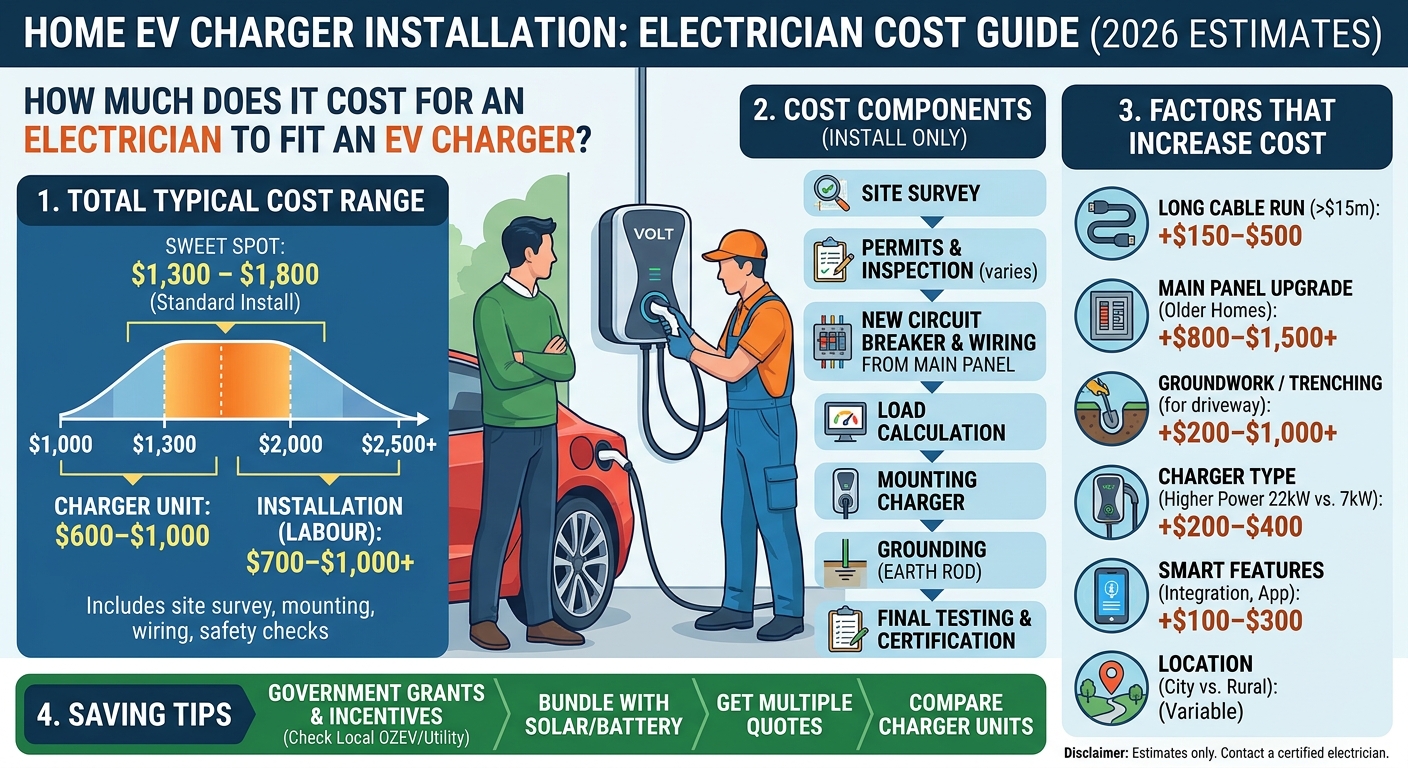
Installing a dedicated residential electric vehicle (EV) charging station provides reliable, high-speed home refueling, supplying 20 to 44 miles of driving range per hour over a high-voltage 240-volt single-phase branch circuit. While purchasing a smart wallbox is a fixed hardware expense, calculating the installation cost requires analyzing the electrician’s professional labor fees alongside site-specific electrical requirements. Homeowners planning this upgrade must evaluate key electrician labor charges to establish an accurate budget.
The average labor cost for a licensed electrician to fit a home EV charger typically ranges from £350 to £600 (labor only) in the UK, or $400 to $1,000 (labor only) in North America. When combining the hardware charger unit with professional labor, the total installation cost ranges from £800 to £1,300 ($1,000 to $2,500 globally).
Under National Electrical Code (NEC Article 625) standards and local electrical safety guidelines (such as IET Wiring Regulations BS 7671), applying continuous load safety rules, assessing panel headroom, and managing wire routing dictate the exact labor hours and costs involved.
For complete hardware reviews, installer guides, and panel load calculators, visit EV Charger Advisor.
1. Breakdown of Electrician Installation Costs
Calculating the total cost to fit a Level 2 home charging station involves separating fixed hardware costs from installer labor and materials:
A. Labor Only (Electrician Fitting Fee): £350 – £600
-
Standard Straightforward Fitting (£350–£450): The main electrical distribution panel (consumer unit) is located inside the garage or adjacent to the wallbox mounting position, requiring a short surface-mounted conduit run.
-
Complex Fitting (£500–£600+): Long wiring runs through finished walls, subpanel installations, ground trenching, or routing wire across multiple stories.
B. Charger Unit Hardware: £450 – £700
-
Smart EVSE Wallboxes: Wi-Fi-enabled wallboxes offering dynamic load balancing, automated Time-of-Use (TOU) scheduling, solar surplus tracking, and app connectivity.
C. Circuit Materials & Cable Components: £100 – £250
-
Conductor Cable Gauges (NEC 125% Rule): Pursuant to NEC 625.42 and continuous duty regulations, circuits must be sized to 125% of maximum continuous current draw:
-
48-Amp Continuous Charger (60A Breaker): Requires #6 AWG copper conductors (or $10\text{mm}^2$ cable).
-
32-Amp Continuous Charger (40A Breaker): Requires #8 AWG copper conductors (or $6\text{mm}^2$ cable).
-
-
Protective Devices: Heavy-duty double-pole circuit breakers, Type A / Type B RCDs, PEN fault protection devices, and weatherproof conduit.
To learn more about how charger power levels and wire sizes compare, check out our guide on EV charging types.
2. Technical Factors That Increase Electrician Labor Hours
Electricians determine fitting fees based on site complexity, material consumption, and job duration:
ELECTRICIAN SITE ASSESSMENT & LABOR PATHWAY:
[Distribution Panel / Consumer Unit] ──► [Perform Continuous Load Calculation]
                                                    │
         ┌──────────────────────────────────────────┴──────────────────────────────────────────┐
         ▼                                                                                     ▼
[Adjacent Garage Mounting]                                                            [Complex Site Conditions]
 • Short Conduit Run                                                                   • Long Distance Runs (50+ Ft)
 • Standard 2-3 Hours Labor                                                            • Drilling Through Exterior Brick/Drywall
 • £350 – £450 Fitting Fee                                                             • Earth Rod / PEN Fault / Subpanel Addition
                                                                                       • £500 – £800+ Fitting Fee
-
Distance from Main Electrical Panel: The farther the charger is from the main panel, the more labor hours are needed to pull heavy, rigid conductors through conduit and wall cavities.
-
Hardwiring vs. Plug-In Outlet Fittings: Direct hardwiring takes 2 to 3 hours and creates a direct, reliable connection. Plug-in receptacle installations require installing industrial NEMA 14-50 or CEE sockets and upstream 240V GFCI circuit protection.
-
Electrical Panel Headroom & EVEMS: If an electrical panel lacks physical breaker slots or current headroom, an electrician must install an Electric Vehicle Energy Management System (EVEMS) under NEC 625.42 to monitor household demand dynamically, avoiding an expensive £1,500+ main service panel replacement.
To explore Wi-Fi-enabled smart wallboxes engineered with integrated load management features, read our guide on smart chargers.
3. What Is Included in a Professional Electrician’s Fitting Fee?
A comprehensive, fully certified electrician installation fee covers several crucial safety and administrative steps:
-
Pre-Installation Load Calculation: Assessing total household peak demand to verify safe continuous operation.
-
Physical Mounting & Cable Management: Securely attaching the weatherproof wallbox to brick, timber, or concrete structures at standard mounting heights (18 to 48 inches).
-
Circuit Sizing & Breaker Connection: Fitting dedicated double-pole breakers and running heavy-gauge copper conductors through protective conduit.
-
Testing & Commissioning: Verifying Earth loop impedance, continuous ground continuity, RCD trip times, and active power flow.
-
Certification & Permitting: Issuing official electrical safety certificates (such as BS 7671 certification or local AHJ municipal permit sign-offs) to validate home insurance and manufacturer hardware warranties.
Comparison Table: EV Charger Fitting Cost Breakdown
| Installation Component | Standard Adjacent Fitting | Extended Cable Run Setup | Main Panel Upgrade Setup |
| Electrician Labor Fee | £350 – £450 | £500 – £650 | £600 – £800 |
| Smart Wallbox Unit | £450 – £600 | £500 – £650 | £500 – £650 |
| Wiring & Conduit Materials | £100 | £250 | £150 |
| Panel / Consumer Unit Upgrade | £0 (Not Needed) | £0 (Not Needed) | £1,200 – £2,000 |
| Testing & Certification | Included | Included | Included |
| Estimated Total Cost | £900 – £1,150 | £1,250 – £1,550 | £2,450 – £3,600 |
Summary & Key Takeaways
-
Average Labor Cost: Electricians charge £350 to £600 for labor only to fit a residential Level 2 EV charger.
-
Total Combined Cost: Combining hardware wallbox costs and fitting labor brings total installation expenses to £800 – £1,300.
-
Proximity Reduces Fitting Costs: Mounting the charger close to your main electrical panel minimizes conduit runs and reduces labor hours.
-
Adhere to Continuous Duty Sizing: Continuous loads require circuit protection and copper conductors (e.g., #6 AWG wire) sized to 125% of maximum charger output under NEC rules.
-
Insist on Official Certification: Always ensure the electrician provides official safety testing certificates and files local municipal permits to preserve property insurance coverage and hardware warranties.













Leave a Reply