
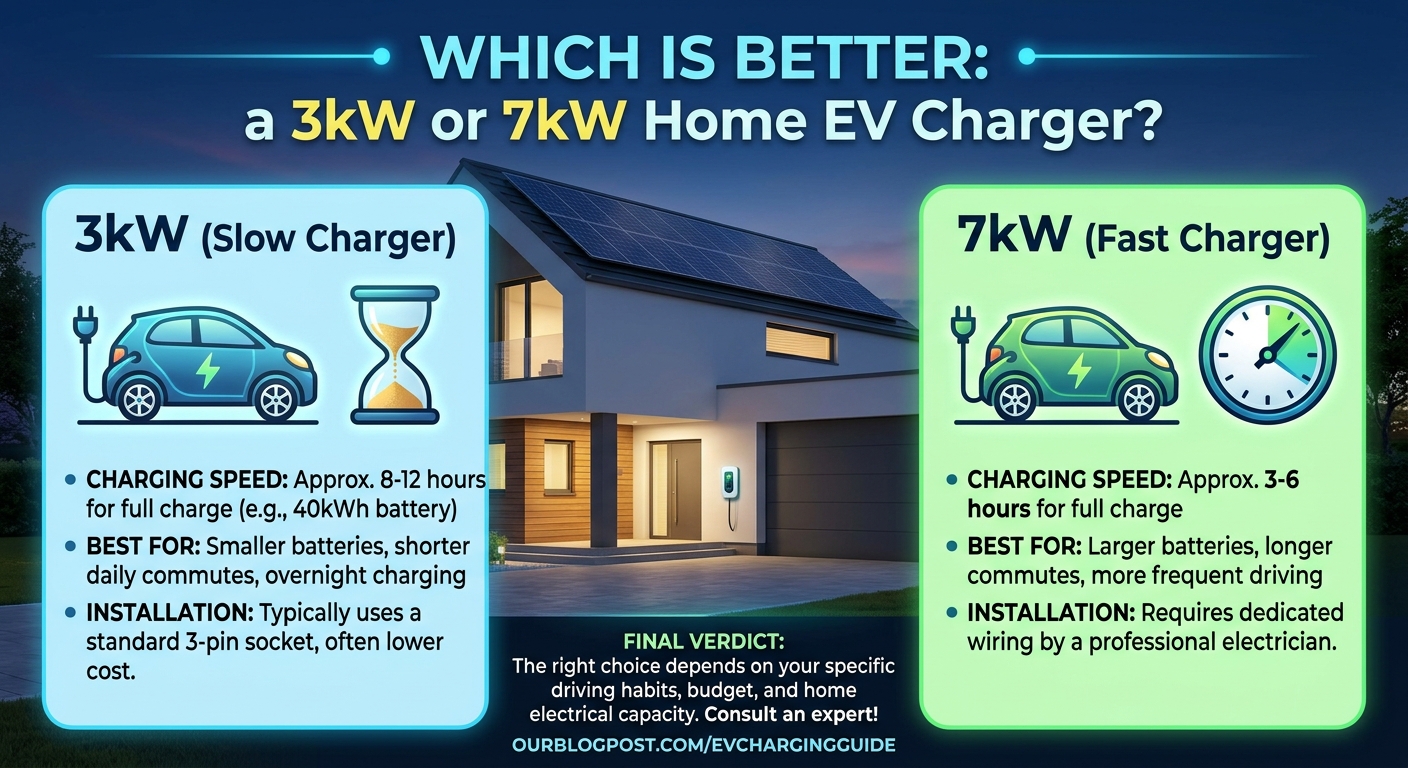
Upgrading to an electric vehicle (EV) unlocks substantial savings on long-term running costs while offering the daily comfort of waking up with a fully replenished battery. Operating on a standard residential power supply, home wallboxes restore driving range efficiently while taking advantage of low overnight electricity tariffs. However, when evaluating hardware specifications and installation quotes, prospective buyers frequently ask: Which is better: a 3kW or 7kW home EV charger?
The short answer is: a 7kW home EV charger is generally better and far more practical for most pure electric vehicle (BEV) owners, as it restores 25 to 30 miles of range per hour—more than double the speed of a 3kW unit—allowing full overnight battery replenishment within off-peak tariff windows.
While a 3kW charger can suffice for plug-in hybrid electric vehicles (PHEVs) or small-battery urban commuters, a 7kW unit provides the essential bandwidth required by modern long-range battery electric vehicles.
For complete hardware reviews, installer guides, and panel load calculators, visit EV Charger Advisor.
1. Key Technical Differences: 3kW vs. 7kW Chargers
Understanding the structural differences between these two charger tiers helps determine which matches your vehicle’s onboard charging capabilities:
A. 3kW Chargers (Slow AC Charging / ~13A–16A Draw)
-
Power Output: Operates at 3.0 kW to 3.7 kW on a standard $230\text{V}$ single-phase circuit.
-
Added Driving Range: Restores approximately 10 to 12 miles of range per hour.
-
Charging Time: Full charge for a typical 60 kWh BEV battery takes 16 to 20 hours.
-
Best Suited For: Plug-in hybrids (PHEVs) with small battery packs ($10\text{ kWh} – 15\text{ kWh}$) or drivers with very short daily commutes (under 20 miles per day).
B. 7kW Chargers (Fast Level 2 AC Charging / 32A Draw)
-
Power Output: Operates at 7.0 kW to 7.4 kW on a dedicated 32A / $230\text{V}$ single-phase branch circuit.
-
Added Driving Range: Restores approximately 25 to 30 miles of range per hour.
-
Charging Time: Full charge for a typical 60 kWh BEV battery takes 8 to 9 hours.
-
Best Suited For: Pure battery electric vehicles (BEVs), multi-EV households, and long-distance commuters requiring rapid overnight battery replenishment.
To learn more about how charger power levels and wire sizes compare, check out our guide on EV charging types.
2. Financial & Utility Tariff Advantages of a 7kW Wallbox
While a 7kW unit carries a slightly higher initial hardware and installation expense, it delivers major operational advantages:
-
Maximizing Off-Peak Electricity Tariffs: Most electric utility time-of-use (TOU) tariffs offer ultra-low electricity prices during a narrow 4 to 5-hour overnight window (e.g., 12 AM to 5 AM). A 7kW charger delivers 35 kWh during a 5-hour off-peak window, whereas a 3kW charger delivers only 15 kWh, forcing you to draw remaining power during expensive peak hours.
-
Future-Proofing Your Home Infrastructure: Modern EVs are equipping larger battery packs ($75\text{ kWh} – 100\text{ kWh}+$). Installing a 7kW wallbox ensures your home charging setup remains fully compatible with future electric vehicles without requiring secondary electrician service visits.
-
Safety & Direct Circuit Wiring: While 3kW units often plug into standard domestic sockets (risking socket overheating during prolonged draws), 7kW wallboxes are direct-hardwired with dedicated circuit protection, satisfying strict National Electrical Code (NEC Article 625) standards.
To explore Wi-Fi-enabled smart wallboxes engineered with off-peak schedule timers, read our guide on smart chargers.
Step-by-Step Mathematical Example: Off-Peak Window Energy Capture Math
Let us perform a mathematical comparison evaluating the energy delivered and financial cost savings of a 3.7kW Charger vs. a 7.4kW Charger during a 4-hour off-peak electricity window ($0.10/\text{kWh}$ off-peak vs. $0.40/\text{kWh}$ peak rate) for a 60 kWh EV battery.
Given Parameters:
-
Battery Capacity to Replenish: $60 \text{ kWh}$
-
Off-Peak Tariff Duration: $4 \text{ Hours}$ (e.g., 1:00 AM to 5:00 AM)
-
Off-Peak Electricity Tariff: $\$0.10 \text{ per kWh}$
-
Standard Peak Electricity Tariff: $\$0.40 \text{ per kWh}$
Calculation 1: 3.7kW Charger Performance
Calculation 2: 7.4kW Charger Performance
Result Breakdown: Because the 7.4kW charger delivers twice as much energy during the cheap 4-hour off-peak window, it saves $4.44 on every full charge, yielding hundreds of dollars in annual fuel savings while cutting total plug-in time in half.
Comparison Table: 3kW vs. 7kW Home EV Charger
| Specification / Feature | 3kW Home Charger | 7kW Home Charger |
| Electrical Circuit Demand | 13A – 16A (230V Single-Phase) | 32A (230V Single-Phase) |
| Added Range per Hour | $10 – 12 \text{ miles/hr}$ | $25 – 30 \text{ miles/hr}$ |
| Full Charge Time (60 kWh BEV) | $16 – 20 \text{ Hours}$ | $8 – 9 \text{ Hours}$ |
| Off-Peak Tariff Optimization | Low (Delivers only ~15 kWh) | High (Delivers ~30–35 kWh) |
| Best Vehicle Match | PHEVs / Small Urban EVs | Pure BEVs / Long-Range EVs |
Summary & Key Takeaways
-
7kW Is Better for Pure EVs: A 7kW home charger is superior for most drivers, providing twice the charging speed of a 3kW unit and completing full recharges overnight.
-
Maximizes Cheap Tariff Windows: 7kW chargers capture substantially more energy during short off-peak electricity windows, lowering total energy bills.
-
Future-Proof Investment: Installing a 7kW charger prepares your home for future electric vehicles with larger battery capacities.
-
3kW Works for PHEVs: A 3kW charger is sufficient if you drive a plug-in hybrid with a small battery or cover under 20 miles per day.













Leave a Reply