
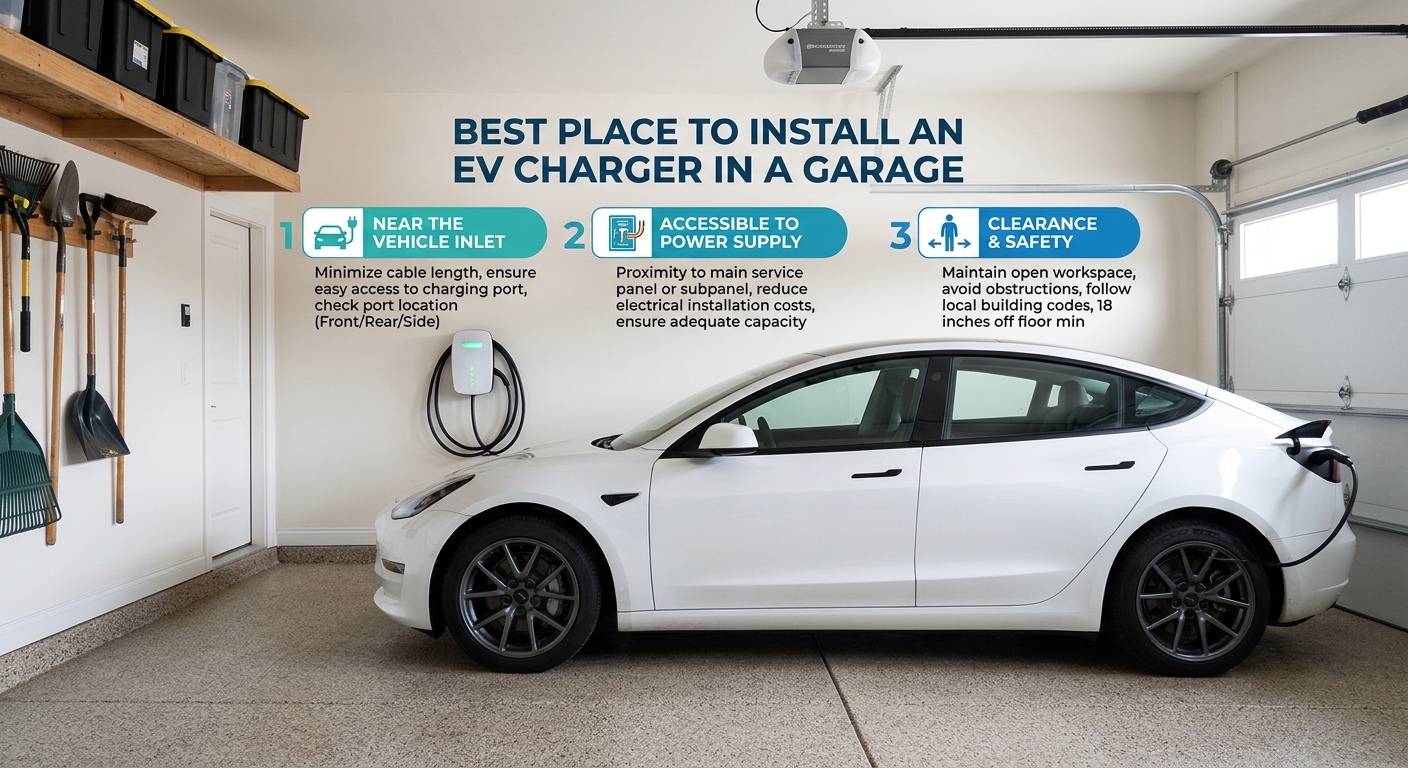
Transitioning to an electric vehicle (EV) brings substantial savings on daily fuel costs, smooth vehicle operation, and the convenience of waking up every morning to a fully replenished battery. Delivering 20 to 44 miles of driving range per hour over a high-voltage 240-volt single-phase branch circuit, installing a home Level 2 wallbox transforms vehicle charging into an effortless overnight routine. However, as homeowners prepare for installation, a vital practical question arises: Where is the best place to install an EV charger in a garage?
The short answer is: the best place to install an EV charger in a garage is on the side wall closest to your vehicle’s charging port, approximately 40 to 48 inches above the floor and within 10 to 15 feet of where the car is routinely parked.
Positioning your wallbox near your vehicle’s specific charge port location eliminates cable strain, prevents sidewalk trip hazards, and avoids forcing heavy charging leads across vehicle hoods or trunk lids.
For complete hardware reviews, installer guides, and panel load calculators, visit EV Charger Advisor.
1. Key Placement Factors: Charge Ports & Wiring Distances
Finding the ideal mounting spot requires evaluating vehicle design and electrical routing:
A. Vehicle Charge Port Location
Unlike gas tanks (which are almost exclusively at the rear sides), EV charge port locations vary significantly by manufacturer:
-
Front Left (Driver-side front fender): Common on models like the Porsche Taycan and Audi e-tron.
-
Rear Left (Driver-side rear quarter panel): Standard on Tesla models, Rivian, and many European EVs.
-
Front Center (Grille area): Common on Nissan LEAF and Hyundai Kona EV.
-
Rear Right (Passenger-side rear): Common on Nissan Ariya and select plug-in hybrids.
Pro Tip: Mounting the charger on the side wall closest to where your charge port rests when nose-in or back-in parked minimizes cable slack.
B. Distance to Main Electrical Panel
Placing the wallbox closer to your main service breaker panel reduces conduit length, lowers electrician labor costs, and minimizes circuit voltage drop.
C. Protection From Vehicular Bumper Impacts
Position the charger where car doors can open fully without striking the unit, or install rubber wall bumpers and protective steel bollards if mounting along the front garage wall.
To learn more about how charger power levels and wire sizes compare, check out our guide on EV charging types.
2. Mandatory NEC Code Requirements for Garage Mounting
Under NEC Article 625, specific safety rules govern indoor garage mounting heights:
-
NEC Minimum Mounting Height (NEC 625.102 / 625.30): The bottom of the wallbox coupling/control unit must be mounted at least 18 inches ($450\text{ mm}$) above the garage floor level to prevent igniting heavier-than-air combustible vapors (such as gasoline fumes from lawn equipment).
-
Optimal Working Height: Installing the unit 40 to 48 inches ($1.0\text{ m} – 1.2\text{ m}$) high provides comfortable, ergonomic plug handling and keeps flexible leads neatly elevated.
-
Maximum Cable Length Rule: Under NEC rules, flexible charging cables are limited to a maximum length of 25 feet ($7.5\text{ m}$) unless equipped with an approved cable management retraction system.
To explore Wi-Fi-enabled smart wallboxes engineered with integrated cable holsters, read our guide on smart chargers.
Step-by-Step Mathematical Example: Garage Circuit Voltage Drop Math
Let us calculate the percentage voltage drop ($\Delta V$) for a 48-Amp Level 2 charger ($240\text{V}$ single-phase supply) running 35 feet ($10.67\text{ m}$) from a main panel to the ideal garage side wall using #6 AWG Copper Wire ($R = 0.000491 \Omega/\text{ft}$).
Given Parameters:
-
Continuous Current Draw ($I$): $48 \text{ Amps}$
-
Nominal Line Voltage ($V$): $240 \text{ Volts}$
-
One-Way Cable Path ($L$): $35 \text{ feet}$
-
Conductor Resistance ($R_{\text{wire}}$): $0.000491 \Omega \text{ per foot}$
Calculation 1: Voltage Drop ($\Delta V$) Math
For a single-phase $240\text{V}$ circuit ($2 \times L = 70\text{ ft}$ total conductor path):
Calculation 2: Percentage Voltage Drop (%)
Result Breakdown: A 0.69% voltage drop stays well below the 3% maximum NEC threshold limit, confirming that positioning the wallbox 35 feet away on the optimal side wall operates safely, efficiently, and with negligible heat loss.
Comparison Table: Garage Wall Mounting Locations
| Mounting Location | Accessibility | Cable Management | Suitability |
| Side Wall (Near Port) | Excellent (Direct reach) | Best (Keeps cable off floor) | Highly Recommended |
| Front Garage Wall | Moderate (Depends on nose/back-in) | Good (Wall-mounted holster) | Good for front-port EVs |
| Center Pillar (2-Car Garage) | High (Serves two vehicles) | Moderate (Cable spans middle) | Great for multi-EV homes |
Summary & Key Takeaways
-
Mount Near the Charge Port: The best place for an EV charger is on the garage side wall closest to your car’s charge port to minimize cable strain.
-
Follow NEC Height Rules: Mount the bottom of the charger at least 18 inches above floor level (40–48 inches recommended for ergonomics).
-
Keep Cables Under 25 Feet: Choose a location that allows the charging handle to reach comfortably without stretching the cable across floor pathways.
-
Optimize Panel Proximity: Mounting closer to your main breaker panel reduces conduit installation costs and keeps voltage drop minimal.













Leave a Reply