
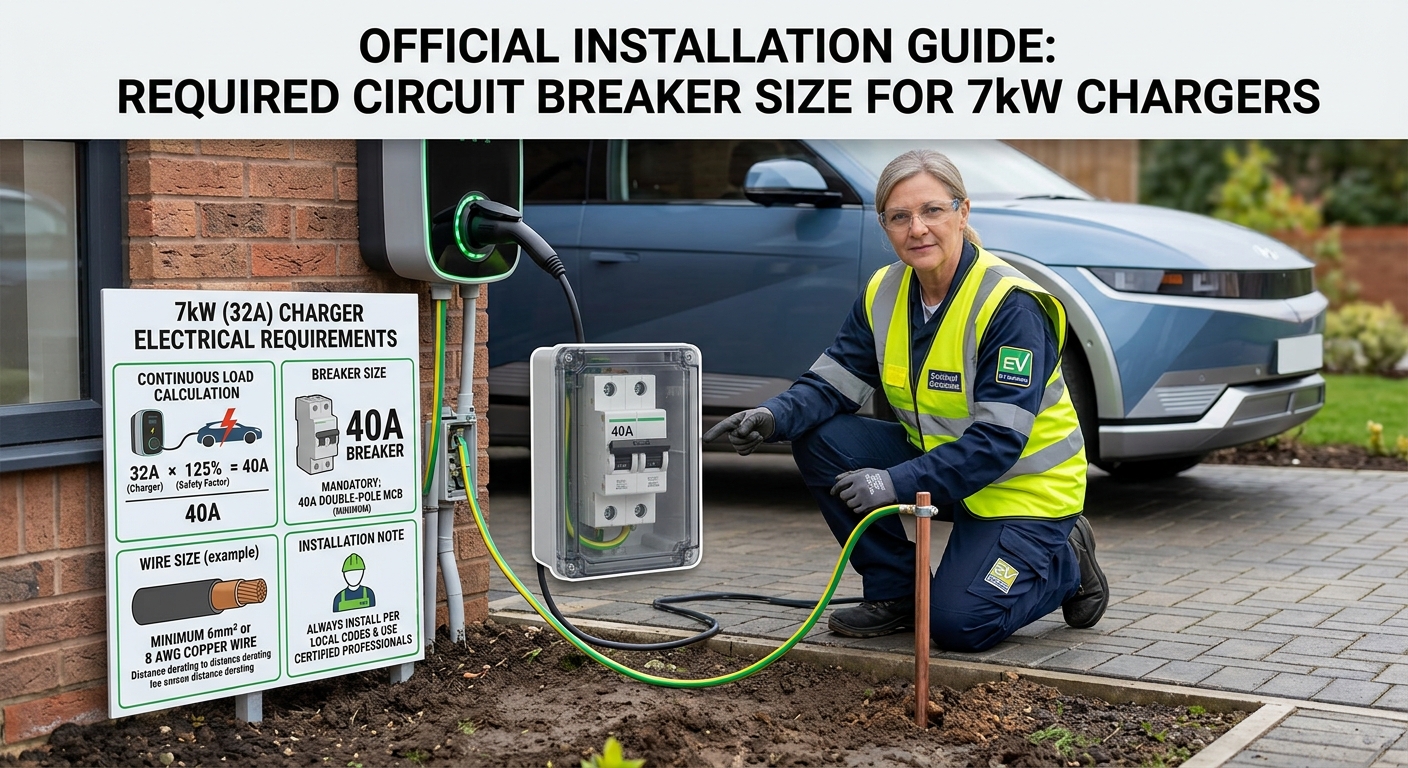
Installing a dedicated 7kW Level 2 electric vehicle (EV) charger is the industry benchmark for fast, reliable overnight home charging. Delivering roughly 7.4 kW ($7,400\text{ Watts}$) of power on a $240\text{-volt}$ single-phase branch circuit, a 7kW wallbox adds 25 to 30 miles (40 to 50 km) of driving range per hour. However, when configuring the main distribution panel, selecting circuit wires, and calculating continuous electrical loads, home owners frequently ask: What size circuit breaker do I need for a 7kW EV charger?
The short answer is: a 40-amp double-pole circuit breaker is typically required for a standard 7kW (32-amp continuous output) EV charger.
Under the National Electrical Code (NEC Article 625) and international wiring regulations (BS 7671), electric vehicle charging is legally classified as a continuous load. Understanding the 125% breaker sizing rule, conductor thermal ratings, and wire gauge requirements prevents nuisance breaker tripping, terminal overheating, and electrical fire hazards.
For complete panel load calculators, breaker selection charts, and wiring guides, visit EV Charger Advisor.
1. Why a 7kW (32A) Charger Requires a 40A Circuit Breaker
The relationship between a charger’s continuous power output and its protective circuit breaker size is governed by fundamental electrical safety rules:
A. The 80% / 125% Continuous Load Rule
Under NEC 625.41 / NEC 210.20, any electrical load that operates at full power continuously for 3 hours or longer must not exceed 80% of the circuit breaker’s maximum amperage rating. Alternatively stated, the circuit breaker and feeder conductors must be sized for at least 125% of the charger’s continuous current draw.
B. Operating Amperage Math ($32\text{A}$ Continuous Draw)
Standard “7kW” single-phase wallboxes operate at $230\text{V} – 240\text{V}$ nominal supply:
Because a $32\text{A}$ continuous load exceeds an $80\%$ limit on a $35\text{A}$ circuit, installing a 40-Amp double-pole circuit breaker ($32\text{A} \times 1.25 = 40\text{A}$) is mandatory.
C. Conductor Wire Gauge Requirements (#8 AWG / 6mm² Copper)
A 40A branch circuit supplying a 32A continuous load requires heavy-gauge copper conductors rated for at least 40A of thermal ampacity:
-
North America: #8 AWG THHN / THWN copper wire (or #6 AWG if using NM-B Romex due to 60°C temperature limits).
-
International / UK: 6mm² twin & earth or 3-core copper cable.
To learn more about how charger power levels and wire sizes compare, check out our guide on EV charging types.
Step-by-Step Mathematical Example: Circuit Sizing & Thermal Power Math
Let us perform the formal NEC safety calculations for sizing the circuit breaker, verifying the 80% safety margin, and calculating line thermal loss ($I^2R$) across a 50-foot (#8 AWG copper) branch circuit powering a 7.4 kW (32A) wallbox.
Given Parameters:
-
Wallbox Power Rating ($P$): $7,400 \text{ Watts (7.4 kW)}$
-
Supply Voltage ($V$): $230 \text{ Volts}$
-
Continuous Charging Draw ($I$): $32.17 \text{ Amps}$
-
One-Way Cable Run ($L$): $50 \text{ feet}$
-
#8 AWG Copper Resistance ($R_{\text{wire}}$): $0.000778 \Omega \text{ per foot}$
Calculation 1: Mandatory Breaker Amperage Sizing (125% Rule)
Calculation 2: Continuous Capacity Verification (80% Rule Check)
Verification: A 32A continuous charger draw matches the 32A continuous allowance of a 40A breaker perfectly ($32\text{A} \le 32\text{A}$).
Calculation 3: Branch Circuit Conductive Thermal Heat Loss ($P_{\text{loss}}$)
For a single-phase $230\text{V}$ circuit ($2 \times L = 100\text{ ft}$ total conductor path):
Result Breakdown: Pairing a 32A continuous charger with a 40-Amp breaker and #8 AWG copper wire keeps voltage drop low and limits branch circuit heat dissipation to a safe ~80.5 Watts over 50 feet, ensuring cool, reliable panel operation during multi-hour charging sessions.
To explore Wi-Fi-enabled smart wallboxes that support adjustable output settings, read our guide on smart chargers.
Comparison Table: EV Charger Power Outputs vs. Required Breaker & Wire Sizes
| Charger Power Output | Continuous Current Draw | Required Breaker Size (125%) | Recommended Wire Gauge (Copper) |
| 3.8 kW Level 2 | $16 \text{ Amps}$ | 20-Amp Double-Pole | #12 AWG / $2.5\text{mm}^2$ |
| 5.8 kW Level 2 | $24 \text{ Amps}$ | 30-Amp Double-Pole | #10 AWG / $4.0\text{mm}^2$ |
| 7.4 kW Level 2 (Standard) | 32 Amps | 40-Amp Double-Pole | #8 AWG / 6.0mm² |
| 9.6 kW Level 2 | $40 \text{ Amps}$ | 50-Amp Double-Pole | #8 AWG THHN / #6 AWG |
| 11.5 kW Level 2 (Fast AC) | $48 \text{ Amps}$ | 60-Amp Double-Pole | #6 AWG THHN / $10\text{mm}^2$ |
Summary & Key Takeaways
-
40A Breaker Is Standard: A 40-amp double-pole circuit breaker is required for a standard 7kW (32-amp output) home EV charger.
-
Apply the 125% Rule: Because EV charging is a continuous load, breaker and wire capacity must equal at least 125% of the charger’s operating current ($32\text{A} \times 1.25 = 40\text{A}$).
-
Match Wire Size to 40A Rating: Use #8 AWG copper wire (THHN/THWN) or 6mm² copper cable to handle the 40-amp circuit safely.
-
Hardwiring Eliminates Receptacle Failures: Hardwiring a 7kW wallbox directly into a 40A circuit provides superior thermal stability compared to 40A plug-in sockets.













Leave a Reply