
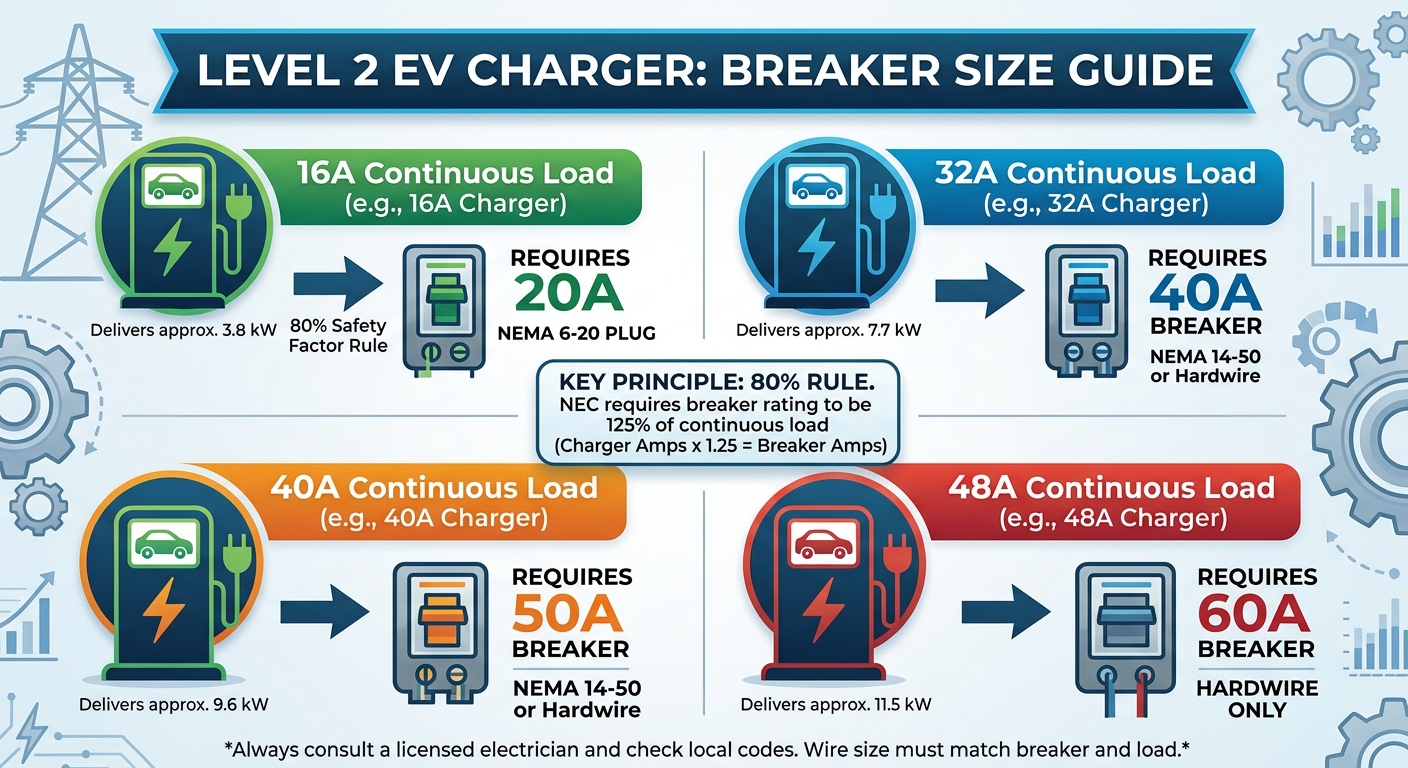
When upgrading your home infrastructure for an electric vehicle, installing a Level 2 EV charger is the best way to ensure rapid, full-overnight battery replenishment. Operating on a 240-volt single-phase branch circuit, Level 2 charging stations deliver anywhere from 12 to 44+ miles of driving range per hour. However, one of the most vital technical decisions during installation is selecting the correct circuit breaker. Homeowners often ask: What size breaker do you need for a Level 2 EV charger?
The short answer is: a Level 2 EV charger typically requires a 20-amp to 100-amp circuit breaker, depending on the charger’s maximum continuous amperage output.
While a 50-amp breaker (for 40A plug-in units) or a 60-amp breaker (for 48A hardwired wallboxes) represents the standard choice for most residential installations, understanding how National Electrical Code (NEC) continuous load rules dictate breaker selection ensures your setup remains safe, code-compliant, and optimized for your home’s electrical panel capacity.
For comprehensive load calculators, hardware reviews, and installation guides, visit EV Charger Advisor.
The Core Rule: NEC 125% Continuous Load Requirement
Under NEC Article 625, electric vehicle charging equipment is legally categorized as a continuous load—meaning the charger draws maximum rated current continuously for 3 hours or longer during a session.
To prevent circuit breakers from overheating and nuisance tripping under continuous electrical load, the NEC mandates that the branch circuit breaker and conductors must be sized for 125% of the charger’s continuous amperage draw (or conversely, the charger’s continuous current cannot exceed 80% of the circuit breaker’s faceplate rating):
Standard Level 2 Breaker & Charger Pairings:
-
20-Amp Breaker: Feeds a 16-Amp continuous charger ($3.84\text{ kW}$) — Ideal for tight 100A panels.
-
30-Amp Breaker: Feeds a 24-Amp continuous charger ($5.76\text{ kW}$) — Excellent low-amperage Level 2 setting.
-
40-Amp Breaker: Feeds a 32-Amp continuous charger ($7.68\text{ kW}$) — Standard entry-level wallbox.
-
50-Amp Breaker: Feeds a 40-Amp continuous charger ($9.60\text{ kW}$) — Maximum allowed for plug-in NEMA 14-50 outlets.
-
60-Amp Breaker: Feeds a 48-Amp continuous charger ($11.52\text{ kW}$) — Most popular hardwired residential setup.
-
100-Amp Breaker: Feeds an 80-Amp continuous charger ($19.20\text{ kW}$) — High-power commercial or specialized residential wallbox.
To learn more about how charger power ratings and plug styles compare, check out our guide on EV charging types.
Step-by-Step Mathematical Example: Breaker Sizing & Power Calculations
Let us calculate the exact circuit breaker size, continuous kilowatt output, and wire gauge for a homeowner installing a hardwired wallbox rated for 48 Amps continuous output.
Given Parameters:
-
Continuous Charger Draw ($I$): $48 \text{ Amps}$
-
Nominal Line Voltage ($V$): $240 \text{ Volts}$
Calculation 1: Minimum Circuit Breaker Amperage
Applying the NEC 125% continuous load rule:
Calculation 2: Usable Continuous Power Output
Calculation 3: Wire Gauge Selection (NEC Article 310)
Conductors supplying a 60A breaker circuit must match or exceed the $60\text{A}$ thermal rating:
-
THHN / THWN-2 Copper Wire in Conduit: Requires #6 AWG copper wire (rated up to $65\text{A}$ at $75^\circ\text{C}$ terminals).
-
NM-B Romex Cable: Because Romex is restricted to the $60^\circ\text{C}$ column under NEC 334.80 (where #6 AWG is rated for only $55\text{A}$), a 60A circuit wired with Romex requires #4 AWG Romex cable.
Result Breakdown: Sizing a 48A continuous Level 2 charger requires a 60-Amp double-pole circuit breaker paired with #6 AWG THHN copper wire in conduit (or #4 AWG Romex), delivering $11.52\text{ kW}$ of power ($36\text{–}44\text{ miles/hr}$).
To explore Wi-Fi-enabled smart wallboxes that support dynamic app management, read our guide on smart chargers.
Plug-In Outlets vs. Hardwired Wallbox Breaker Rules
Your physical installation choice directly determines your maximum breaker size:
1. Plug-In Receptacle Installations (NEMA 14-50 / 6-50)
-
Maximum Breaker Allowed: 50 Amps (Delivering $40\text{A}$ continuous load).
-
GFCI Protection Mandate: NEC Article 625 requires installing an expensive GFCI double-pole breaker ($100–$150) for all EV receptacles in garages or outdoor spaces.
2. Direct Hardwired Installations
-
Maximum Breaker Allowed: 60 Amps to 100 Amps (Delivering $48\text{A}$ to $80\text{A}$ continuous load).
-
Key Advantages: Eliminates external GFCI breakers (the charger includes built-in GFCI protection), prevents plug overheating, and unlocks maximum $48\text{A}$ residential charging speeds.
Comparison Table: Breaker Sizes vs. Level 2 EV Charger Performance
| Circuit Breaker Size | Max Continuous Draw (80%) | Power Output @ 240V | Minimum Copper Wire (THHN) | Added Range per Hour |
| 20 Amps | $16 \text{ Amps}$ | $3.84 \text{ kW}$ | #12 AWG | $12 – 15 \text{ miles/hr}$ |
| 30 Amps | $24 \text{ Amps}$ | $5.76 \text{ kW}$ | #10 AWG | $18 – 22 \text{ miles/hr}$ |
| 40 Amps | $32 \text{ Amps}$ | $7.68 \text{ kW}$ | #8 AWG | $22 – 28 \text{ miles/hr}$ |
| 50 Amps (Plug-In Max) | $40 \text{ Amps}$ | $9.60 \text{ kW}$ | #6 AWG | $28 – 34 \text{ miles/hr}$ |
| 60 Amps (Hardwired Standard) | 48 Amps | 11.52 kW | #6 AWG THHN / #4 Romex | 36 – 44 miles/hr |
| 100 Amps (High-Power Max) | 80 Amps | 19.20 kW | #2 AWG Copper | $60+ \text{ miles/hr}$ |
Summary & Key Takeaways
-
Wide Breaker Range: Level 2 chargers operate on circuit breakers ranging from 20 Amps to 100 Amps, depending on the unit’s output capability.
-
Standard Residential Sizes: A 50-amp breaker (for 40A plug-in setups) and a 60-amp breaker (for 48A hardwired wallboxes) represent the most popular choices.
-
Always Apply the 125% Rule: Multiply continuous charger output by 1.25 to find the required breaker size (e.g., $48\text{A} \times 1.25 = 60\text{A breaker}$).
-
Hardwiring Is Superior: Hardwired connections allow 60A breakers ($48\text{A} / 11.52\text{ kW}$ charging) and eliminate the need for costly external GFCI breakers.













Leave a Reply