
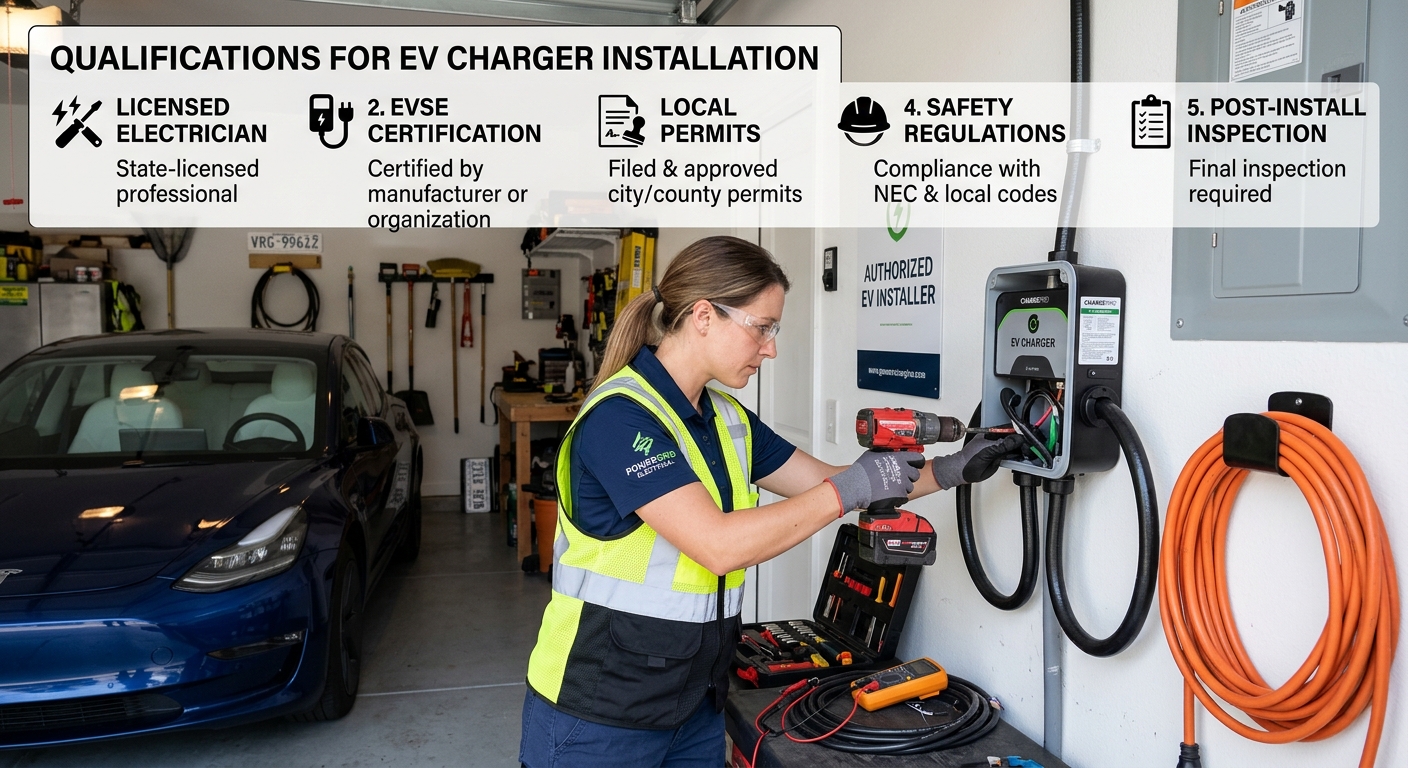
Establishing a residential electric vehicle (EV) charging setup is a major home electrical upgrade. Installing a Level 2 wallbox delivers 20 to 44 miles of driving range per hour over a high-voltage 240-volt single-phase branch circuit. Because EV charging involves connecting a high-amperage continuous electrical load to a home’s main service panel, selecting an installer with verified technical qualifications is essential. Property owners and homeowners frequently ask: What qualifications do you need to install an EV charger?
Installing an EV charger requires a licensed electrician who holds state or local electrical credentials, specialized EVSE training certifications (such as EVITP), and thorough expertise in National Electrical Code (NEC Article 625) compliance.
Under NEC Article 625 standards, verifying that an installer holds the correct licenses, certifications, load management training, and local municipal permitting credentials protects your property against electrical hazards, voided hardware warranties, and insurance claims.
For complete hardware reviews, installer guides, and panel load calculators, visit EV Charger Advisor.
1. The Core Credential Pyramid for EV Installers
A qualified EV charger installer should possess credentials across three distinct professional levels:
A. State & Local Electrical Licensure
-
Journeyman or Master Electrician License: The installer must hold an active state or local electrical license granted after completing 4,000 to 8,000 hours of documented field apprenticeship and passing a comprehensive electrical code exam.
-
Electrical Contractor License: The installing firm must hold an active electrical contractor license with active general liability insurance and worker’s compensation coverage.
B. EV-Specific Certifications (EVITP)
-
EVITP Certification: The Electric Vehicle Infrastructure Training Program (EVITP) is the industry standard for specialized EVSE training. Certified electricians complete 20+ hours of targeted instruction and pass a proctored exam covering EV battery characteristics, site assessment, continuous load sizing, grid integration, and safety.
-
Manufacturer Accreditations: Top charger manufacturers (such as Tesla, Wallbox, ChargePoint, and Qmerit) maintain factory-authorized installer networks trained specifically on their smart load-balancing protocols and hardware commissioning.
C. Municipal Permitting & Inspection Authority
-
Local AHJ Permitting: Installers must be registered with the local Authority Having Jurisdiction (AHJ) to pull required electrical permits and schedule official post-installation safety inspections.
To learn more about how charger power levels and wire sizes compare, check out our guide on EV charging types.
2. Technical Code Competencies (NEC Article 625)
A qualified installer must demonstrate mastery over key NEC continuous load rules:
QUALIFIED INSTALLER CODE CHECKLIST:
[NEC Article 220 Load Calculation] ──► Determines Main Panel Capacity
                                              │
         ┌────────────────────────────────────┴────────────────────────────────────┐
         ▼                                                                         ▼
[NEC 625.42: 125% Breaker Sizing]                                [NEC 625.42: EVEMS Deployment]
 (48A Load ──► 60A Breaker + #6 AWG Wire)                       (Throttles Current to Avoid Panel Upgrade)
-
NEC 125% Overcurrent Protection Rule: EV charging is classified as a continuous load. Qualified electricians size branch circuit breakers and conductor wiring to 125% of the charger’s continuous draw (e.g., a 48A continuous charger requires a 60A double-pole breaker and #6 AWG copper wire).
-
NEC Article 220 Load Calculations: Certified installers calculate existing household electrical demand before connecting a 40A or 50A breaker to an existing 100A or 200A main service panel.
-
EVEMS Integration: If main panel capacity is limited, qualified EV specialists can install an Electric Vehicle Energy Management System (EVEMS) under NEC 625.42, avoiding an expensive $2,500–$4,000 main service panel replacement.
To explore Wi-Fi-enabled smart wallboxes engineered with integrated load management features, read our guide on smart chargers.
3. Risks of Hiring an Unqualified Installer
Attempting DIY installations or hiring uncertified handymen creates serious financial and safety risks:
-
Receptacle Thermal Failure: Unqualified installers often use standard $10 builder-grade range outlets instead of industrial-grade NEMA 14-50 receptacles (such as Hubbell or Bryant), leading to socket melting under daily continuous current.
-
Undersized Wire Gauges: Sizing conductors without applying the 125% continuous duty multiplier creates high wire resistance and severe fire hazards inside wall cavities.
-
Voided Insurance & Warranties: Unpermitted electrical work completed by unlicensed individuals can void home insurance coverage and void manufacturer warranties on $600+ smart charging hardware.
Comparison Table: Qualifications Verification Matrix
| Qualification Parameter | Unlicensed Handyman | General Licensed Electrician | Certified EV Specialist |
| State Electrical License | NO | YES | YES |
| EVITP Certification | NO | Unlikely | YES |
| NEC Article 625 Expertise | None | Basic Awareness | Deep Technical Knowledge |
| Panel Load Calculation | Skips Load Check | Standard Calculation | NEC 220 + EVEMS Expertise |
| Industrial Outlet Selection | Standard Dryer Outlet | May use builder-grade socket | Uses Heavy-Duty Industrial Receptacles |
| Permits & Inspections | Cannot Pull Permits | YES | YES |
Summary & Key Takeaways
-
Three Pillars of Qualification: Require state electrical licensing, specialized EVITP or brand certification, and active contractor insurance.
-
Verify EVITP Certification: The Electric Vehicle Infrastructure Training Program ensures electricians understand continuous loads, utility interconnections, and EV safety.
-
Enforce NEC 125% Continuous Load Sizing: Sizing a 48A continuous wallbox requires a dedicated 60A double-pole circuit breaker and #6 AWG copper wire.
-
Always Require Municipal Permits: Official permits and AHJ inspections protect property values, insurance coverage, and hardware warranties.













Leave a Reply