
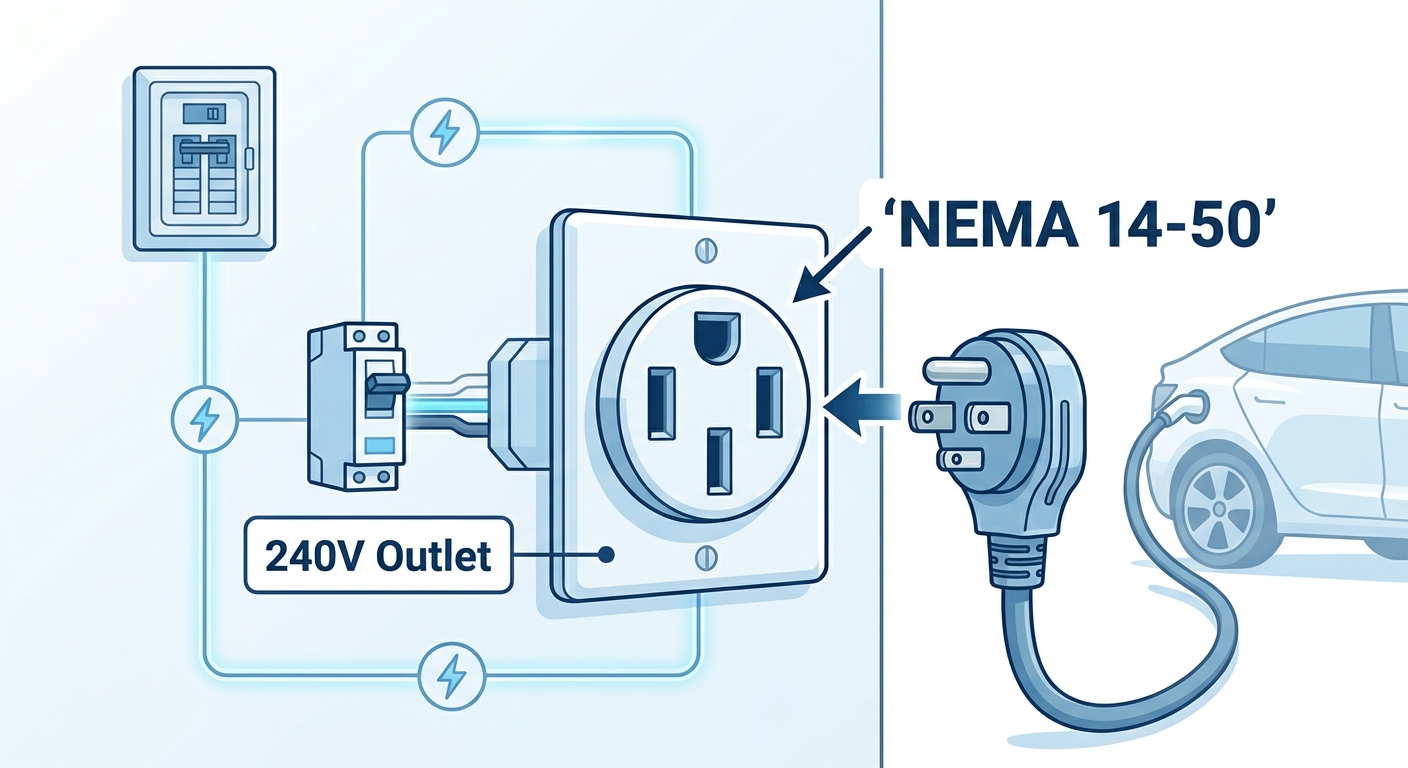
Upgrading to an electric vehicle (EV) brings smooth performance, quiet operation, and predictable home refueling. Installing a Level 2 charging setup delivers 20 to 44 miles of driving range per hour over a 240-volt single-phase branch circuit, making home charging convenient and efficient. Selecting the correct wall outlet is a critical first step in establishing a safe and compliant residential charging infrastructure.
The required receptacle depends directly on the intended charging speed. Standard household outlets (NEMA 5-15) accommodate slow Level 1 trickle charging, whereas high-speed Level 2 charging necessitates a dedicated 240-volt outlet—most commonly a NEMA 14-50 or NEMA 6-50 receptacle installed on a 50-amp branch circuit.
Under National Electrical Code (NEC Article 625) standards, selecting the correct outlet configuration, ensuring proper conductor sizing, and choosing industrial-grade receptacles prevents thermal degradation, nuisance GFCI trips, and fire hazards.
For complete hardware reviews, installer guides, and panel load calculators, visit EV Charger Advisor.
1. Primary Residential EV Charging Receptacles
Residential electric vehicle charging relies on two distinct voltage levels and outlet configurations:
A. Standard 120-Volt Outlet (NEMA 5-15) — Level 1 Charging
-
Outlet Style: Standard 3-prong household socket.
-
Electrical Capacity: Operates at 120V with a 12-amp continuous power draw (1.44 kW) on a 15A or 20A circuit breaker.
-
Charging Speed: Adds 3 to 5 miles of range per hour (~36 to 50 miles overnight).
-
Best Suited For: Plug-in hybrid electric vehicles (PHEVs), short daily commutes, or temporary backup charging.
B. High-Power 240-Volt Outlets — Level 2 Fast Charging
-
NEMA 14-50 Receptacle (Industry Standard): A 4-prong 240-volt receptacle (2 Hots, Neutral, Ground) installed on a 50-Amp double-pole circuit breaker. Following the NEC 80% continuous duty rule, it safely delivers 40 Amps of continuous current (9.60 kW output).
-
NEMA 6-50 Receptacle: A 3-prong 240-volt receptacle (2 Hots, Ground, no Neutral). Also installed on a 50A breaker delivering 40 Amps continuous power (9.60 kW output).
-
NEMA 14-30 Receptacle (Dryer Outlet): A 4-prong 240-volt receptacle installed on a 30A breaker, limiting continuous EV charging draw to 24 Amps (5.76 kW output).
To learn more about how charger power levels and wire sizes compare, check out our guide on EV charging types.
2. Hardware Quality & Installation Standards
Selecting the appropriate receptacle hardware is critical to enduring the high continuous electrical demands of EV charging:
-
Industrial-Grade Outlets: Standard residential range or dryer outlets are engineered for appliances plugged in infrequently. Continuous daily EV charging generates sustained thermal expansion, which can degrade lower-grade terminals. Always specify industrial-grade receptacles (such as Hubbell or Bryant) featuring heavy-duty brass contacts.
-
NEC GFCI Protection Standard (NEC 625.54): All 240V plug-in receptacles installed in garages or outdoor locations require a 2-pole GFCI circuit breaker in the main electrical panel.
-
Hardwired Direct Connections: Direct hardwiring to a dedicated 60-amp circuit supports maximum 48-amp continuous speeds (11.52 kW), eliminates wall socket contact wear, and avoids upstream GFCI circuit breaker requirements.
To explore Wi-Fi-enabled smart wallboxes engineered with integrated load management features, read our guide on smart chargers.
3. Charging Performance Comparison
Evaluating standard 120V outlets against high-power 240V receptacles highlights the operational efficiency of dedicated Level 2 infrastructure:
A. Standard 120V Household Outlet (NEMA 5-15)
-
Continuous Power Output: 1.44 kW
-
Time to Add 45 kWh of Range: Approximately 34 Hours
-
Circuit Efficiency: Standard efficiency on short dedicated branch runs.
B. High-Power 240V Outlet (NEMA 14-50)
-
Continuous Power Output: 9.60 kW
-
Time to Add 45 kWh of Range: Approximately 5 Hours and 15 Minutes
-
Circuit Efficiency: Sized with #6 AWG copper conductors over 60 feet, the circuit maintains stable operation with less than 1% voltage drop—well within the NEC 3% limit.
Comparison Table: EV Charging Outlet Specifications
| Outlet Type | Voltage | Required Breaker | Max Continuous Current | Power Output | Range Added / Hour |
| NEMA 5-15 (Standard Plug) | 120V | 15A or 20A Single-Pole | 12 Amps (80% Rule) | 1.44 kW | 3 – 5 Miles / Hour |
| NEMA 14-30 (Dryer Plug) | 240V | 30A Double-Pole | 24 Amps (80% Rule) | 5.76 kW | 18 – 22 Miles / Hour |
| NEMA 6-50 (3-Prong 240V) | 240V | 50A Double-Pole | 40 Amps (80% Rule) | 9.60 kW | 30 – 38 Miles / Hour |
| NEMA 14-50 (4-Prong 240V) | 240V | 50A Double-Pole | 40 Amps (80% Rule) | 9.60 kW | 30 – 38 Miles / Hour |
| Hardwired Level 2 Wallbox | 240V | 60A Double-Pole | 48 Amps Continuous | 11.52 kW | 36 – 44 Miles / Hour |
Summary & Key Takeaways
-
Receptacle Selection: Standard 120V outlets (NEMA 5-15) supply 3–5 miles/hr, whereas 240V outlets (NEMA 14-50 or 6-50) provide 30–38 miles/hr.
-
NEC 80% Rule Compliance: Pursuant to NEC Article 625, continuous load on a 50A breaker is capped at 40 Amps (9.60 kW).
-
Industrial-Grade Specification: Protect against receptacle degradation by choosing commercial-grade NEMA 14-50/6-50 outlets.
-
Hardwiring Advantage: Direct hardwiring to a dedicated 60A circuit provides maximum 48A (11.52 kW) output while bypassing plug contact wear.













Leave a Reply