
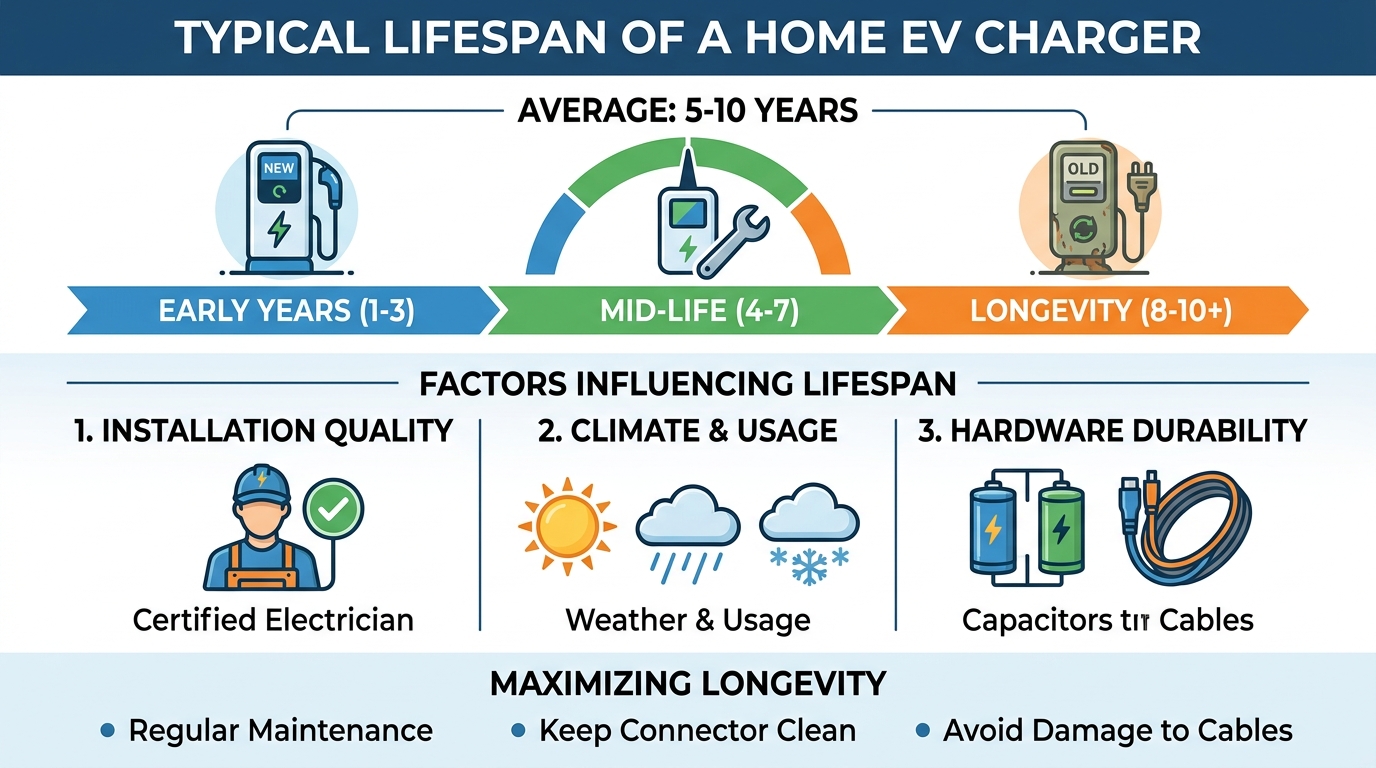
Investing in an electric vehicle (EV) home charging station offers daily convenience, predictable overnight refueling, and substantial fuel savings. Operating over a high-voltage 240-volt single-phase branch circuit, installing a Level 2 wallbox provides 20 to 44 miles of driving range per hour. However, as homeowners plan long-term home electrification investments, a fundamental practical question arises: What is the lifespan of a home EV charger?
The short answer is: a high-quality home EV charger typically has a lifespan of 10 to 15 years (and up to 20+ years for premium, well-maintained hardwired units). While internal solid-state power electronics last for decades, cable wear, mechanical contact degradation, and weather exposure dictate the physical replacement cycle.
Understanding how thermal management, physical usage, and electrical safety standards under National Electrical Code (NEC Article 625) affect charger longevity helps you choose durable hardware and extend system operational life.
For complete hardware reviews, installer guides, and panel load calculators, visit EV Charger Advisor.
1. Key Factors Influencing Home EV Charger Lifespan
While Level 2 wallboxes are built with heavy-duty solid-state components, several operational variables dictate how long a charger remains safe and functional:
A. Quality of Thermal Management & Enclosure (NEMA/IP Rating)
-
Indoor vs. Outdoor Exposure: Chargers installed in direct sunlight, severe rain, or freezing conditions face thermal degradation faster than garage-mounted units. Look for outdoor wallboxes rated NEMA 3R, NEMA 4, or IP65+.
-
Active Thermal Throttling: Premium chargers incorporate internal temperature sensors that throttle continuous current if internal terminal screws or relays run hot, protecting internal circuit boards.
B. Mechanical Wear on Cables & Plugs (Primary Failure Point)
-
The Charging Cable: The flexible output cord experiences physical stress from bending, coiling, or accidental vehicle run-overs. Damaged cable jackets or cracked J1772/NACS plug latches are the #1 reason chargers require servicing.
-
Terminal Contact Degradation: Daily plugging and unplugging wears down copper contact pins. Keeping connectors docked in a clean holster prevents moisture intrusion and pin oxidation.
C. Hardwired Installation vs. Plug-In Outlet Thermal Stress
-
Hardwired Superiority: Hardwiring directly into a main panel eliminates socket contact heating, supports continuous 48A ($11.52\text{ kW}$) output, and lasts longer.
-
Plug-In (NEMA 14-50) Wear: Repeated thermal expansion on builder-grade NEMA 14-50 receptacles can loosen terminal screws over 5 to 7 years, increasing electrical resistance.
To learn more about how charger power levels and wire sizes compare, check out our guide on EV charging types.
2. Software Obsolescence vs. Hardware Longevity
When evaluating charger lifespan, it is essential to separate physical hardware from cloud software services:
-
“Dumb” Chargers (15–20+ Year Potential): Non-Wi-Fi wallboxes feature simple relay circuits. With zero app software dependencies, they continue charging reliably as long as physical conductors and contactors remain intact.
-
Smart Chargers (10–15 Year Lifespan): Wi-Fi-enabled wallboxes offer Time-of-Use scheduling, solar surplus diversion, and app monitoring. While the physical hardware may last 15+ years, manufacturer app support or cloud server connectivity may sunset earlier.
-
Firmware Over-The-Air (OTA) Updates: Choosing established wallbox manufacturers ensures ongoing firmware updates that keep charging protocols compatible with future EV models.
To explore Wi-Fi-enabled smart wallboxes engineered with integrated load management features, read our guide on smart chargers.
Step-by-Step Mathematical Example: Circuit Efficiency & Thermal Loss Calculation
Let us analyze the operational efficiency and total internal heat dissipation over a 10-Year Service Life (3,650 Daily Charging Sessions) for a 48-Amp Continuous Level 2 Hardwired Charger ($240\text{V}$ supply) operating 4 hours daily on #6 AWG Copper Wire ($R = 0.000491 \Omega/\text{ft}$) over a 40-foot ($12.19\text{ m}$) run ($\eta = 0.90$).
Given Parameters:
-
Continuous Charging Draw ($I$): $48 \text{ Amps}$
-
Supply Voltage ($V$): $240 \text{ Volts}$
-
One-Way Conductor Length ($L$): $40 \text{ feet}$
-
Conductor Resistance for #6 AWG Copper ($R_{\text{wire}}$): $0.000491 \Omega \text{ per foot}$
-
Daily Session Duration ($t$): $4.0 \text{ Hours per Day}$
-
Service Lifespan Horizon: $10 \text{ Years (3,650 Days)}$
Calculation 1: Continuous AC Gross Power Delivery ($P_{\text{gross}}$)
Calculation 2: Total Energy Transferred Over 10 Years ($E_{\text{10-yr}}$)
Calculation 3: Conductor Line Loss Power Dissipation ($P_{\text{loss}}$)
For a single-phase circuit ($2 \times L = 80\text{ ft}$ total conductor loop path):
Calculation 4: Percentage Voltage Drop ($\Delta V$) Math
Result Breakdown: Over a 10-year lifespan, a hardwired 48A charger safely transfers 168,192 kWh of energy with a low 0.79% voltage drop and minimal 90.5 Watts conductor line loss, demonstrating the long-term reliability of a properly sized hardwired installation.
Comparison Table: Home EV Charger Lifespan & Component Failure Risk
| Charger Component | Expected Lifespan | Primary Failure Mode | Maintenance Prevention Tip |
| Solid-State Relays / PCB | 15 – 20+ Years | Power surge / High thermal stress | Install whole-home surge protection |
| Flexible Output Cable | 7 – 12 Years | Jacket cracking / Copper strand fatigue | Hang on wall hook; avoid driving over |
| J1772 / NACS Plug Handle | 8 – 12 Years | Pin oxidation / Mechanical latch break | Store in holster cap away from rain |
| NEMA 14-50 Wall Socket | 5 – 8 Years | Socket spring tension loss & arcing | Hardwire wallbox directly to panel |
| Smart Wi-Fi / App Module | 7 – 10 Years | Cloud server deprecation / Wi-Fi fail | Choose established brands with OTA support |
Summary & Key Takeaways
-
10 to 15 Year Average Lifespan: A quality Level 2 home EV charger lasts 10 to 15 years, with hardwired units lasting even longer.
-
Cables Are the Main Wear Item: Protect output cables by hanging them on holsters rather than leaving them on garage floors.
-
Hardwiring Extends Longevity: Direct hardwiring to a dedicated 60A circuit eliminates plug contact degradation and socket heat stress.
-
Surge Protection Is Critical: Installing whole-house surge protection guards delicate internal wallbox relays against grid voltage spikes.













Leave a Reply