
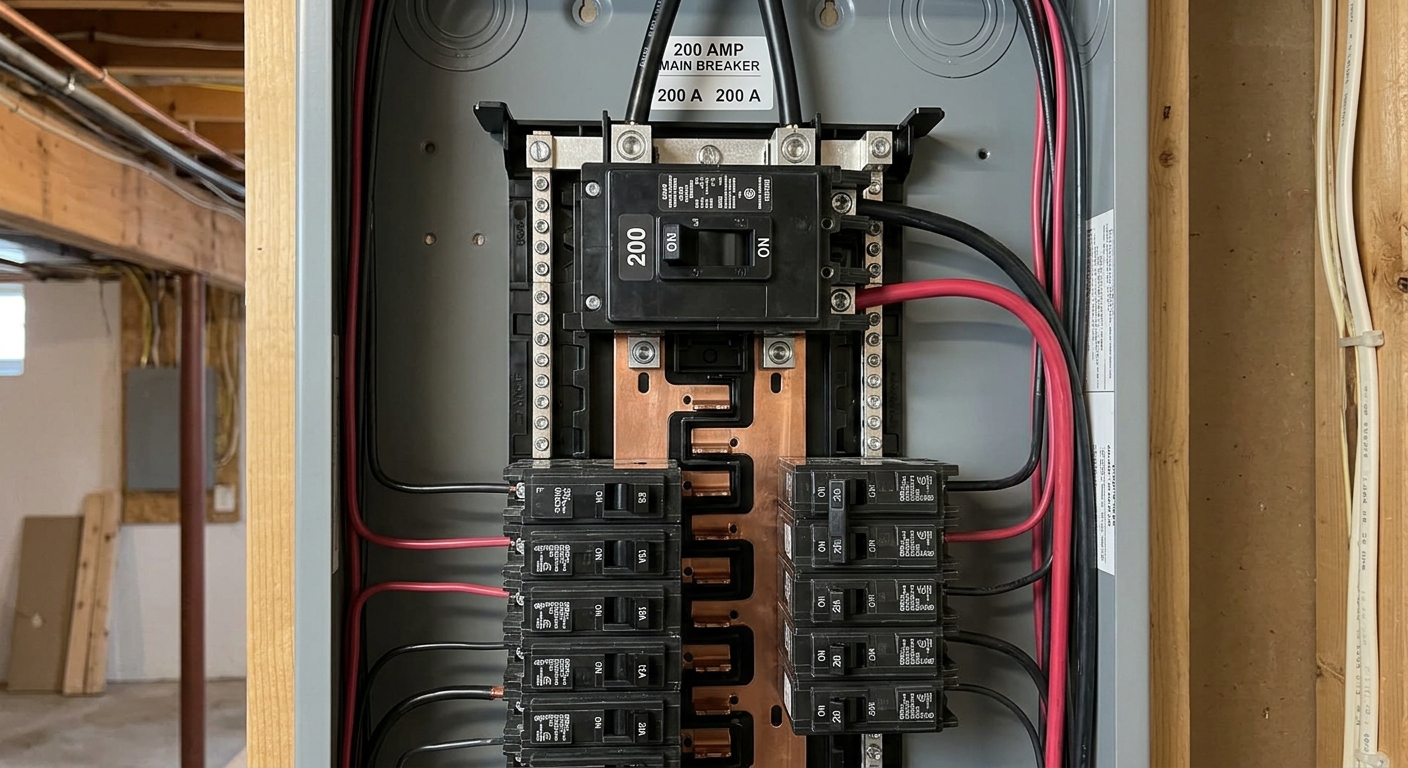
When upgrading a residential electrical system or setting up high-power loads—such as an 80-Amp Level 2 EV charger, a workshop subpanel, or a whole-house tankless water heater—understanding panelboard ampacity limits is essential. A common question homeowners ask electricians is: What is the largest breaker you can install in a 200-amp panel?
The short answer is: the largest main disconnect breaker or single branch/subpanel feeder breaker you can physically install inside a 200-amp panel is 200 Amps.
However, while a single branch breaker can theoretically be rated up to 200 Amps to feed a subpanel, specific National Electrical Code (NEC) rules apply depending on whether the breaker serves a single continuous load, feeds a secondary subpanel, or backfeeds power from solar energy systems.
For comprehensive panel load calculators, hardware guides, and installer breakdowns, visit EV Charger Advisor.
1. Main Disconnect Breakers vs. Branch Circuit Breakers
To evaluate maximum breaker sizes accurately, you must distinguish between panel component functions:
1. Main Disconnect Breaker (200 Amps)
The main breaker sits at the top or center of a 200A panel, acting as the primary overcurrent protection device for the entire building. It limits total simultaneous current draw across all combined household branch circuits to 200 Amps ($48\text{ kW}$ at $240\text{V}$).
2. Subpanel Feeder Breakers (Up to 200 Amps)
If you are running a heavy feeder cable to a detached garage, workshop, or secondary subpanel, the NEC permits installing a double-pole breaker up to 200 Amps inside the main panel—provided the feeder conductor cable (e.g., $3/0\text{ AWG}$ copper or $4/0\text{ AWG}$ aluminum) matches the 200A rating.
3. Individual Appliance Branch Breakers (20A to 100A Typical)
Individual dedicated branch circuits are sized strictly according to the appliance nameplate rating. For example, a standard Level 2 EV charger drawing $48\text{A}$ continuous load requires a 60A double-pole breaker, while an ultra-high-output $80\text{A}$ continuous EV charger requires a 100A double-pole breaker.
To learn more about how charger power levels and wire sizes compare, check out our guide on EV charging types.
2. Does the Sum of All Branch Breakers Have to Stay Under 200 Amps?
A common misconception among homeowners is that the sum of all individual circuit breaker faceplate numbers cannot exceed 200 Amps.
The Diversity Factor Principle
Under the National Electrical Code (NEC Article 220), the total combined amperage rating of all branch breakers in a residential panel can legally exceed 200 Amps by a wide margin. It is completely code-compliant to have fifteen 20A breakers ($300\text{A}$ total) plus two 50A EV/range breakers ($100\text{A}$ total) inside a single 200A panel.
This is permitted because of load diversity: household appliances rarely draw maximum current simultaneously. The 200A main breaker protects the panel busbars from total overload, while individual branch breakers protect their respective wire conductors.
3. Step-by-Step Mathematical Example: Sizing a Large 100A Branch Breaker for an EV Charger
Let us calculate the required breaker size and panel load impact for installing an ultra-fast 80-Amp continuous commercial/residential EV charger on a 200-amp main panel.
Given Parameters:
-
Continuous EV Charger Output ($I$): $80 \text{ Amps}$
-
Nominal Line Voltage ($V$): $240 \text{ Volts}$
-
Main Panel Rating: $200 \text{ Amps @ 240V} = 48,000 \text{ Watts}$
-
Max Continuous Safety Capacity (80% Rule): $160 \text{ Amps} = 38,400 \text{ Watts}$
Calculation 1: Applying the NEC 125% Continuous Load Rule (NEC Article 625)
EV charging is legally classified as a continuous load (running for 3 hours or longer). Branch breakers must be sized to 125% of the continuous draw:
Calculation 2: Calculating Continuous Power Output
Calculation 3: Evaluating Remaining Panel Continuous Margin
Assuming an existing baseline home demand of $14.4\text{ kW}$ ($60\text{ Amps}$):
Result Breakdown: The electrician installs a massive 100-Amp double-pole breaker to supply the $80\text{A}$ ($19.2\text{ kW}$) continuous charger. The total continuous load ($140\text{A}$) sits safely inside the panel’s $160\text{A}$ continuous limit.
To explore Wi-Fi-enabled smart wallboxes that offer dynamic energy management, read our guide on smart chargers.
4. Solar Interconnection Restrictions: The NEC 120% Busbar Rule
When installing a supply breaker for backfeeding energy (such as a solar PV inverter or battery storage system), special restrictions apply under NEC Article 705.12 (120% Rule).
How the 120% Rule Restricts Backfeed Breaker Sizes
Because solar inverters inject current onto panel busbars alongside utility grid power, the sum of the main breaker and the solar supply breaker cannot exceed 120% of the busbar rating:
-
Standard 200A Busbar with 200A Main Breaker: $(200\text{A} \times 1.20) – 200\text{A} = \mathbf{40 \text{ Amps Max Solar Breaker}}$.
-
Upgraded 225A Busbar with 200A Main Breaker: $(225\text{A} \times 1.20) – 200\text{A} = \mathbf{70 \text{ Amps Max Solar Breaker}}$.
Comparison Table: Common Large Breaker Sizes in 200A Panels
| Breaker Amperage | Typical Wire Gauge Required | Common Residential Application | Max Continuous Draw Allowed |
| 50 Amps | #6 AWG Copper | NEMA 14-50 EV Outlet, Electric Range | $40 \text{ Amps } (9.6\text{ kW})$ |
| 60 Amps | #6 AWG THHN in Conduit | Standard 48A Level 2 EV Hardwired Wallbox | 48 Amps ($11.5\text{ kW}$) |
| 100 Amps | #2 AWG or #1/0 AWG Copper | 80A EV Charger, Subpanel Feeder, Electric Furnace | 80 Amps ($19.2\text{ kW}$) |
| 200 Amps | 3/0 AWG Cu / 4/0 AWG Al | Main Panel Disconnect, Heavy Garage Subpanel | 160 Amps ($38.4\text{ kW}$) |
Summary & Key Takeaways
-
200-Amp Absolute Maximum: The largest individual breaker (main disconnect or subpanel feeder) allowed inside a 200A panel is 200 Amps.
-
Breaker Sums Can Exceed 200A: NEC code permits the total sum of branch breaker ratings to exceed 200 Amps due to load diversity principles.
-
Continuous Loads Require 125% Sizing: Sizing large branch breakers for EV chargers requires multiplying continuous current by 125% (e.g., $80\text{A}$ draw requires a $100\text{A}$ breaker).
-
Solar Backfeed Breakers Are Capped: Under the NEC 120% rule, solar backfeed breakers are capped at 40 Amps on a standard 200A busbar with a 200A main breaker.













Leave a Reply