
Switching to an electric vehicle (EV) unlocks immediate fuel savings, whisper-quiet performance, and zero local tailpipe emissions. Delivering 20 to 44 miles of driving range per hour over a high-voltage 240-volt single-phase branch circuit, home Level 2 charging transforms battery replenishment into an effortless overnight routine. However, as EV drivers travel across regions or select home charging hardware, a primary practical question arises: What is the best plug type for EV charging?
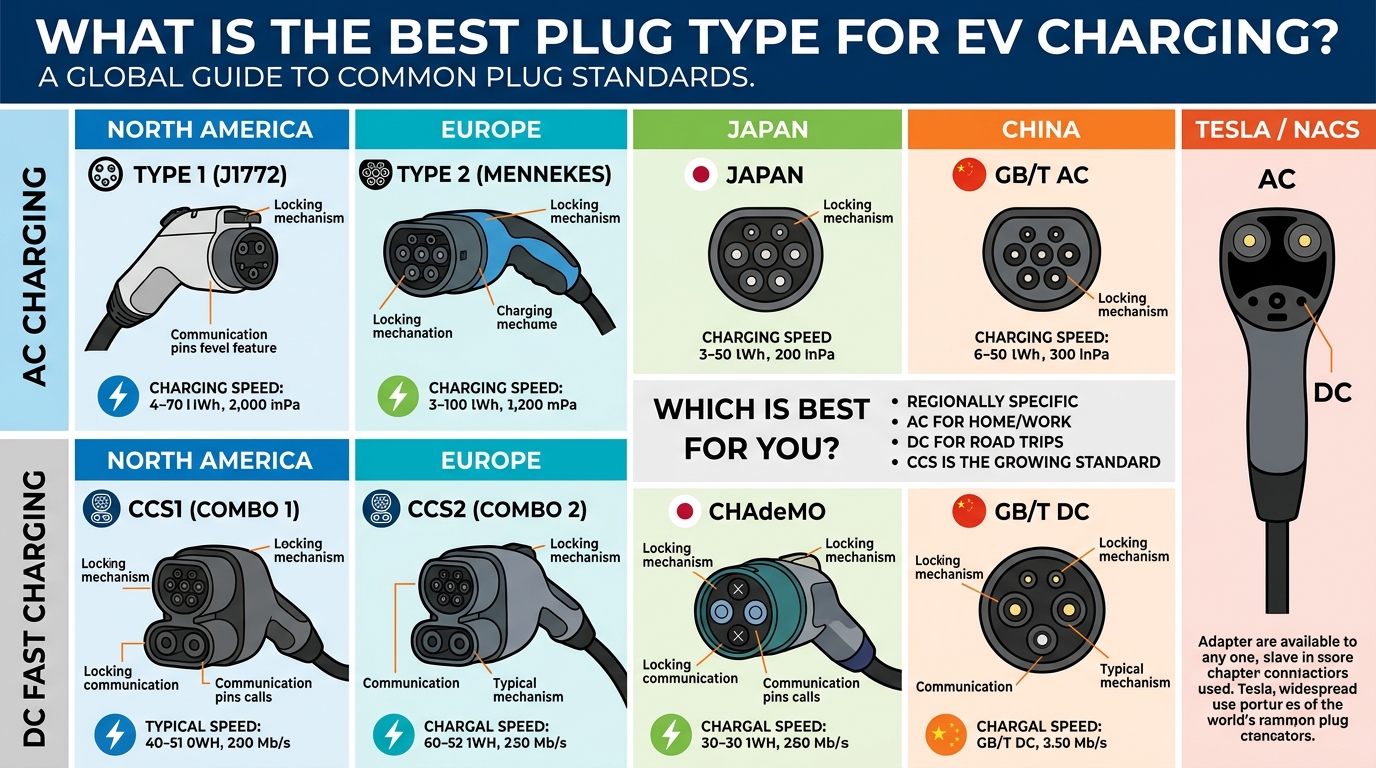
The short answer is: the best plug type for EV charging depends entirely on your geographic region and whether you are charging at home (AC) or on the highway (DC Fast Charging). In North America, the North American Charging Standard (NACS / SAE J3400) has emerged as the definitive best connector, while Type 2 (Mennekes) and CCS2 dominate Europe and international markets.
Understanding the differences between AC home plugs, combined DC fast-charging standards, and universal retrofits ensures seamless charging compatibility wherever you drive.
For complete hardware reviews, installer guides, and panel load calculators, visit EV Charger Advisor.
1. North America: The Shift to NACS (SAE J3400)
North America has undergone a major industry-wide consolidation toward a single unified connector:
A. NACS (SAE J3400) — The Current Industry Standard
-
Primary Markets: United States, Canada, and Mexico.
-
Why It Is the Best: Engineered originally by Tesla, NACS combines both AC Level 2 home charging and high-power DC fast charging into a single, compact, lightweight handle. Virtually all major automakers (Ford, GM, Rivian, Hyundai, Kia, BMW, Mercedes) have transitioned to native NACS ports on their new electric vehicles.
B. J1772 (Type 1) — Legacy North American AC Plug
-
Primary Markets: Legacy non-Tesla North American EVs.
-
Capabilities: Handles single-phase AC Level 1 (120V) and Level 2 (240V) charging up to 80 Amps. Requires a separate bulky lower pin combination (CCS1) to support public DC fast charging.
To learn more about how charger power levels and wire sizes compare, check out our guide on EV charging types.
2. Europe & International Markets: Type 2 & CCS2 Standard
Outside North America, official government mandates established three-phase power standards:
-
Type 2 / Mennekes (EN 62196-2) for AC Charging: The mandated standard across Europe, the UK, Australia, and parts of Asia. Unlike North American single-phase connectors, Type 2 supports three-phase AC electricity ($400\text{V}$), enabling home and destination charging speeds up to 22 kW ($32\text{A}$ per phase).
-
CCS2 (Combined Charging System Type 2): Europe’s universal standard for DC fast charging, adding two heavy DC pins beneath the standard Type 2 AC connector housing to support rapid public charging outputs up to 350 kW.
-
GB/T Standard (China): China utilizes separate, mandated national plug standards for AC charging and high-power DC charging across the world’s largest EV fleet.
To explore Wi-Fi-enabled smart wallboxes engineered with native connector options, read our guide on smart chargers.
Step-by-Step Mathematical Example: Single-Phase (NACS/J1772) vs. Three-Phase (Type 2) Power Delivery
Let us compare the maximum Level 2 AC power output delivered by a North American Single-Phase Circuit ($240\text{V} / 48\text{A}$) using NACS versus a European Three-Phase Circuit ($400\text{V} / 32\text{A}$) using a Type 2 connector.
Given Parameters:
-
North America Single-Phase Voltage ($V_{\text{1P}}$): $240 \text{ Volts}$
-
North America Continuous Current ($I_{\text{1P}}$): $48 \text{ Amps}$
-
European Three-Phase Line-to-Line Voltage ($V_{\text{3P}}$): $400 \text{ Volts}$
-
European Continuous Current per Phase ($I_{\text{3P}}$): $32 \text{ Amps}$
Calculation 1: Single-Phase Max AC Power Delivery ($P_{\text{1P}}$)
Calculation 2: Three-Phase Max AC Power Delivery ($P_{\text{3P}}$)
Calculation 3: Power Difference Overhead
Result Breakdown: While North American NACS/J1772 chargers max out at 11.52 kW on residential single-phase power, European Type 2 connectors on three-phase infrastructure deliver 22.17 kW, effectively doubling AC charging speeds.
Comparison Table: Global EV Charging Plug Standards
| Plug / Standard Name | Primary Region | AC / DC Capability | Max Power Delivery |
| NACS (SAE J3400) | North America | Combined AC & DC | 11.5 kW AC / 250+ kW DC |
| J1772 (Type 1) | North America / Japan | AC Only | 19.2 kW AC |
| Type 2 (Mennekes) | Europe / UK / Aus | AC Only (3-Phase) | 22.0 kW AC |
| CCS2 | Europe / UK / Aus | Combined AC & DC | 350 kW DC |
Summary & Key Takeaways
-
NACS Is the Best in North America: NACS (SAE J3400) offers a compact, single-handle design for both AC home charging and high-speed DC fast charging.
-
Type 2 / CCS2 Rules Internationally: European and international markets mandate Type 2 for AC three-phase charging and CCS2 for rapid highway fast charging.
-
Universal Adapters Are Available: If your vehicle uses J1772 or CCS1, passive NACS-to-J1772 or NACS-to-CCS1 adapters allow seamless charging at NACS stations.
-
Three-Phase Unlocks 22 kW AC: European Type 2 connectors exploit 400V three-phase grid power to deliver up to 22 kW of AC home charging speed.













Leave a Reply