
Upgrading to an electric vehicle (EV) brings substantial long-term fuel savings, quiet performance, and zero local tailpipe emissions. Delivering 20 to 44 miles of driving range per hour over a high-voltage 240-volt single-phase supply, hardwiring a home Level 2 wallbox transforms battery replenishment into a seamless overnight routine. However, as prospective EV owners navigate different connector standards and smart home features, a primary practical question arises: What is the best hardwired EV charger for home?
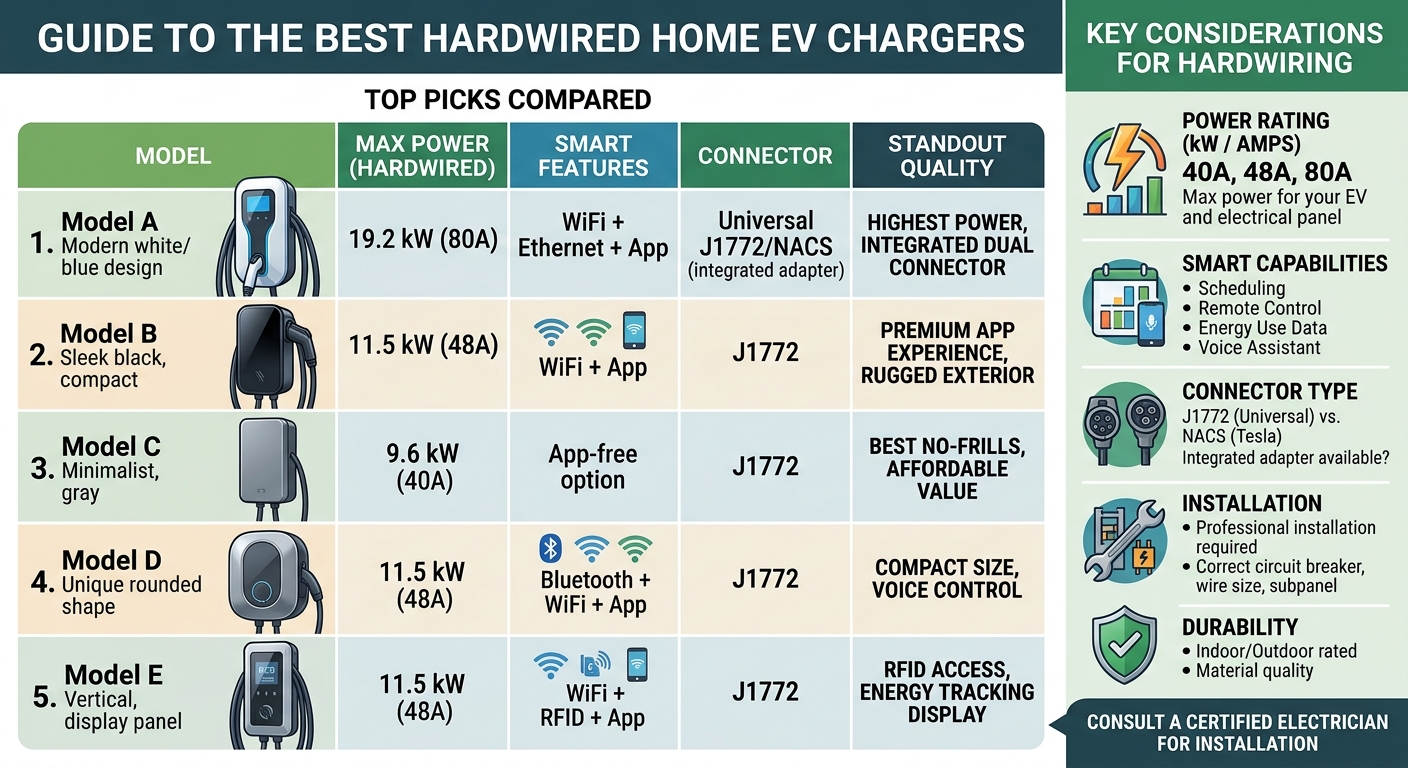
The short answer is: the best hardwired EV charger for home depends on your vehicle type, smart-home needs, and electrical panel capacity. Top contenders include the Tesla Universal Wall Connector (best overall versatility), Emporia Smart EV Charger (best value), ChargePoint Home Flex (best app interface & 50A flexibility), and Wallbox Pulsar Plus (best compact design with dynamic power sharing).
Hardwiring a wallbox directly to a dedicated 60-Amp branch circuit unlocks the full 48-Amp ($11.52\text{ kW}$) continuous charging speed of modern Level 2 chargers while eliminating wall socket failure points, thermal plug degradation, and GFCI breaker trips under National Electrical Code (NEC Article 625) standards.
For complete hardware reviews, installer guides, and panel load calculators, visit EV Charger Advisor.
1. Top Hardwired Home EV Chargers Ranked
Choosing the right hardwired wallbox depends on your household setup, vehicle compatibility, and budget:
A. Tesla Universal Wall Connector (Best Overall & Future-Proof)
-
Output Speed: Up to 48 Amps ($11.52\text{ kW}$) on a 60A hardwired breaker.
-
Connector Type: Built-in Magic Dock holding both NACS (J3400) and J1772 connectors.
-
Key Advantage: Charges any electric vehicle (Tesla, Ford, GM, Hyundai, Rivian) seamlessly without extra external adapters. Features a sleek design, 24-foot cable, and integrated Tesla app management.
B. Emporia Smart EV Charger (Best Value Smart Charger)
-
Output Speed: Up to 48 Amps ($11.52\text{ kW}$) when hardwired.
-
Key Advantage: Offers robust Wi-Fi smart scheduling, energy consumption tracking, and integration with the Emporia Energy Ecosystem (solar array management) at an unmatched price point.
C. ChargePoint Home Flex (Best App & Up to 50A Charging)
-
Output Speed: Up to 50 Amps ($12.0\text{ kW}$) on a hardwired 70A breaker (or adjustable down to 16A).
-
Key Advantage: Features an ultra-flexible cable that stays soft in freezing winter temperatures, intuitive utility-rate aware app scheduling, and broad energy rebate eligibility. Available in separate J1772 or NACS configurations.
D. Wallbox Pulsar Plus (Best Compact & Multi-EV Power Sharing)
-
Output Speed: Up to 48 Amps ($11.52\text{ kW}$).
-
Key Advantage: Ultra-compact footprint. Supports Power Sharing—allowing two hardwired units to sit on a single electrical circuit and dynamically balance power between two charging vehicles without overloading the panel.
To learn more about how charger power levels and wire sizes compare, check out our guide on EV charging types.
2. Why Hardwiring Is Superior to Plug-In Outlets
While plug-in chargers (NEMA 14-50 wall sockets) offer quick initial plug-and-play setup, hardwiring directly into a junction box provides significant long-term advantages:
-
Unlocks Faster 48A / 50A Speeds: Under NEC rules, NEMA 14-50 wall receptacles are capped at a maximum continuous draw of 32A to 40A ($7.68\text{ kW} – 9.6\text{ kW}$) on a 50A circuit. Hardwiring allows a continuous 48A or 50A output ($11.52\text{ kW} – 12.0\text{ kW}$), increasing charging speed by 20% to 50%.
-
Eliminates Socket Thermal Failure Risks: NEMA 14-50 plugs subjected to continuous high amperage for 8 hours daily can experience terminal loosening and socket overheating. Hardwiring creates a permanent, secure copper-to-terminal bond.
-
Prevents Nuisance GFCI Tripping: NEC codes require 240V plug receptacles to be protected by GFCI circuit breakers. Because smart wallboxes have built-in CCID ground-fault protection, double-GFCI setups often cause false circuit trips. Hardwired connections eliminate the need for a GFCI breaker.
To explore Wi-Fi-enabled smart wallboxes engineered with integrated GFCI safety mechanisms, read our guide on smart chargers.
Step-by-Step Mathematical Example: Circuit Sizing & Voltage Drop Math
Let us calculate the required breaker size, continuous output power, and percentage voltage drop ($\Delta V$) for a hardwired 48-Amp Level 2 EV Charger ($240\text{V}$ single-phase supply) running 50 feet ($15.24\text{ m}$) from a main electrical panel using #6 AWG Copper Wire ($R = 0.000491 \Omega/\text{ft}$).
Given Parameters:
-
Continuous Charger Draw ($I_{\text{continuous}}$): $48 \text{ Amps}$
-
NEC Continuous Duty Safety Factor: $125\% \quad (1.25)$
-
Supply Line Voltage ($V$): $240 \text{ Volts}$
-
One-Way Cable Run ($L$): $50 \text{ feet}$
-
Conductor Resistance ($R_{\text{wire}}$): $0.000491 \Omega \text{ per foot}$
Calculation 1: Required Circuit Breaker Sizing (125% Rule)
Calculation 2: Continuous Power Delivery Output ($P$)
Calculation 3: Voltage Drop ($\Delta V$) Math
For a single-phase $240\text{V}$ circuit ($2 \times L = 100\text{ ft}$ total conductor path):
Calculation 4: Percentage Voltage Drop (%)
Result Breakdown: A 0.98% voltage drop stays well below the 3% maximum NEC threshold limit, proving that a 50-foot hardwired circuit using #6 AWG copper wire delivers a safe, high-speed 11.52 kW charge with minimal heat loss.
Comparison Table: Top Hardwired EV Chargers Comparison
| Charger Model | Max Hardwired Output | Native Connector Type | Key Standout Feature |
| Tesla Universal Wall Connector | 48A ($11.52\text{ kW}$) | NACS & J1772 (Magic Dock) | Native charging for Tesla and non-Tesla EVs |
| Emporia Smart Charger | 48A ($11.52\text{ kW}$) | J1772 or NACS | Best value, smart scheduling & solar management |
| ChargePoint Home Flex | 50A ($12.0\text{ kW}$) | J1772 or NACS | Top-rated app interface & cold-weather cable |
| Wallbox Pulsar Plus | 48A ($11.52\text{ kW}$) | J1772 or NACS | Ultra-compact design with smart power sharing |
Summary & Key Takeaways
-
Tesla Universal Is Best Overall: The Magic Dock design natively supports both NACS and J1772 vehicles, making it ideal for mixed-EV homes.
-
Emporia Leads on Value: Offers premium 48A smart features and energy tracking at an entry-level price tag.
-
Hardwiring Unlocks Full 48A Power: Direct hardwiring allows 11.52 kW charging speeds, bypassing 32A/40A plug limitations.
-
Follow the 125% Breaker Rule: A 48A continuous charger requires a dedicated 60A double-pole breaker and #6 AWG copper wire.













Leave a Reply