
As electric vehicle (EV) adoption scales worldwide, driver habits are shifting from filling up at gas stations to managing smart home wallboxes and public fast-charging networks. Dedicated Level 2 chargers operating on 240-volt single-phase supplies deliver 20 to 44 miles of driving range per hour, making daily battery replenishment an effortless overnight task. However, as new EV owners set up their charging schedules, a common recommendation emerges: What is the 80% rule for EV charging?
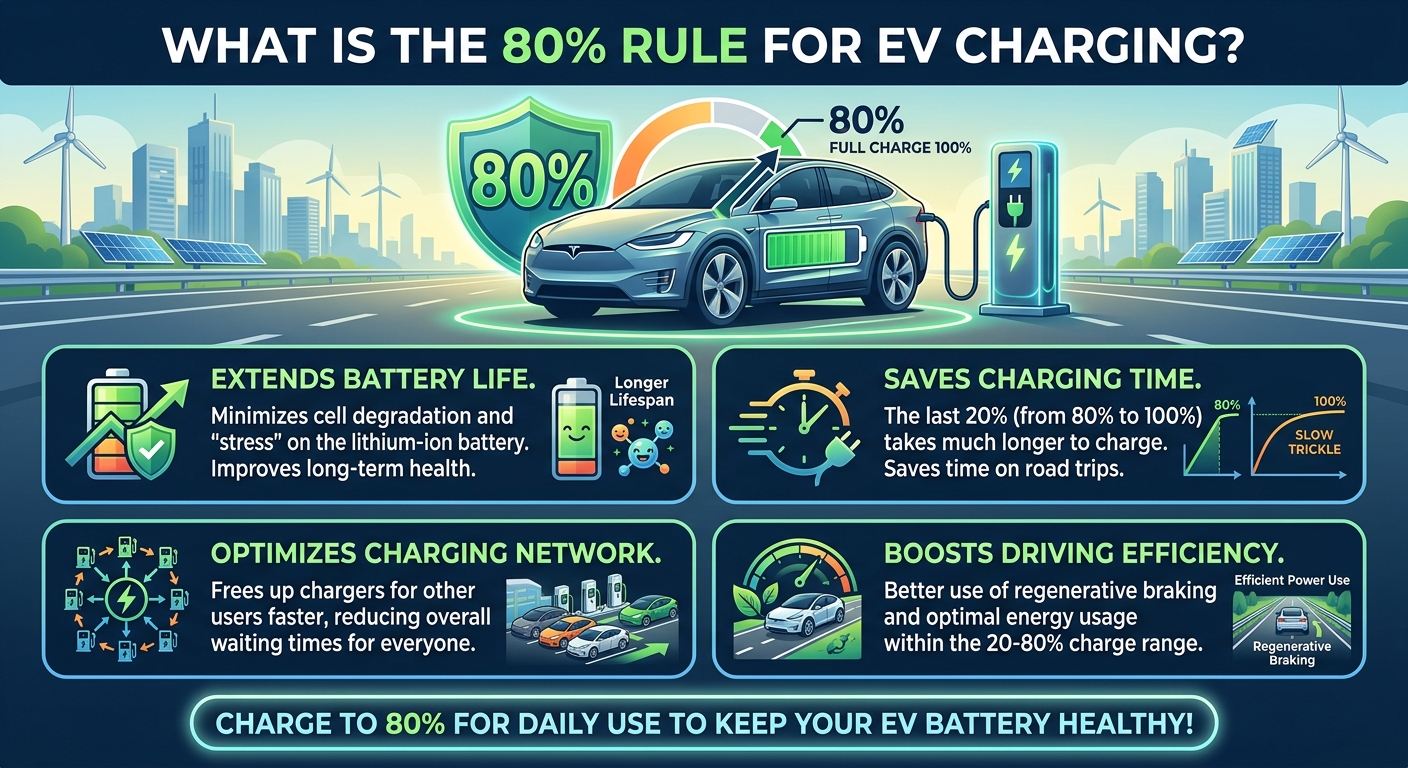
The short answer is: the 80% rule for EV charging is a operational guideline recommending that drivers cap their daily battery charge at 80% capacity (and avoid dropping below 20%) to preserve lithium-ion battery health, reduce thermal stress, and optimize public fast-charging speeds.
By operating primarily within a 20% to 80% State of Charge (SoC) window for routine daily commutes, EV owners significantly slow down chemical degradation without sacrificing daily driving usability.
For complete hardware reviews, installer guides, and panel load calculators, visit EV Charger Advisor.
1. The Dual Purpose Behind the 80% Rule
The 80% rule serves two critical electro-technical functions:
A. Preserving Long-Term Battery Health & Lifespan
Most modern EVs utilize Lithium Nickel Manganese Cobalt (NMC) or Lithium Nickel Cobalt Aluminum (NCA) battery chemistry.
-
High-Voltage Stress: Forcing a lithium-ion cell above 80% to 100% SoC subjects the internal cathode to high electrical potential, accelerating electrolyte oxidation and chemical degradation.
-
Low-SoC Stress: Conversely, letting the battery drop below 20% increases internal mechanical stress on the graphite anode. Keeping the battery between 20% and 80% minimizes thermal and mechanical expansion.
B. Optimizing Public DC Fast Charging Speeds
When using commercial DC Fast Chargers (DCFC) ranging from 50 kW to 350 kW, charging speed is not linear:
-
The “Theater Seating” Analogy: Going from 10% to 80% SoC takes as little as 18 to 25 minutes.
-
Thermal Throttling Past 80%: To protect the battery from overheating, the Vehicle Battery Management System (BMS) dramatically throttles charging speeds after 80%. Going from 80% to 100% can often take twice as long as going from 10% to 80%. Stopping at 80% saves substantial time and clears public chargers for other drivers.
To learn more about how charger power levels and wire sizes compare, check out our guide on EV charging types.
2. When Is It OK to Charge to 100%?
While the 80% rule applies to daily commuting, charging to 100% is entirely safe and intended under specific conditions:
-
Before Long Road Trips: Charge to 100% right before leaving on a long road trip so you can utilize the vehicle’s full rated range.
-
Lithium Iron Phosphate (LFP) Batteries: Vehicles equipped with LFP (LiFePO4) battery chemistries (found in standard-range Tesla Model 3s and various BYD models) operate at lower voltage thresholds and are less susceptible to high-SoC degradation. Manufacturers often recommend charging LFP batteries to 100% once a week to calibrate the BMS.
To explore Wi-Fi-enabled smart wallboxes engineered with adjustable charge limiters, read our guide on smart chargers.
Step-by-Step Mathematical Example: DC Fast Charging Time Comparison
Let us analyze the charging speed curve for an EV with a 77.4 kWh battery pack plugging into a 150 kW DC Fast Charger.
Given Parameters:
-
Total Battery Capacity: $77.4 \text{ kWh}$
-
Average Power Intake (10% to 80% SoC): $130 \text{ kW average}$
-
Average Power Intake (80% to 100% SoC): $25 \text{ kW throttled average}$
Calculation 1: Time Required to Charge from 10% to 80% ($70\% \text{ net delta}$)
Calculation 2: Time Required to Charge from 80% to 100% ($20\% \text{ net delta}$)
Calculation 3: Total Comparison
Result Breakdown: Adding 70% battery capacity (10% to 80%) takes only 25 minutes, whereas adding the final 20% (80% to 100%) takes 37.1 minutes. Stopping at 80% provides the optimal balance of range and time efficiency.
Comparison Table: Daily Battery SOC Management Guidelines
| State of Charge (SoC) Range | Usage Scenario | Impact on Battery Degradation | Fast Charging Efficiency |
| Below 20% | Emergency / Long travel | Increases anode mechanical stress | High power intake speed |
| 20% to 80% (Sweet Spot) | Daily Commuting / Routine | Minimal (Optimal cell health) | Peak charging efficiency |
| 80% to 100% | Road trips / Pre-trip prep | Higher chemical voltage stress | Throttled / Slow intake speed |
Summary & Key Takeaways
-
Caps Daily Degradation: The 80% rule keeps battery cells inside a low-stress voltage window during everyday commuting.
-
Saves Time at Public Chargers: DC fast charging speeds drop significantly past 80%, making it far faster to resume driving rather than waiting for 100%.
-
Charge to 100% for Road Trips: Charging to 100% is fine when you need full vehicle range for travel; just avoid letting the car sit at 100% for days.
-
LFP Batteries Are an Exception: LFP battery chemistries can handle regular 100% charging with minimal degradation impact.













Leave a Reply