
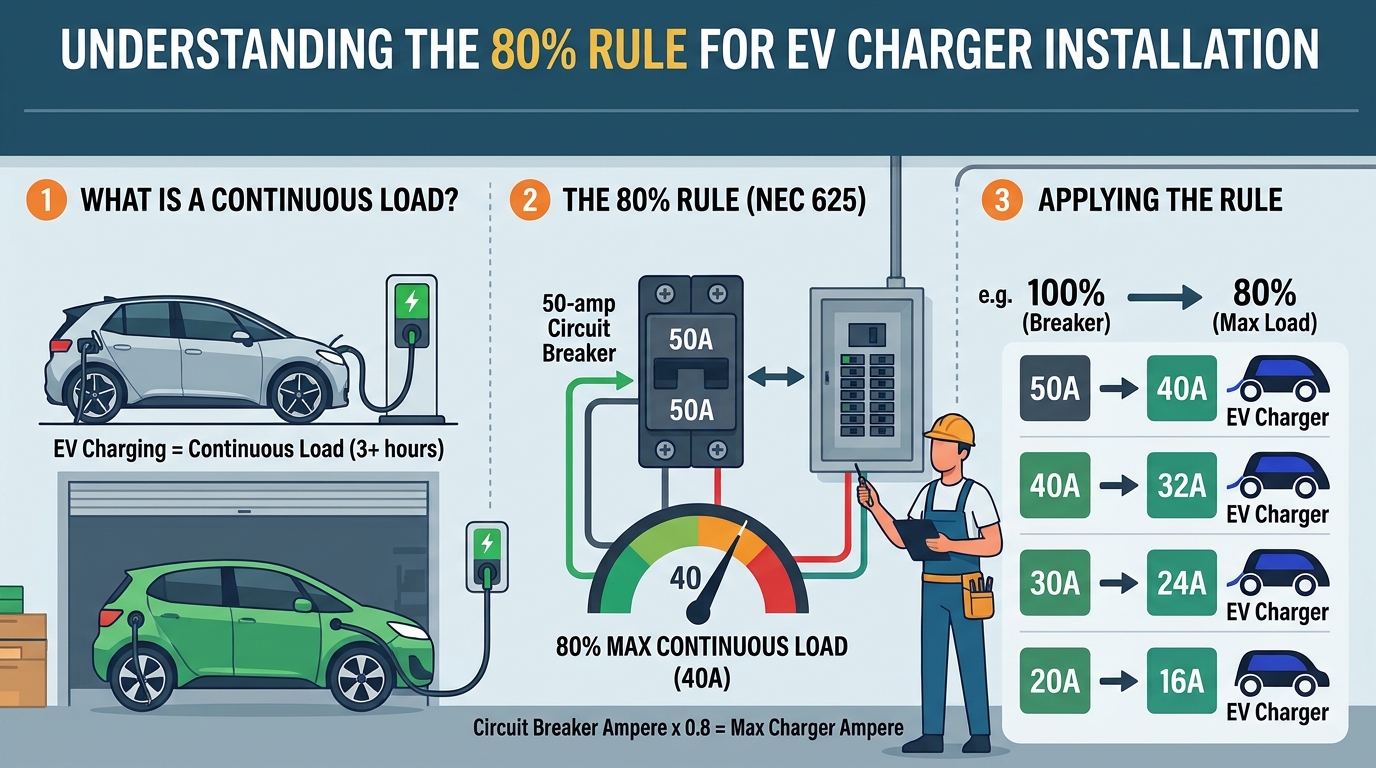
Transitioning to electric vehicle (EV) ownership brings silent operation, fast torque response, and low daily fuel costs. Operating over high-voltage 240-volt single-phase branch circuits, installing a home Level 2 charging station restores 20 to 44 miles of driving range per hour. However, as drivers configure their home charging speeds and manage vehicle battery life, they frequently encounter a fundamental concept known across the industry as the “80% Rule.”
When discussed in electric mobility, the 80% Rule serves a dual purpose: it is both a critical electrical safety code requirement (National Electrical Code NEC Article 625) and a daily battery health maintenance guideline.
Understanding how the 80% rule applies to both electrical circuit continuous loading and lithium-ion battery management ensures that your home charging setup is code-compliant, safe from thermal overloads, and optimized for long-term battery longevity.
For complete hardware reviews, installer guides, and panel load calculators, visit EV Charger Advisor.
1. The Electrical Code Meaning: NEC Continuous Load 80% Rule
Under the National Electrical Code (NEC Article 625.42), electric vehicle charging equipment is classified as a continuous load—defined as any electrical draw where peak current flows continuously for 3 hours or more.
A. The 125% Overcurrent Protection Math (80% Continuous Limit)
To prevent circuit breakers, conductors, and wall receptacles from suffering thermal degradation or nuisance tripping during sustained 6-to-10-hour charging sessions, the NEC mandates that a continuous load must not exceed 80% of the branch circuit breaker’s nameplate rating (or conversely, the breaker must be sized at 125% of the continuous load):
B. Standard Breaker vs. Continuous Amperage Thresholds
-
50-Amp Circuit Breaker: Safe continuous EV draw is 40 Amps ($9.60 \text{ kW}$ output).
-
60-Amp Circuit Breaker: Safe continuous EV draw is 48 Amps ($11.52 \text{ kW}$ output).
-
30-Amp Dryer Circuit: Safe continuous EV draw is 24 Amps ($5.76 \text{ kW}$ output).
Drawing 100% of a breaker’s rated capacity continuously for hours causes wire insulation breakdown, connection arcing, and extreme fire hazards.
To learn more about how charger power levels and wire sizes compare, check out our guide on EV charging types.
2. The Battery Health Meaning: The 20% to 80% Lithium-Ion Charge Window
Beyond electrical wiring, the “80% Rule” refers to recommended daily State of Charge (SoC) management for lithium-ion battery chemistries (NMC / NCA):
A. Preventing Chemical & Thermal Degradation
-
Daily Use Ceiling (80% Max): Charging a lithium-ion battery to 100% every night creates high voltage stress and thermal buildup inside the cells, accelerating internal capacity degradation. Limiting daily charging to 80% maximizes pack lifespan.
-
Reserving 100% for Road Trips: Charging to 100% is perfectly safe when done occasionally for long highway journeys, provided the vehicle is driven immediately after reaching full charge.
-
The Lithium Charging Curve: Charging from 20% to 80% proceeds at maximum AC speed. Beyond 80%, the vehicle’s Battery Management System (BMS) intentionally slows the charge rate to balance cell voltages safely.
To explore Wi-Fi-enabled smart wallboxes engineered with integrated load management features, read our guide on smart chargers.
Step-by-Step Mathematical Example: Circuit Sizing & Daily Charge Window Math
Let us perform a technical calculation to determine the required circuit breaker rating, conductor wire gauge, and daily charge session duration to add an 80% charge window (adding 48 kWh of net energy) to a 60 kWh EV battery pack using a 32-Amp continuous Level 2 wallbox ($240\text{V}$ supply) operating at 90% efficiency ($\eta = 0.90$).
Given Parameters:
-
Continuous EV Charger Current ($I_{\text{continuous}}$): $32 \text{ Amps}$
-
Supply Line Voltage ($V$): $240 \text{ Volts}$
-
Target Net Energy Replenishment ($E_{\text{net}}$): $60 \text{ kWh} \times 0.80 = \mathbf{48 \text{ kWh}}$
-
AC/DC Conversion Efficiency ($\eta$): $90\% \quad (0.90)$
Calculation 1: NEC Minimum Required Circuit Breaker Sizing (125% Rule)
-
Wire Conductor Specification: Requires a minimum of #8 AWG Copper Wire (THHN/THWN-2).
Calculation 2: Gross AC Power Output ($P_{\text{gross}}$)
Calculation 3: Net Power Delivered to Battery Cells ($P_{\text{net}}$)
Calculation 4: Session Duration to Reach the 80% Charge Limit ($T$)
Result Breakdown: Sizing a continuous 32A charger requires a dedicated 40A circuit breaker (#8 AWG copper wire), delivering 48 kWh (the 80% battery limit) in 6 hours and 56 minutes.
Comparison Table: Dual Definitions of the 80% Rule
| Parameter / Aspect | Electrical Code 80% Rule (NEC 625) | Battery Health 80% Rule (SoC) |
| Primary Domain | Electrical Wiring & Circuit Breakers | EV Lithium-Ion Battery Chemistry |
| Main Objective | Prevent electrical fires & thermal overloads | Prevent battery capacity degradation |
| Core Guideline | Limit continuous current to 80% of breaker rating | Limit daily charging target to 80% SoC |
| Example Rule | 48A continuous draw requires a 60A breaker | Charge to 80% daily; reserve 100% for long trips |
| Safety Standard | Mandatory Legal Requirement (NEC) | Manufacturer Recommended Best Practice |
Summary & Key Takeaways
-
Mandatory Electrical Safety: NEC rules dictate that continuous EV charging draw must never exceed 80% of the circuit breaker rating.
-
Proper Sizing Examples: A 48A charger needs a 60A breaker (#6 AWG copper), a 40A charger needs a 50A breaker, and a 32A charger needs a 40A breaker.
-
Protect Battery Health: Limit daily overnight AC charging targets to 80% State of Charge to minimize lithium-ion cell degradation.
-
Hardwire for Higher Power: Hardwiring 48A wallboxes directly eliminates plug contact wear while supporting full continuous Level 2 speeds.













Leave a Reply