
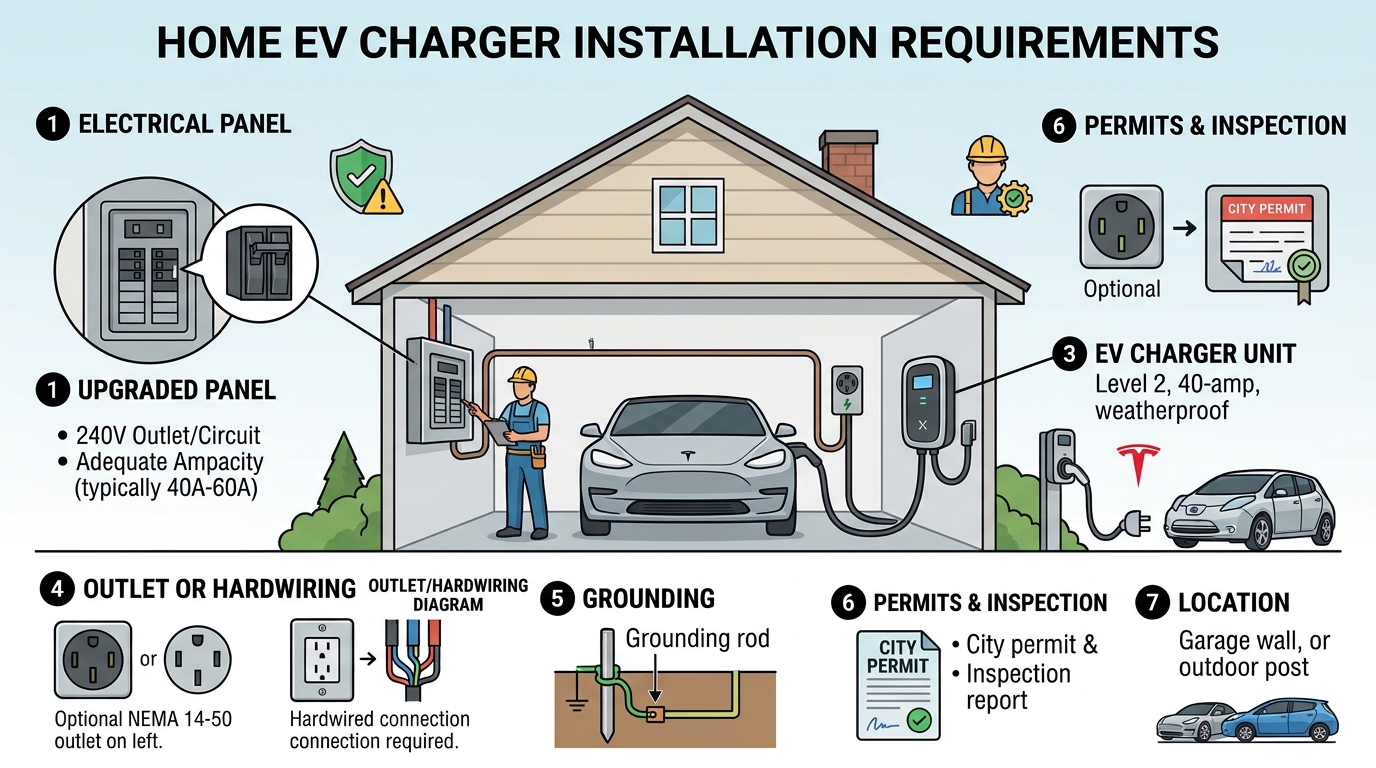
Transitioning to electric vehicle (EV) ownership brings silent operation, instant torque response, and significant daily fuel savings. Operating over a high-voltage 240-volt single-phase branch circuit, installing a home Level 2 charging station provides 20 to 44 miles of driving range per hour—drastically outpacing standard 120-volt wall outlets. However, successfully upgrading your garage or driveway for high-speed fueling involves more than just mounting a unit on the wall. A successful setup requires a dedicated parking space, an electrical load assessment, a compatible Level 2 charging unit, and a licensed electrician for safe wiring and circuit protection.
Under National Electrical Code (NEC Article 625) standards, satisfying physical placement rules, conductor wire sizing, overcurrent protection, and municipal permitting ensures your installation is safe, fully code-compliant, and built for long-term reliability.
For complete hardware reviews, installer guides, and panel load calculators, visit EV Charger Advisor.
1. The Four Essential Requirements for Home EV Charger Installation
To ensure a safe and code-compliant installation, your home setup must satisfy four primary criteria:
A. A Dedicated Parking Space & Physical Clearance
-
Cable Reach & Mounting Height: Standard EVSE charging cables range from 18 to 25 feet. Mount the wallbox close to where your vehicle’s charge port is parked to avoid straining cables or creating trip hazards.
-
NEC Mounting Rules: The wallbox must be mounted between 18 inches (indoors) or 24 inches (outdoors) and 48 inches above floor level to ensure safety and mechanical protection.
B. Electrical Load Assessment (Panel Capacity Check)
-
Service Panel Headroom: Electric vehicle charging is classified as a continuous load. Your main distribution panel (typically 100A, 150A, or 200A) must have sufficient spare capacity to support an extra heavy draw.
-
NEC Article 220 Calculations: An electrician performs a standard load calculation factoring in existing HVAC, water heating, and kitchen loads. If panel capacity is limited (e.g., on an older 100A panel), installing an Electric Vehicle Energy Management System (EVEMS) under NEC 625.42 allows dynamic load throttling to bypass an expensive $2,500–$5,000 main service panel upgrade.
C. Compatible Level 2 Charging Unit Selection
-
Plug-In vs. Hardwired: Choose between a plug-in unit (using a NEMA 14-50 receptacle) or a direct hardwired wallbox. Direct hardwiring supports higher charging speeds (up to 48A continuous), eliminates socket thermal degradation, and avoids the requirement for costly upstream 240V GFCI circuit breakers.
-
Smart Features: Select a Wi-Fi-enabled smart charger with Current Transformer (CT) clamps if you want automated Time-of-Use scheduling or solar-matching surplus diversion.
D. Licensed Electrician for Safe Wiring & Circuit Protection (NEC 125% Rule)
-
Dedicated Circuit Requirement: EV chargers cannot share a circuit with other household appliances. They require a dedicated double-pole circuit breaker.
-
Overcurrent Protection (NEC 625.42): Circuit breakers and wiring must be sized to 125% of the charger’s continuous current output:
-
48-Amp Continuous Charger ($11.52\text{ kW}$): Requires a 60-Amp double-pole breaker and #6 AWG copper conductors.
-
40-Amp Continuous Charger ($9.60\text{ kW}$): Requires a 50-Amp double-pole breaker and #6 AWG copper conductors.
-
32-Amp Continuous Charger ($7.68\text{ kW}$): Requires a 40-Amp double-pole breaker and #8 AWG copper conductors.
-
To learn more about how charger power levels and wire sizes compare, check out our guide on EV charging types.
Step-by-Step Mathematical Example: Dedicated Circuit Sizing & Voltage Drop Calculation
Let us perform a technical calculation to determine the required circuit breaker rating, gross power output, percentage voltage drop ($\Delta V$), and charging duration to add 40 kWh of energy to an EV using a 48-Amp Continuous Level 2 Charger ($240\text{V}$ supply) running 55 feet ($16.76\text{ m}$) on #6 AWG Copper Wire ($R = 0.000491 \Omega/\text{ft}$) at 90% efficiency ($\eta = 0.90$).
Given Parameters:
-
Continuous EV Charger Draw ($I$): $48 \text{ Amps}$
-
Supply Voltage ($V$): $240 \text{ Volts}$
-
One-Way Cable Length ($L$): $55 \text{ feet}$
-
Conductor Resistance for #6 AWG Copper ($R_{\text{wire}}$): $0.000491 \Omega \text{ per foot}$
-
Target Net Energy Replenishment ($E_{\text{net}}$): $40 \text{ kWh}$
-
Conversion Efficiency ($\eta$): $90\% \quad (0.90)$
Calculation 1: Circuit Breaker Rating (NEC 125% Continuous Rule)
Calculation 2: Continuous Gross AC Power Output ($P_{\text{gross}}$)
Calculation 3: Net Power Delivered to Battery Cells ($P_{\text{net}}$)
Calculation 4: Voltage Drop ($\Delta V$) Math
For a single-phase 240V circuit ($2 \times L = 110\text{ ft}$ total conductor loop path):
Calculation 5: Required Charging Session Duration ($T$)
Result Breakdown: Installing a 48A continuous Level 2 charger requires a dedicated 60A double-pole breaker and #6 AWG copper wire, delivering 40 kWh of usable range in 3 hours and 51 minutes with an excellent 1.08% voltage drop.
Comparison Table: Home EV Charger Installation Requirements Matrix
| Installation Component | Technical Parameter | NEC Code Rule / Specification |
| Parking Space & Mount | Indoor / Outdoor Wall Clearance | Mounted 18” to 48” above floor level |
| Electrical Load Check | Main Service Panel Capacity | NEC Article 220 Load Calculation (EVEMS if needed) |
| Branch Circuit Sizing | Continuous Duty Protection | NEC 625.42 (125% Rule: 60A breaker for 48A draw) |
| Conductor Wiring | Copper Wire Gauge | #6 AWG (THHN/THWN-2) for 48A/60A circuits |
| Permitting & Safety | Local Electrical Inspection | Mandatory municipal permit & certified electrician |
Summary & Key Takeaways
-
Assess Panel Capacity First: Always perform an electrical load assessment to verify your main panel has sufficient amperage headroom.
-
Follow the NEC 125% Rule: Sizing for a continuous 48A charger requires a dedicated 60A double-pole breaker and #6 AWG copper conductors.
-
Hire a Licensed Electrician: Ensure safe installation, proper torque connections, and compliance with local municipal electrical codes.
-
Hardwiring Is Recommended: Hardwiring supports maximum 48A ($11.52\text{ kW}$) speeds while eliminating plug wear and expensive GFCI breaker requirements.













Leave a Reply