
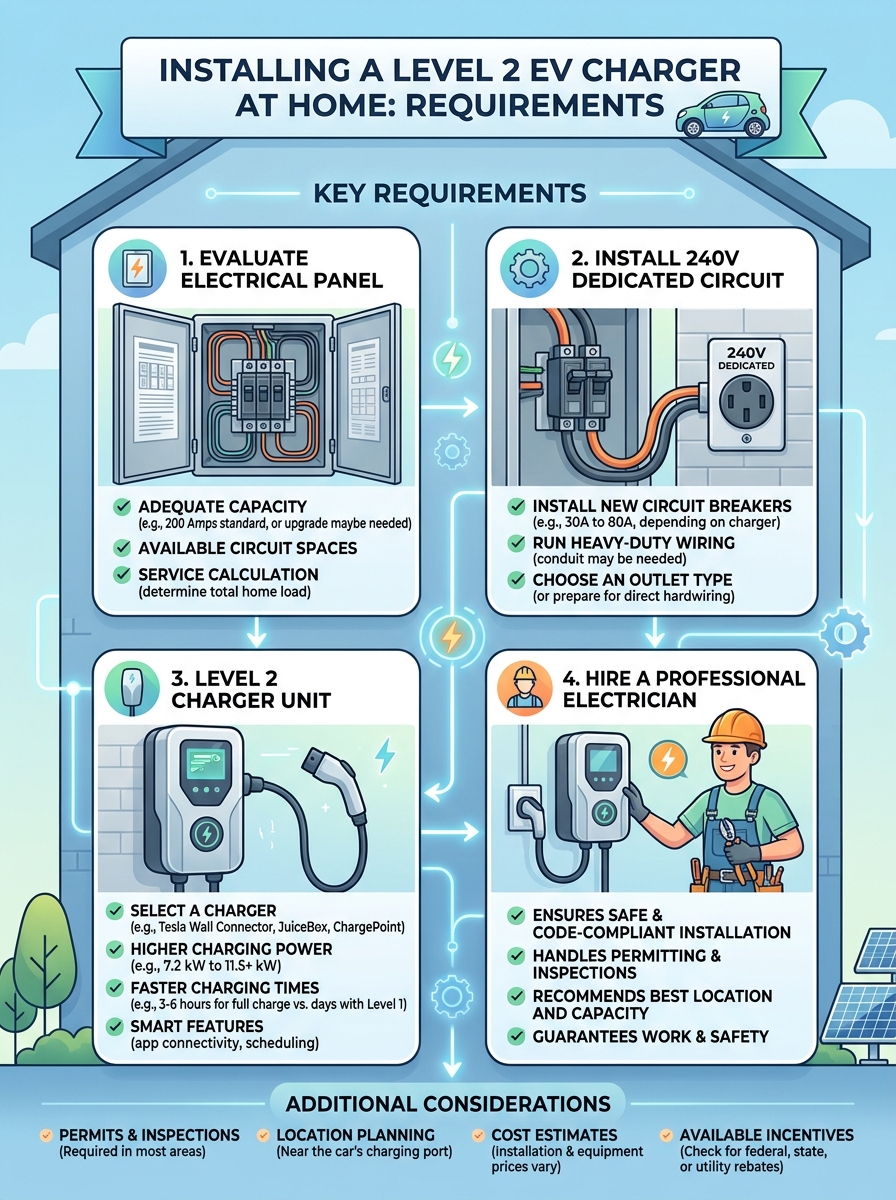
Upgrading to a Level 2 residential charging station is the most effective way to optimize home electric vehicle (EV) ownership. Delivering 20 to 44 miles of driving range per hour over a 240-volt single-phase branch circuit, Level 2 charging outperforms standard 120-volt wall outlets. Establishing this dedicated infrastructure requires evaluating home electrical capacity, acquiring listed hardware, and adhering to strict electrical safety protocols.
Installing a home Level 2 EV charger requires a 240-volt electrical circuit, a compatible charger unit, a licensed electrician, and sufficient electrical panel capacity.
Under National Electrical Code (NEC Article 625) standards, satisfying main service panel load calculations, conductor wire sizing, overcurrent protection, and municipal permitting ensures that home charging infrastructure operates safely and efficiently.
For complete hardware reviews, installer guides, and panel load calculators, visit EV Charger Advisor.
1. The Core Infrastructure Requirements
A successful residential Level 2 installation depends on four primary electrical and physical requirements:
A. Sufficient Electrical Panel Capacity
-
Panel Amperage Check: EV charging operates as a heavy continuous load. Your main distribution panel (typically 100A, 150A, or 200A) must have adequate spare capacity to support continuous high-amperage power draw.
-
NEC Article 220 Load Calculation: A licensed electrician performs an electrical load calculation accounting for existing HVAC, water heating, and kitchen loads. If panel headroom is limited (e.g., on a 100A service), installing an Electric Vehicle Energy Management System (EVEMS) under NEC 625.42 enables dynamic load throttling, bypassing an expensive main service panel upgrade.
B. Dedicated 240-Volt Branch Circuit
-
Dedicated Circuit Rule: EV chargers cannot share a branch circuit with other home appliances. They require an isolated double-pole circuit breaker.
-
Overcurrent Protection (NEC 125% Rule): Pursuant to NEC 625.42, circuit breakers and conductor wiring must be sized to 125% of the charger’s continuous current draw:
-
48-Amp Continuous Charger (11.52 kW): Requires a dedicated 60-Amp double-pole circuit breaker and #6 AWG copper conductors.
-
40-Amp Continuous Charger (9.60 kW): Requires a dedicated 50-Amp double-pole circuit breaker and #6 AWG copper conductors.
-
32-Amp Continuous Charger (7.68 kW): Requires a dedicated 40-Amp double-pole circuit breaker and #8 AWG copper conductors.
-
C. Compatible Level 2 Charger Unit
-
Hardwired vs. Plug-In Receptacles: Plug-in units (NEMA 14-50 / 6-50) offer portability but cap continuous output at 40 Amps (9.60 kW). Direct hardwiring supports maximum 48-Amp continuous output (11.52 kW), eliminates wall socket contact wear, and avoids the requirement for expensive upstream 240V GFCI circuit breakers.
-
Safety Certification: Ensure the wallbox is tested and listed by a Nationally Recognized Testing Laboratory (NRTL) such as UL or ETL.
D. Licensed Electrician & Municipal Permitting
-
Professional Installation: A licensed electrician manages load calculations, heavy wire routing, panel breaker installation, and proper torque specifications.
-
Permits and Inspections: Most local jurisdictions require an electrical permit and a post-installation safety inspection by a certified building official to maintain insurance and warranty compliance.
To learn more about how charger power levels and wire sizes compare, check out our guide on EV charging types.
2. Physical & Location Requirements
Physical installation parameters must comply with NEC guidelines to maintain usability and hardware protection:
-
Mounting Height Standard: Wallboxes must be mounted between 18 inches (indoors) or 24 inches (outdoors) and 48 inches above floor level for safety and accessibility.
-
Cable Reach: Standard charging cables span 18 to 25 feet. Position the charger so the cable comfortably reaches the vehicle charge port without creating trip hazards or strain.
-
Weatherproofing Ratings: Outdoor installations require wallboxes rated NEMA 3R or NEMA 4 (IP65+) to protect internal control electronics from rain, snow, and extreme ambient temperatures.
To explore Wi-Fi-enabled smart wallboxes engineered with integrated load management features, read our guide on smart chargers.
3. Practical Charging Performance Metrics
Matching hardware configurations to daily driving needs helps optimize overall installation costs:
A. 32-Amp Level 2 Setup (40A Breaker / #8 AWG Copper Wire)
-
Continuous Power Output: 7.68 kW
-
Replenishment Rate: Adds 20 to 28 miles of range per hour
-
Time to Add 45 kWh: Approximately 5 Hours and 50 Minutes
B. 48-Amp Level 2 Hardwired Setup (60A Breaker / #6 AWG Copper Wire)
-
Continuous Power Output: 11.52 kW
-
Replenishment Rate: Adds 36 to 44 miles of range per hour
-
Time to Add 45 kWh: Approximately 3 Hours and 55 Minutes
-
Circuit Efficiency: Installed with #6 AWG copper conductors over standard distances, the circuit operates with less than 1% total voltage drop—well within the NEC 3% efficiency limit.
Comparison Table: Level 2 Installation Requirements Matrix
| Installation Factor | Plug-In Level 2 Setup | Hardwired Level 2 Setup |
| Circuit Voltage | 240V Single-Phase | 240V Single-Phase |
| Connection Type | Industrial NEMA 14-50 / 6-50 Outlet | Direct Hardwired Terminal Block |
| Max Continuous Current | 40 Amps (80% Rule) | 48 Amps Continuous |
| Max Power Output | 9.60 kW | 11.52 kW |
| Required Circuit Breaker | 50A Double-Pole Breaker | 60A Double-Pole Breaker |
| Conductor Gauge | #6 AWG Copper Wire | #6 AWG Copper Wire |
| GFCI Breaker Needed? | YES (NEC 625.54) | NO (Internal Wallbox GFCI) |
| Installer Requirement | Licensed Electrician | Licensed Electrician |
Summary & Key Takeaways
-
Four Core Requirements: Level 2 home charging requires adequate panel capacity, a dedicated 240V circuit, a listed charger unit, and a licensed electrician.
-
Follow the NEC 125% Rule: Sizing a 48A continuous charger requires a dedicated 60A double-pole circuit breaker and #6 AWG copper conductors.
-
Hardwiring Is Recommended: Direct hardwiring supports maximum 11.52 kW output while eliminating socket contact wear and upstream GFCI breaker costs.
-
Obtain Permits: Always secure municipal electrical permits and schedule official inspections to verify code compliance.













Leave a Reply