
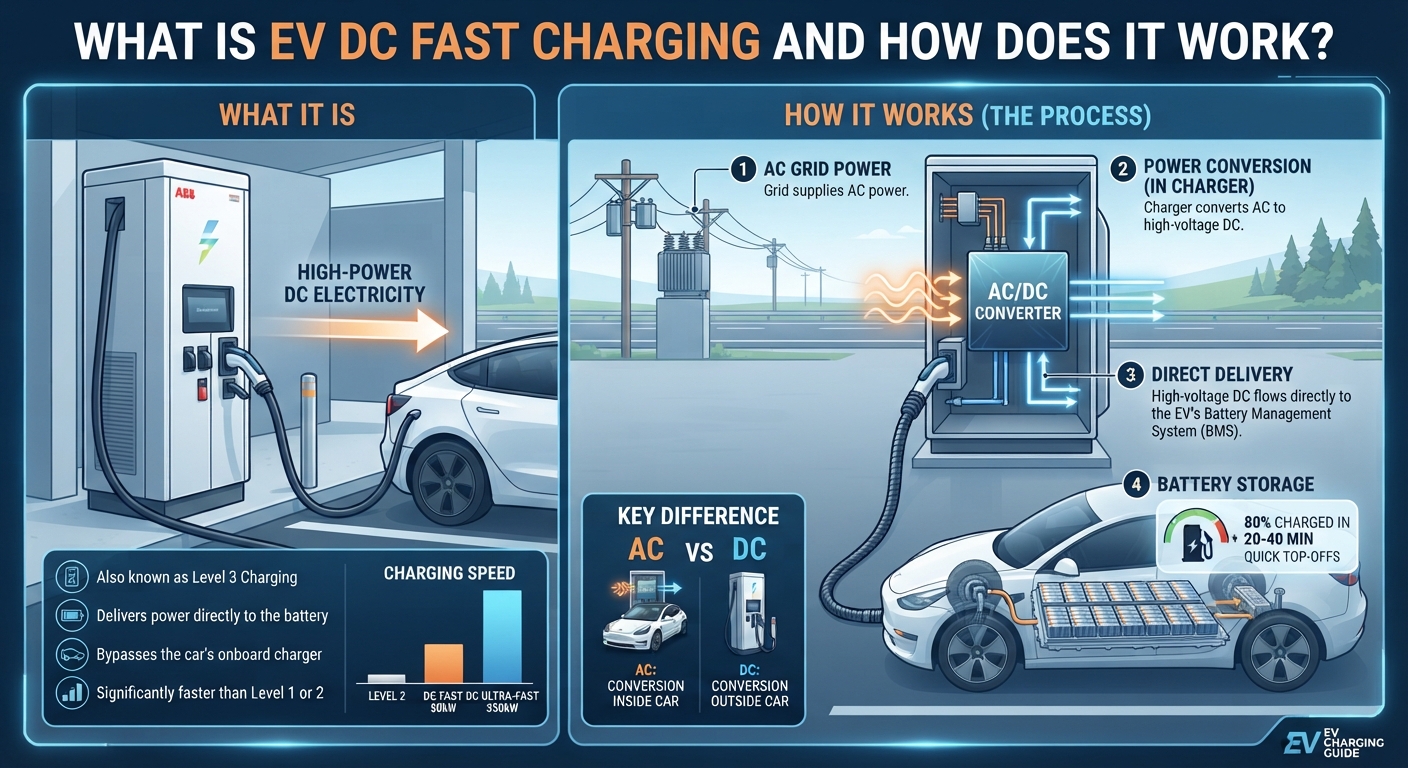
DC fast charging, also called Level 3 charging, is the quickest way to charge an electric vehicle. The charging station converts grid power into direct current (DC) and sends it straight to your battery, bypassing the car’s onboard charger. Most stations deliver between 50 kW and 350 kW, and many EVs can go from 10% to 80% in roughly 20 to 45 minutes, depending on the car and the charger.
What Is DC Fast Charging?
Your EV battery stores energy as direct current (DC), but the power grid delivers alternating current (AC). Every charging method has to convert AC to DC somewhere.
- With AC charging (Level 1 and Level 2), the conversion happens inside your car, in a component called the onboard charger. That charger limits how fast you can charge.
- With DC fast charging, the conversion happens inside the station itself. The station can be much larger and more powerful than anything built into a car, so it can deliver far more power.
That difference is why DC fast charging is built for road trips and quick stops, while Level 2 suits overnight charging at home.
How Does DC Fast Charging Work?
- You plug in. The connector links your car to the station. Common connector types are CCS, NACS and, on some older cars, CHAdeMO.
- The car and station communicate. They exchange information about battery voltage, temperature and how much power the car can safely accept.
- The station converts power. Equipment inside the charger turns grid AC into high-voltage DC.
- Power flows to the battery. The car’s battery management system controls how much current it requests, and the station supplies it.
- Speed adjusts during the session. Charging usually starts fast, then slows as the battery fills.
- You stop charging. Most drivers unplug around 80% on a road trip.
Level 1 vs. Level 2 vs. DC Fast Charging
| Feature | Level 1 | Level 2 | DC fast charging |
|---|---|---|---|
| Power type | AC | AC | DC |
| Typical power | About 1.2–1.8 kW | About 7–19 kW | 50–350+ kW |
| Where the conversion happens | Inside the car | Inside the car | Inside the station |
| Best for | Slow overnight top-ups | Daily home or work charging | Road trips and quick stops |
For more on the slower options, see our Level 1 charging and Level 2 charging guides.
How Fast Is DC Fast Charging?
Stations come in different power tiers. These times are for charging to about 80% on many EVs, and they vary a lot by car:
| Station power | What to expect |
|---|---|
| 50 kW | Slower and older; often 45–90 minutes to reach 80% on many EVs |
| 100–150 kW | Common at newer sites; roughly 20–40 minutes to 80% |
| 200–350 kW | Ultra-fast; 10–20 minutes for 10–80% in ideal conditions, on compatible cars |
What Limits Your Charging Speed?
A fast station doesn’t guarantee a fast session. Four things matter:
- Your car’s maximum charging rate. A car that accepts 150 kW won’t charge faster on a 350 kW station.
- The charger’s real output. Some stations share power between ports or deliver less than their rated maximum.
- Battery state of charge. Speed is usually highest at low charge levels and drops as the battery fills.
- Battery temperature. Cold or very hot batteries charge more slowly to protect the cells.
Why Does Charging Slow Down After 80%?
The battery management system reduces the current as the battery fills, to protect cell health and prevent overheating. On many EVs, going from 80% to 100% takes as long as going from 20% to 80%. On a road trip, it’s usually faster to charge to about 80% and drive on than to wait for a full charge.
Is DC Fast Charging Bad for Your Battery?
Occasional fast charging is fine and is what these systems are designed for. Using it all the time can add stress and may speed up battery wear over many years. A common approach is:
- Charge at home on Level 2 for daily driving.
- Use DC fast charging mainly for longer trips.
- Avoid charging to 100% at a fast charger unless you need the range.
How Much Does DC Fast Charging Cost?
Public fast charging usually costs more per kWh than charging at home. Some US examples run roughly 30 to 48 cents per kWh, but prices vary by network, location and time of day. Compare that with home electricity, which often costs much less per kWh. Check the price in the charging app before you plug in.
Can You Install a DC Fast Charger at Home?
Almost never. DC fast chargers need very high power and expensive equipment, so they’re mainly installed at highway sites, retail locations and businesses. Home charging uses AC, usually with a Level 2 charger. See our guides on how much it costs to install an EV charger and whether a Level 2 charger is worth it.
Tips for Using DC Fast Chargers
- Check the connector type and power rating before you go.
- Arrive with a lower charge. Batteries charge fastest at low levels, so arriving at 10–20% saves time.
- Precondition the battery if your car offers it, especially in cold weather.
- Stop around 80% on road trips.
- Watch the charging curve in your car or app, and unplug when the speed drops sharply.
Frequently Asked Questions
What is DC fast charging?
It’s a type of EV charging that delivers direct current straight to the battery, bypassing the car’s onboard charger, at typically 50 kW to 350 kW.
Is DC fast charging the same as Level 3?
Yes. People often use the terms DC fast charging, Level 3 charging and rapid charging for the same thing.
How does DC fast charging work?
The station converts grid AC to DC and sends it directly to the battery. The car’s battery management system controls how much power it accepts.
How long does DC fast charging take?
Many EVs go from 10% to 80% in about 20 to 45 minutes. The exact time depends on the car, the station and the battery temperature.
Why does DC fast charging slow down at 80%?
The battery management system cuts the charging rate as the battery fills, to protect the cells and prevent overheating.
Is DC fast charging bad for my EV battery?
Occasional use is fine. Frequent use may add wear over time, so many owners rely on home charging for everyday needs.
How much does DC fast charging cost?
It usually costs more per kWh than home charging. Prices vary by network and location.
Can all EVs use DC fast charging?
Most modern battery-electric cars can, but some plug-in hybrids and older models can’t. Check your car’s specs and connector type.
Final Takeaway
DC fast charging works by converting power at the station and feeding DC directly into your battery, which is why it’s so much quicker than home charging. Your car’s limits, the battery’s charge level and temperature all affect real speeds. Use fast charging for trips and Level 2 at home for everyday driving.
Have a question about your charging setup? Contact us, or explore our DC fast charging guides and charging types articles.
Disclaimer: Charging speeds and prices vary by vehicle, charger, network and conditions. Check your car’s manual for its charging limits.





Leave a Reply