
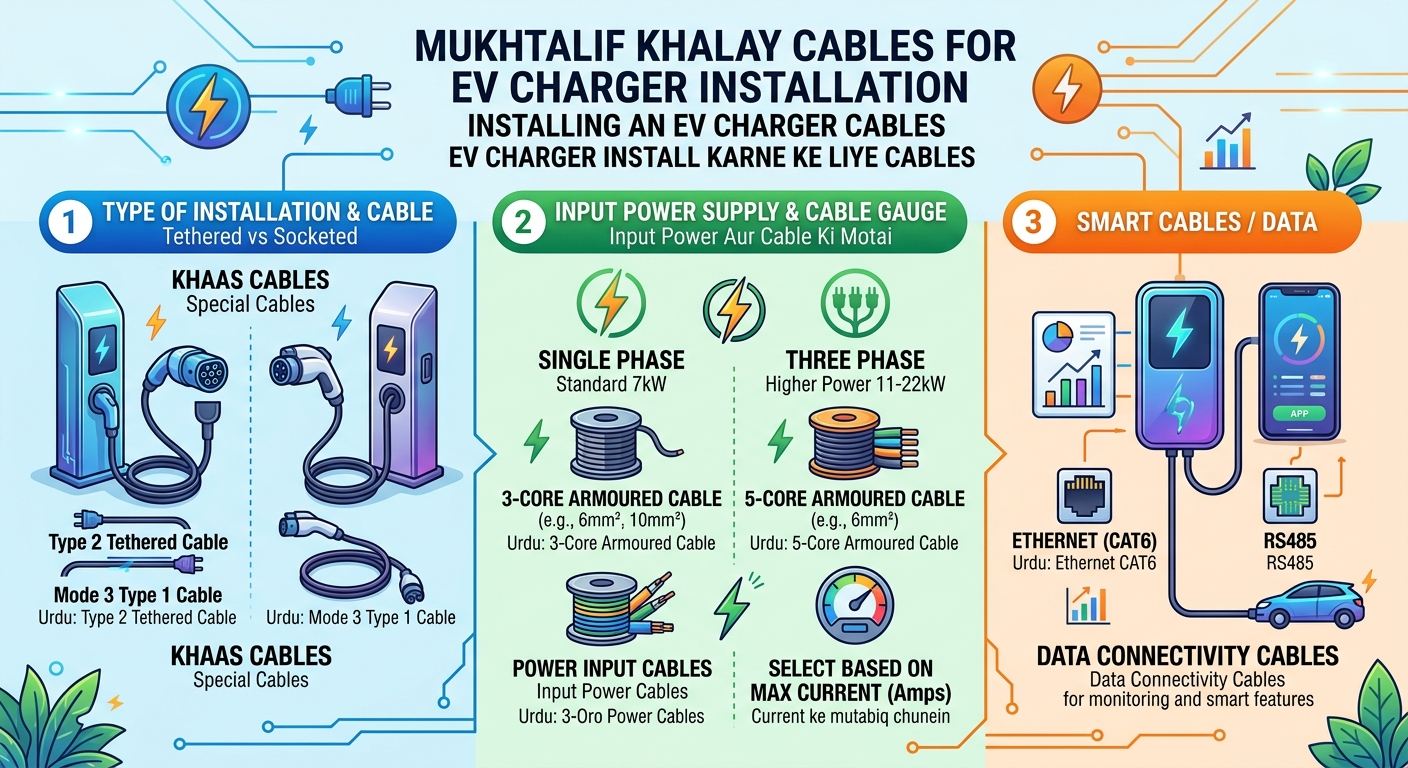
Upgrading your home to support a Level 2 electric vehicle (EV) charger requires running a dedicated high-voltage (240V) branch circuit from your main electrical panel directly to your charging location. Choosing the correct electrical wiring is critical—an undersized cable will overheat, melt terminal connectors, trip circuit breakers, and create severe fire hazards.
To install a home EV charger safely, you need a dedicated heavy-gauge copper conductor sized specifically according to your charger’s continuous power output, circuit breaker amperage, and distance from your electrical panel. Additionally, if you choose a socket-style charger or untethered wallbox, you will need a compatible Type 2 or NACS connector cable to link the wall unit to your vehicle’s charging port.
Understanding cable types, copper wire gauges, and National Electrical Code (NEC) standards ensures a safe, code-compliant home charging installation.
For comprehensive hardware breakdowns, wire gauge charts, and installer guides, visit EV Charger Advisor.
1. Electrical Supply Cable: Sizing the Wire Gauge (AWG)
The primary cable in an EV charger installation is the building wire that delivers high-voltage power from your main breaker panel to the charger wallbox. Under NEC Article 625, EV charging is legally classified as a continuous load (drawing 100% power for 3 hours or longer). Consequently, electrical wires and circuit breakers must be sized to 125% of the charger’s output rating.
Below is the standard copper wire gauge chart based on American Wire Gauge (AWG) standards for residential 240V Level 2 setups:
| Charger Output (Amps) | Required Breaker Size | Wire Gauge (THHN in Conduit) | Wire Gauge (NM-B / Romex) | Usable Power @ 240V |
| 16 Amps | 20 Amps | #12 AWG Copper | #12 AWG Copper | $3.8 \text{ kW}$ |
| 24 Amps | 30 Amps | #10 AWG Copper | #10 AWG Copper | $5.7 \text{ kW}$ |
| 32 Amps | 40 Amps | #8 AWG Copper | #8 AWG Copper | $7.7 \text{ kW}$ |
| 40 Amps | 50 Amps | #6 AWG Copper | #6 AWG Copper | $9.6 \text{ kW}$ |
| 48 Amps | 60 Amps | #6 AWG Copper (75°C) | #4 AWG Copper (60°C) | $11.5 \text{ kW}$ |
Critical Cable Insulation Types (THHN vs. NM-B / Romex):
-
THHN / THWN-2 Conductors in Conduit: Individual insulated copper wires pulled through PVC or metal conduit. Rated at 75°C terminal temperature, #6 AWG THHN copper wire is the industry standard for 60-Amp circuits ($48\text{A}$ continuous charging).
-
NM-B (Romex) Sheathed Cable: Standard interior non-metallic cable. Because building codes limit NM-B to the 60°C thermal column ($55\text{A}$ max for #6 AWG), running a 60A circuit on NM-B Romex requires stepping up to thicker #4 AWG copper wire.
To learn more about how charger power ratings and plug styles compare, check out our guide on EV charging types.
2. Distance & Voltage Drop Math: Upsizing Wire for Long Runs
When electrical current travels through long copper wires, electrical resistance creates a gradual reduction in delivered voltage (known as voltage drop). Electrical codes recommend keeping total branch circuit voltage drop under 3% to prevent charger thermal shutdown or efficiency loss.
For cable runs exceeding 100 feet ($30\text{ meters}$) from your main panel, you must upsize the conductor wire gauge by one level.
Step-by-Step Mathematical Example: Voltage Drop Calculation
Let us calculate the single-phase 240V voltage drop for a 40-Amp continuous Level 2 charger installed on #6 AWG copper wire over a 150-foot run.
Given Parameters:
-
Continuous Load ($I$): $40 \text{ Amps}$
-
One-Way Cable Distance ($L$): $150 \text{ feet}$
-
Supply Voltage ($V$): $240 \text{ Volts}$
-
Copper Conductor Resistance ($R$ for #6 AWG): $\approx 0.491 \text{ Ohms per 1,000 feet}$
Calculation 1: Calculating Total Cable Circuit Length (Out and Back)
Calculation 2: Calculating Voltage Drop ($\Delta V$)
Calculation 3: Calculating Percentage Voltage Drop
Result Breakdown: At 150 feet, the voltage drop is 2.45%, which sits comfortably under the 3.0% maximum threshold. If the run extended to 200 feet ($3.27\%$ drop), the electrician would be required to upsize from #6 AWG to #4 AWG copper wire.
3. Vehicle Charging Connector Cable: Tethered vs. Socket (Type 2)
Beyond the building power wiring running inside your wall, you must consider the flexible charging cable that plugs into your car:
1. Tethered Wallboxes (Attached Cable)
Most residential Level 2 chargers come with a permanently attached 18-foot to 25-foot heavy-duty charging cable equipped with a Type 2 (IEC 62196), CCS2, GB/T, or NACS (SAE J3400) vehicle connector.
2. Socket-Style Untethered Wallboxes
Popular in public commercial setups and European/Pakistani residential installs, socket chargers feature a universal AC port on the front faceplate. Owners must supply a separate Type 2 to Type 2 spiral or straight charging cable rated for either 32-Amp Single-Phase ($7.4\text{ kW}$) or 32-Amp Three-Phase ($22\text{ kW}$) power transfer.
To explore Wi-Fi-enabled smart wallboxes that support dynamic power adjustment, read our guide on smart chargers.
Cable Selection Summary Checklist
| Component | Standard Requirement | Recommended Specs |
| Circuit Breaker | Rated at 125% of continuous charger amps | Double-pole 40A, 50A, or 60A breaker |
| Conductor Material | Solid or Stranded Annealed Copper | Copper wire only (Avoid aluminum for branch runs) |
| Conduit Wire (THHN) | 75°C / 90°C wet/dry rated insulation | #6 AWG THHN Copper for 60A breakers |
| Wall Cable (NM-B) | 60°C thermal column limitation | #4 AWG NM-B Romex for 60A breakers |
| Vehicle Plug Cable | Matches vehicle inlet port standard | Heavy-duty Type 2 or NACS cable ($18\text{k} – 25\text{ft}$) |
Summary & Key Takeaways
-
Size for Continuous Load: EV chargers draw maximum current for hours; power cables and circuit breakers must be rated for 125% of continuous charger output.
-
Use #6 AWG Copper for High-Speed Charging: A 48A charger on a 60A breaker requires #6 AWG copper THHN wire inside conduit.
-
Account for Distance: If your charger is located more than 100–120 feet away from your main panel, upsize the wire gauge to prevent performance-robbing voltage drop.
-
Choose the Right Vehicle Connector: Ensure your wallbox features an attached or detachable Type 2 or NACS cable compatible with your EV’s onboard charging port.













Leave a Reply