
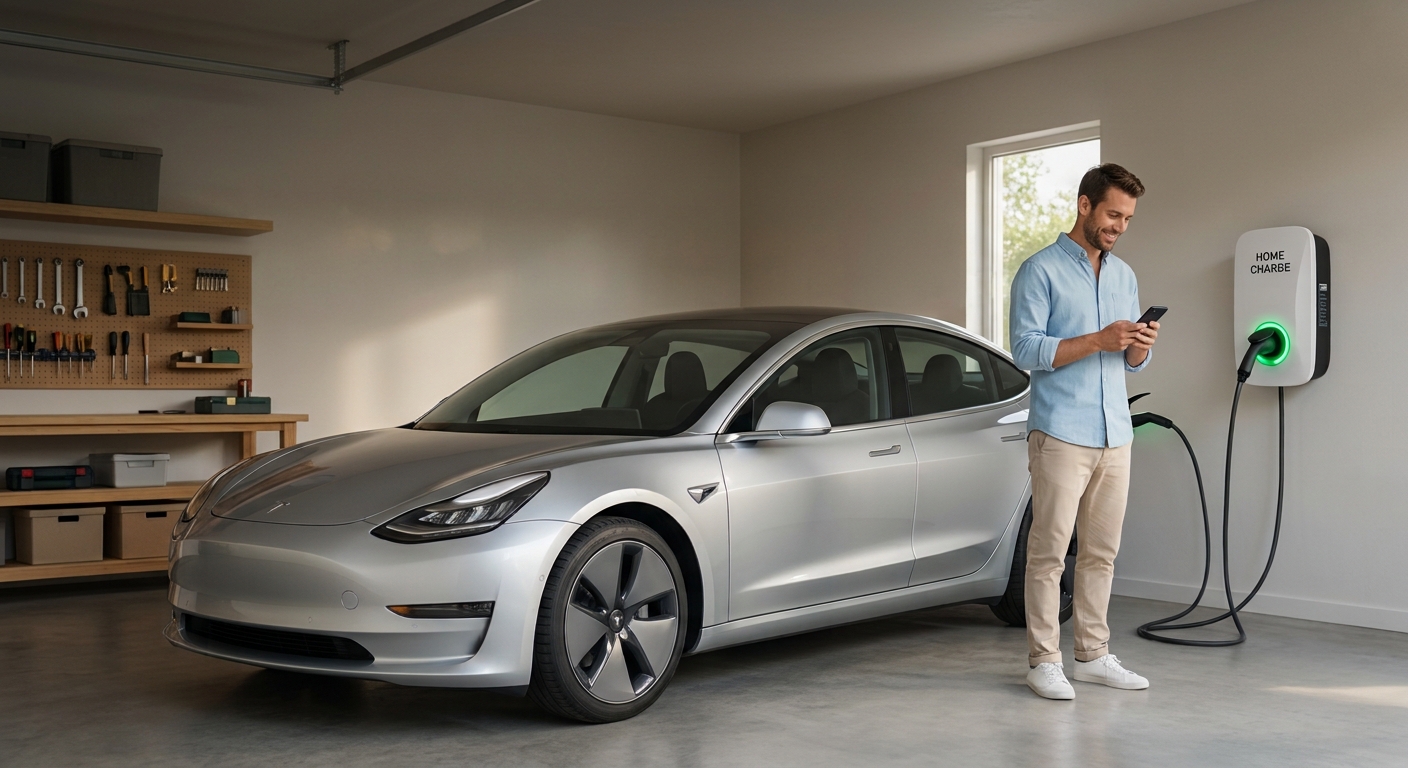
Switching to an electric vehicle (EV) unlocks substantial savings on daily fuel costs, whisper-quiet performance, and zero local tailpipe emissions. Operating on a high-voltage 240-volt single-phase supply, dedicated Level 2 wallboxes deliver 20 to 44 miles of driving range per hour, transforming battery replenishment into an effortless overnight routine. However, as prospective EV owners evaluate equipment costs and electrical panel upgrades, a primary practical question arises: What are the benefits of installing an EV charging station at home?
The short answer is: installing an EV charging station at home provides unmatched daily convenience, lower electricity costs via off-peak residential tariffs, significantly faster charging speeds compared to standard wall outlets, enhanced battery longevity, and smart energy management features.
Having private charging infrastructure at your doorstep eliminates reliance on public charging networks, protects your vehicle’s battery health, and maximizes your overall return on investment.
For complete hardware reviews, installer guides, and panel load calculators, visit EV Charger Advisor.
1. Four Primary Advantages of Residential EV Charging
Setting up a private Level 2 wallbox yields distinct operational, financial, and technical benefits:
A. Unmatched Daily Convenience & Time Savings
Instead of driving out of your way to find open public charging hubs or waiting in queues, home charging allows you to simply plug in when you park. You wake up every morning with a fully replenished battery, effectively turning your garage or driveway into a private fueling station.
B. Lower Fuel Costs & Off-Peak Utility Savings
Public DC fast chargers frequently charge premium rates per kilowatt-hour ($\text{kWh}$) to cover operating overhead. In contrast, home charging utilizes lower residential energy tariffs. By scheduling charging during overnight Time-of-Use (TOU) off-peak hours, homeowners can cut charging expenses by 50% to 70% compared to public stations.
C. 3x to 8x Faster Charging Speeds
Standard Level 1 trickle chargers (120V / 12A wall outlets) add only 3 to 5 miles of range per hour, taking up to 30 to 40 hours for a full recharge. A dedicated Level 2 wallbox (240V / 32A to 48A) restores 25 to 44 miles per hour, completing a full 10% to 90% recharge in 5 to 8 hours overnight.
D. Smart Energy & Solar Integration
Modern Wi-Fi-enabled smart chargers allow you to monitor power usage, lock hardware via mobile apps, and automatically sync charging windows with home solar PV systems to charge your vehicle using 100% clean, self-generated energy.
To learn more about how charger power levels compare, check out our guide on EV charging types.
2. Preserving Battery Longevity & Home Property Value
Beyond speed and cost, home Level 2 charging provides long-term technical advantages:
-
Protects Battery Cell Health: Frequent use of public DC fast chargers (100 kW to 350 kW) subjects lithium-ion cells to high thermal stress. Steady AC Level 2 home charging (7.4 kW to 11.5 kW) delivers gentle thermal management, preserving long-term battery capacity and range.
-
Increases Property Appeal: Equipping a home with a code-compliant 240V charging circuit (NEC Article 625) future-proofs the building and boosts residential property value as EV adoption grows.
To explore Wi-Fi-enabled smart wallboxes engineered with off-peak schedule timers, read our guide on smart chargers.
Step-by-Step Mathematical Example: Annual Cost Savings Math (Home vs. Public Charging)
Let us calculate the annual financial savings for an EV driver commuting 12,000 miles per year at an average efficiency of 3.5 Miles per kWh ($3,428.57\text{ kWh/year}$ consumed).
Given Parameters:
-
Annual Driving Distance: $12,000 \text{ miles}$
-
Vehicle Efficiency: $3.5 \text{ Miles / kWh}$
-
Total Energy Consumed ($E_{\text{annual}}$): $12,000 / 3.5 = \mathbf{3,428.57 \text{ kWh}}$
-
Public Fast Charger Commercial Rate: $\$0.48 \text{ per kWh}$
-
Home Off-Peak Residential Tariff: $\$0.14 \text{ per kWh}$
Calculation 1: Annual Cost Using Commercial Public Chargers ($C_{\text{public}}$)
Calculation 2: Annual Cost Using Home Off-Peak Charging ($C_{\text{home}}$)
Calculation 3: Net Annual Financial Savings ($\Delta C$)
Result Breakdown: Charging at home yields $1,165.71 in net annual fuel savings, allowing a standard $800–$1,200 Level 2 wallbox installation to pay for itself completely in under 12 months.
Comparison Table: Home Charging vs. Public & Outlet Charging
| Feature / Criteria | Standard Wall Outlet (Level 1) | Dedicated Home Wallbox (Level 2) | Commercial Public Station (DCFC) |
| Power Output / Voltage | 1.4 kW (120V / 12A) | 7.4 kW – 11.5 kW (240V / 32A–48A) | 50 kW – 350 kW (400V–800V DC) |
| Added Range per Hour | $3 – 5 \text{ miles/hr}$ | $25 – 44 \text{ miles/hr}$ | $100 – 300+ \text{ miles/hr}$ |
| Electricity Cost Rate | Low (Residential) | Lowest (Residential Off-Peak) | High (Commercial markup) |
| Battery Thermal Stress | Minimal | Minimal (Ideal for battery health) | Moderate to High |
Summary & Key Takeaways
-
Unmatched Convenience: Start every day with a full battery without taking detours or standing in lines at public stations.
-
Substantial Cost Savings: Save over $1,100 annually by taking advantage of low off-peak residential utility tariffs.
-
Faster Overnight Speeds: Restore 25 to 44 miles of range per hour, completing full charges in 5 to 8 hours.
-
Protects Battery Longevity: Gentle AC charging reduces cell heat stress compared to frequent public rapid fast charging.













Leave a Reply