
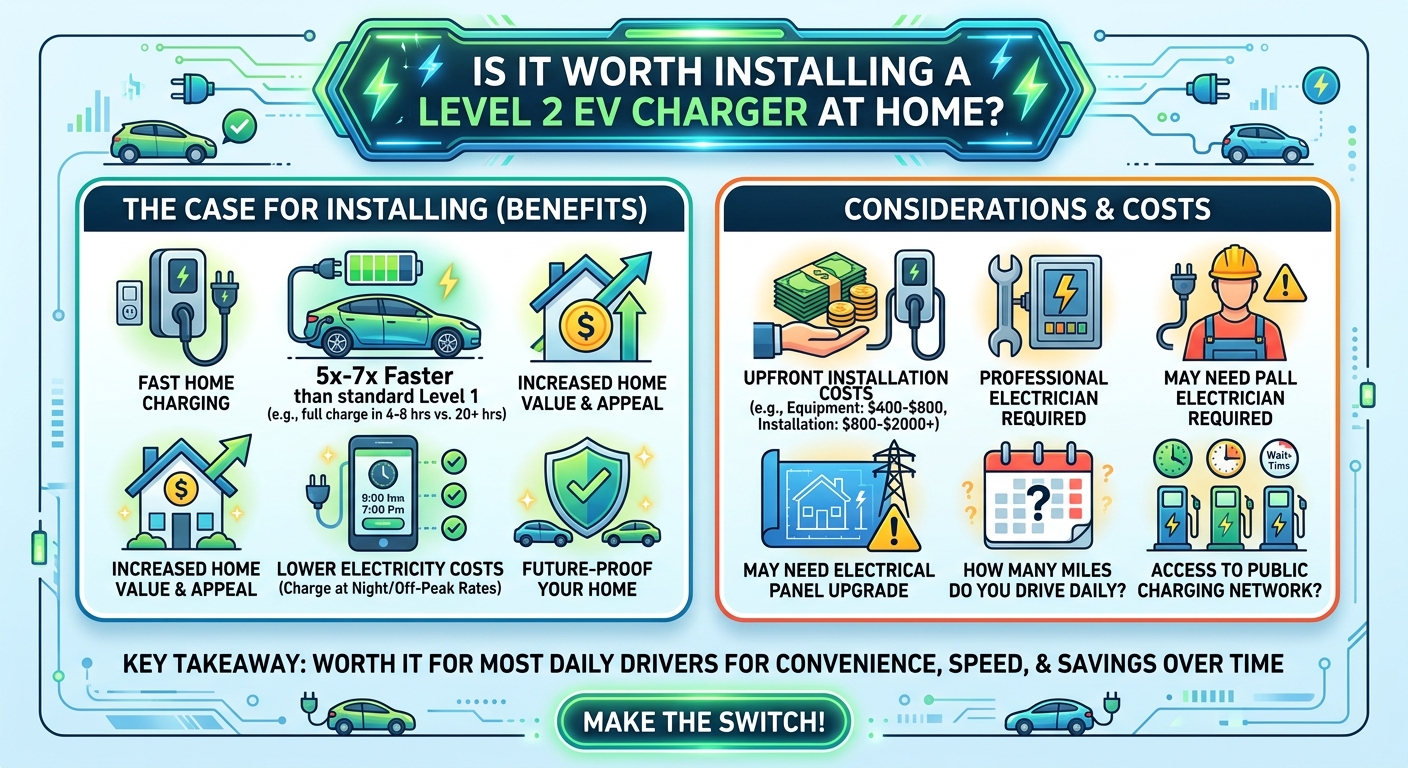
Transitioning to an electric vehicle (EV) offers massive daily fuel savings, whisper-quiet operation, and zero local tailpipe emissions. Delivering 20 to 44 miles of driving range per hour over a high-voltage 240-volt single-phase branch circuit, setting up a home Level 2 wallbox transforms vehicle replenishment into an effortless overnight habit. However, as prospective EV owners evaluate hardware purchases and electrician installation costs, a fundamental financial and practical question arises: Is it worth installing a Level 2 EV charger at home?
The short answer is: yes, installing a Level 2 EV charger at home is worth it for the vast majority of electric vehicle owners, as it provides 3x to 8x faster charging speeds, unlocks low off-peak electricity tariffs, increases home property resale value, and delivers a complete financial payback in 1 to 2 years.
While standard Level 1 wall outlets (120V) can satisfy short daily drives, stepping up to a dedicated Level 2 wallbox provides the charging buffer, battery thermal protection, and long-term cost efficiency required for effortless EV ownership.
For complete hardware reviews, installer guides, and panel load calculators, visit EV Charger Advisor.
1. Four Reasons Installing a Level 2 Wallbox Is Worth It
Investing in a private Level 2 home installation yields clear financial, operational, and technical dividends:
A. Rapid Return on Investment (ROI) & Fuel Savings
Public DC fast chargers (DCFC) frequently charge premium commercial markup rates per kilowatt-hour ($\text{kWh}$) to cover business overhead. In contrast, home Level 2 charging taps directly into cheap residential rates. Scheduling charging during overnight Time-of-Use (TOU) off-peak hours cuts annual fuel costs by 50% to 70% compared to public stations, allowing the charger to pay for itself rapidly.
B. Eliminating Range Anxiety & Save Time
Standard Level 1 trickle charging adds only 3 to 5 miles of range per hour ($1.4\text{ kW}$ output), taking up to 40+ hours for a full recharge. A dedicated Level 2 wallbox ($7.4\text{ kW} – 11.5\text{ kW}$) restores 25 to 44 miles per hour, fully replenishing any electric car overnight in 5 to 8 hours.
C. Optimized Battery Longevity & Thermal Health
Frequent reliance on public DC fast chargers (100 kW to 350 kW) subjects lithium-ion cells to high thermal stress. Steady AC Level 2 home charging delivers gentle thermal management, preserving long-term battery health, reducing cell degradation, and retaining maximum driving range.
D. Smart Energy Integration & Solar Syncing
Modern Wi-Fi smart chargers allow homeowners to automate charging schedules, track real-time power consumption, and integrate seamlessly with residential solar PV systems to charge their EV using 100% clean, self-generated solar energy.
To learn more about how charger power levels and wire sizes compare, check out our guide on EV charging types.
2. When Might a Level 2 Charger NOT Be Worth It?
While Level 2 chargers are ideal for most EV drivers, a standard Level 1 outlet might suffice if:
-
Low Daily Commute: You drive fewer than 20 to 30 miles per day and have 12+ hours to let the car sit plugged in overnight.
-
Short-Term Rental Homes: You rent your home and cannot secure landlord permission or municipal electrical permits to install a 240V circuit (NEC Article 625).
-
Plug-In Hybrid (PHEV) Vehicles: You drive a PHEV with a small battery pack (10–18 kWh) that recharges fully on a Level 1 outlet in 5 to 7 hours.
To explore Wi-Fi-enabled smart wallboxes engineered with off-peak schedule timers, read our guide on smart chargers.
Step-by-Step Mathematical Example: Payback Period & Financial ROI Math
Let us calculate the net financial payback period for installing a Level 2 home wallbox for a driver commuting 14,000 miles per year at an average efficiency of 3.5 Miles per kWh ($4,000\text{ kWh/year}$ consumed).
Given Parameters:
-
Equipment & Licensed Installation Cost: $\$1,200 \text{ (Total Upfront Investment)}$
-
Annual Energy Consumed ($E_{\text{annual}}$): $14,000 / 3.5 = \mathbf{4,000 \text{ kWh / year}}$
-
Public Fast Charger Commercial Rate: $\$0.45 \text{ per kWh}$
-
Home Off-Peak Residential Rate: $\$0.15 \text{ per kWh}$
Calculation 1: Annual Cost Using Public Fast Chargers ($C_{\text{public}}$)
Calculation 2: Annual Cost Using Home Off-Peak Level 2 Charging ($C_{\text{home}}$)
Calculation 3: Net Annual Savings ($\Delta C$)
Calculation 4: Payback Period Calculation
Result Breakdown: Charging at home saves $1,200 per year compared to public fast charging, achieving a complete 100% financial payback on the Level 2 charger installation in exactly 12 months.
Comparison Table: Level 1 vs. Level 2 Home Charger Value
| Feature / Criteria | Standard Wall Outlet (Level 1) | Dedicated Wallbox (Level 2) |
| Supply Voltage / Amperage | 120V / 12A (1.4 kW) | 240V / 32A–48A (7.4 kW – 11.5 kW) |
| Added Range per Hour | 3 to 5 miles/hr | 25 to 44 miles/hr |
| Full Recharge Time (60 kWh) | 40 to 45 Hours | 5 to 8 Hours |
| Financial Payback Period | N/A (Free outlet) | 1 to 2 Years (via off-peak rates) |
| Winter Pre-Conditioning | Poor (Low thermal power) | Excellent (Heats cabin & battery) |
Summary & Key Takeaways
-
Fully Worth the Investment: A Level 2 home charger is worth it for most BEV owners, combining maximum daily convenience with fast charging speeds.
-
Pays for Itself Quickly: Low off-peak residential electricity rates allow the installation cost to pay for itself in 1 to 2 years.
-
Protects Battery Health: Gentle AC Level 2 charging reduces cell thermal stress compared to frequent public DC fast charging.
-
Boosts Home Value: Installing a code-compliant 240V charging circuit future-proofs your garage and enhances overall property appeal.













Leave a Reply