
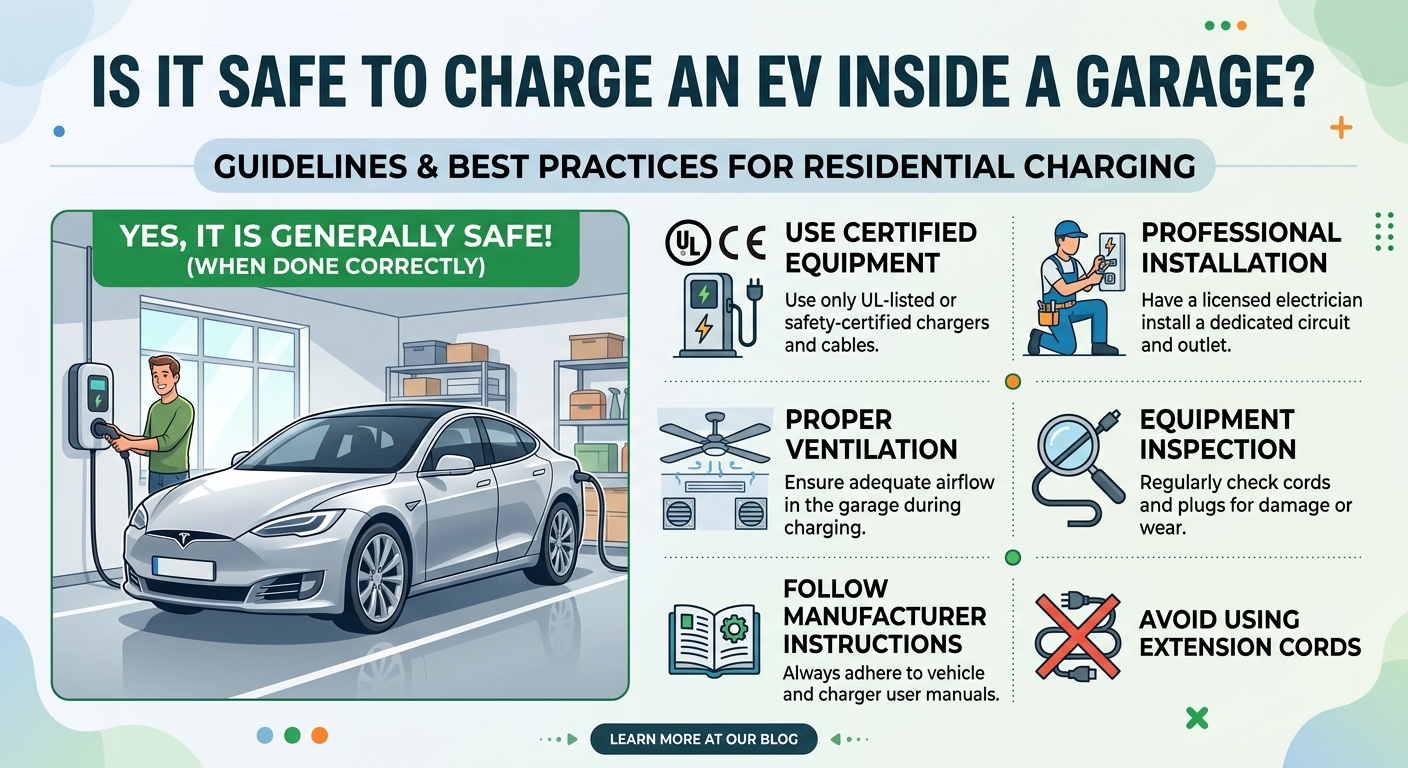
Setting up a home charging routine is one of the most convenient aspects of electric vehicle ownership. With a dedicated Level 2 wallbox, drivers can easily replenish 20 to 44 miles of driving range per hour overnight. However, because electric vehicle battery packs store significant chemical energy and operate on high-voltage alternating current (AC), first-time EV owners frequently ask: Is it safe to charge an EV inside a garage?
The short answer is: yes, it is entirely safe to charge an electric vehicle (EV) inside a garage, provided you follow standard electrical safety practices, use certified equipment (UL/CE listed), and adhere to National Electrical Code (NEC Article 625) standards.
Unlike internal combustion engine (ICE) vehicles, electric vehicles produce zero tailpipe emissions, eliminating carbon monoxide (CO) risks completely. Understanding ventilation rules, thermal management, proper mounting heights, and breaker sizing ensures your indoor garage setup is completely secure.
For complete hardware reviews, installer guides, and panel load calculators, visit EV Charger Advisor.
1. Why Indoor EV Charging Is inherently Safe
Indoor garage charging is designed from the ground up with multi-layered electrical and chemical safety protocols:
A. Zero Carbon Monoxide or Toxic Exhaust Emissions
Unlike gasoline or diesel engines, which generate lethal carbon monoxide gas when idling inside an enclosed space, an EV’s onboard charger operates purely through electrochemistry. You can charge an EV in a fully closed garage overnight with zero risk of air contamination or gas accumulation.
B. Advanced EVSE Pilot Handshake Protocol
An EV wallbox (EVSE) does not continuously energize its cable when hanging on the wall. Under SAE J1772 and NACS (SAE J3400) standards, high-voltage current is only supplied after a digital low-voltage signal confirms a secure, sealed latch between the charging handle and the vehicle’s port.
C. Active Thermal & Battery Management Systems (BMS)
Modern EV battery packs are equipped with active liquid cooling loops and liquid-cooled thermal management. The vehicle’s BMS continuously monitors cell temperatures, voltage levels, and state of charge. If overheating or grid fluctuations occur, the BMS automatically throttles charging speeds or disconnects power.
To learn more about how charger power levels and wire sizes compare, check out our guide on EV charging types.
2. Important NEC Safety Rules for Indoor Garage Setups
To guarantee total electrical safety inside an enclosed garage, your installation must satisfy key NEC Article 625 code requirements:
1. Mandatory Mounting Height (NEC 625.102)
The coupling/control unit of an indoor EV wallbox must be mounted at least 18 inches ($450\text{ mm}$) above floor level. This prevents potential sparking near heavier-than-air flammable vapors (such as spilled gasoline or paint thinners stored on garage floors).
2. Continuous Load Sizing (The 125% Rule)
EV charging is legally classified as a continuous electrical load (operating at full capacity for 3 hours or more). Under NEC 625.41, branch circuit conductors and circuit breakers must be sized at 125% of the charger’s continuous output rating:
-
32A Continuous Charger: Requires a 40A double-pole breaker and #8 AWG copper wire.
-
48A Continuous Charger: Requires a 60A double-pole breaker and heavy #6 AWG THHN copper conductors.
3. Hardwiring vs. Plug-In Receptacles
While plug-in NEMA 14-50 outlets are common in garages, hardwiring your charger directly eliminates plug/socket contact wear, reduces $I^2R$ thermal resistance, and avoids nuisance tripping on GFCI-protected breakers.
To explore Wi-Fi-enabled smart wallboxes built with integrated thermal sensors, read our guide on smart chargers.
Step-by-Step Mathematical Example: Circuit Thermal Sizing for Garage Safety
Let us calculate the required continuous current, conductor sizing, and circuit breaker protection for a hardwired 11.52 kW Level 2 Wallbox installed inside a garage.
Given Parameters:
-
Charger Power Output: $11.52 \text{ kW} (11,520 \text{ Watts})$
-
Supply Line Voltage: $240 \text{ Volts Single-Phase}$
Calculation 1: Continuous Current Draw ($I_{\text{continuous}}$)
Calculation 2: Required Circuit Breaker Size (125% Safety Factor)
Calculation 3: Thermal Resistance Loss ($P_{\text{loss}}$) Across 30 Feet of #6 AWG Copper Wire
Using a conductor resistance of $R = 0.000491 \Omega/\text{ft}$ across a 30-foot branch circuit ($60\text{ ft}$ total conductor path):
Result Breakdown: Sizing the circuit breaker to 60 Amps ensures the system operates comfortably within thermal safety limits. Heat loss across 30 feet of #6 AWG copper wire is restricted to a negligible ~68 Watts, preventing dangerous insulation degradation inside garage walls.
Comparison Table: Indoor Garage vs. Outdoor Driveway Safety Metrics
| Safety Factor | Indoor Garage Installation | Outdoor Driveway Setup |
| Carbon Monoxide Hazard | Zero Risk (No engine exhaust) | Zero Risk |
| Minimum Mounting Height | 18 Inches ($450\text{ mm}$) above floor | 24 Inches ($600\text{ mm}$) above grade |
| Weather/Water Exposure | Fully Protected (Dry interior) | Requires NEMA 3R/4 Enclosure |
| Optimal Wiring Method | Hardwired or Plug-in NEMA 14-50 | Direct Hardwired (Recommended) |
| Thermal Protection | Excellent (Shielded from direct sun) | Solar heat gain requires derating |
Summary & Key Takeaways
-
100% Safe: Charging an EV inside a garage is completely safe and free from toxic fumes or carbon monoxide emissions.
-
Follow Minimum Mounting Heights: Mount indoor wallboxes at least 18 inches above floor level to comply with NEC Article 625 safety codes.
-
Observe the 125% Rule: Ensure circuit breakers and heavy copper cables are sized for 125% of the charger’s continuous current rating (e.g., a 60A breaker for a 48A charger).
-
Hardwiring Is Best: Direct hardwiring reduces plug contact resistance, ensuring cooler operation during long overnight charging sessions.













Leave a Reply