
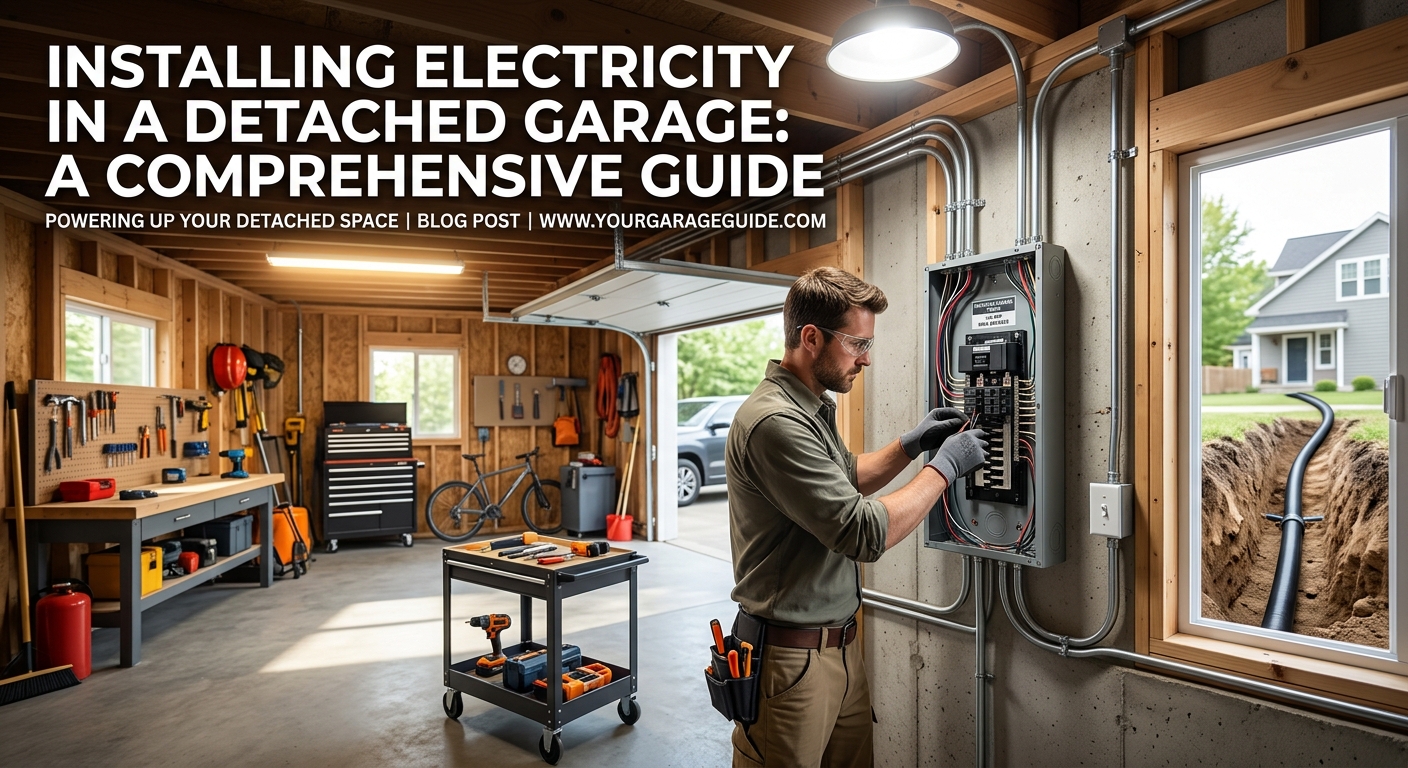
Adding electrical service to a detached garage transforms a simple storage building into a fully functional workshop, well-lit parking space, or high-speed EV charging hub. Delivering 20 to 44 miles of driving range per hour over a high-voltage 240-volt single-phase branch circuit, installing a dedicated Level 2 wallbox in a detached garage provides the ultimate charging convenience. However, because running power across a yard involves underground trenching and distinct grounding rules, homeowners often ask: Is it possible to install electricity in a detached garage?
The short answer is: yes, you can install electricity in a detached garage by running an underground feeder line (in conduit or direct-burial cable) from your main house panel to a dedicated sub-panel inside the garage.
Whether powering basic LED lighting and automated door openers or supporting heavy 240V equipment like air compressors and Level 2 EV chargers, installing garage power requires adhering strictly to National Electrical Code (NEC Article 225 & 250) rules.
For complete hardware reviews, installer guides, and panel load calculators, visit EV Charger Advisor.
1. Choosing Between a Single Circuit vs. a Sub-Panel
Depending on your daily electrical demands, two main approaches exist for running power to a detached structure:
A. Single Multi-Wire Branch Circuit (Low Demand)
-
Setup: A single 120-volt or 240-volt circuit running from a breaker in the main home panel directly to the garage.
-
Capacity Limit: Supports 15 to 20 Amps.
-
Best Suited For: Basic LED overhead lights, automatic garage door openers, and standard low-power 120V wall outlets.
-
Limitation: Cannot support an EV charger, space heater, or heavy power tools simultaneously.
B. Dedicated Garage Sub-Panel (High Demand / Recommended)
-
Setup: A heavy 4-wire feeder line (two hots, one neutral, one isolated equipment ground) routed from the house main panel to a 60A, 100A, or 125A sub-panel mounted inside the garage.
-
Best Suited For: Simultaneous operation of 240V Level 2 EV charging wallboxes (32A to 48A continuous draw), HVAC/heating units, welders, and power tool circuits.
To learn more about how charger power levels and wire sizes compare, check out our guide on EV charging types.
2. Mandatory NEC Code Requirements for Underground Runs
Running power to a separate building requires meeting specific electrical code standards to prevent physical cable damage and ground faults:
-
Underground Trenching Depths (NEC 300.5):
-
Schedule 40/80 PVC Conduit: Must be buried at least 18 inches ($450\text{ mm}$) deep below finished grade.
-
Direct-Burial UF-B / NMWU Cable: Must be buried at least 24 inches ($600\text{ mm}$) deep.
-
-
Four-Wire Feeder Rule (NEC 250.32): Modern electrical codes strictly mandate a 4-wire feeder run. Neutrals and grounds must remain isolated at the garage sub-panel (neutral bus unbonded from the panel chassis).
-
Local Grounding Electrode System: The detached garage sub-panel must connect to its own dedicated grounding system (typically two 8-foot ground rods driven into the earth at least 6 feet apart).
-
240V GFCI Protection Requirements: Under recent NEC editions, all 120V and 240V garage receptacles require Ground-Fault Circuit Interrupter (GFCI) protection.
To explore Wi-Fi-enabled smart wallboxes engineered with integrated GFCI safety mechanisms, read our guide on smart chargers.
Step-by-Step Mathematical Example: Feeder Voltage Drop Math for Long Underground Runs
Because detached garages sit away from the main home, cable length creates resistance that lowers line voltage. Under NEC guidelines, feeder voltage drop ($\Delta V$) should stay below 3% to prevent motor burnout and charging power loss.
Let us evaluate the voltage drop for a 100-Amp Sub-Panel feeder carrying a 48-Amp Level 2 EV Charger load ($240\text{V}$ single-phase supply) running 120 feet ($36.57\text{ m}$) using #2 AWG Aluminum SER/Feeder Conductor ($R = 0.000319 \Omega/\text{ft}$).
Given Parameters:
-
Continuous Charger Current Draw ($I$): $48 \text{ Amps}$
-
Nominal Line Voltage ($V$): $240 \text{ Volts}$
-
One-Way Trench Distance ($L$): $120 \text{ feet}$
-
Conductor Resistance ($R_{\text{wire}}$): $0.000319 \Omega \text{ per foot}$
Calculation 1: Voltage Drop ($\Delta V$) Math
For a single-phase $240\text{V}$ circuit ($2 \times L = 240\text{ ft}$ total conductor path):
Calculation 2: Percentage Voltage Drop (%)
Result Breakdown: A 1.53% voltage drop stays well below the 3% maximum NEC threshold limit, confirming that a 120-foot feeder run using #2 AWG aluminum conductors operates safely, efficiently, and within thermal limits.
Comparison Table: Detached Garage Electrical Installation Options
| Approach | Typical Capacity | Trench Depth (PVC Conduit) | Supported Equipment |
| Single Branch Circuit | 15A – 20A (120V) | 18 inches ($450\text{ mm}$) | Overhead lights, garage door opener, small tools |
| 60A Sub-Panel | 60A (240V) | 18 inches ($450\text{ mm}$) | Lights, 32A Level 2 EV charger, small power tools |
| 100A Sub-Panel | 100A (240V) | 18 inches ($450\text{ mm}$) | Lights, 48A Level 2 EV charger, workshop, HVAC |
Summary & Key Takeaways
-
Yes, It Is Fully Possible: You can easily install electricity in a detached garage by running an underground feeder from your main house panel.
-
Install a Sub-Panel for Expansion: Installing a 60A or 100A sub-panel provides the capacity needed for Level 2 EV chargers, power tools, and future electrical additions.
-
Follow Trench Burial Rules: Dig trenches at least 18 inches deep when using PVC conduit to protect conductors from physical damage.
-
Isolate Ground and Neutral: Detached garage sub-panels require a 4-wire feeder with separate neutral and ground buses plus local ground rods driven into the earth.













Leave a Reply