
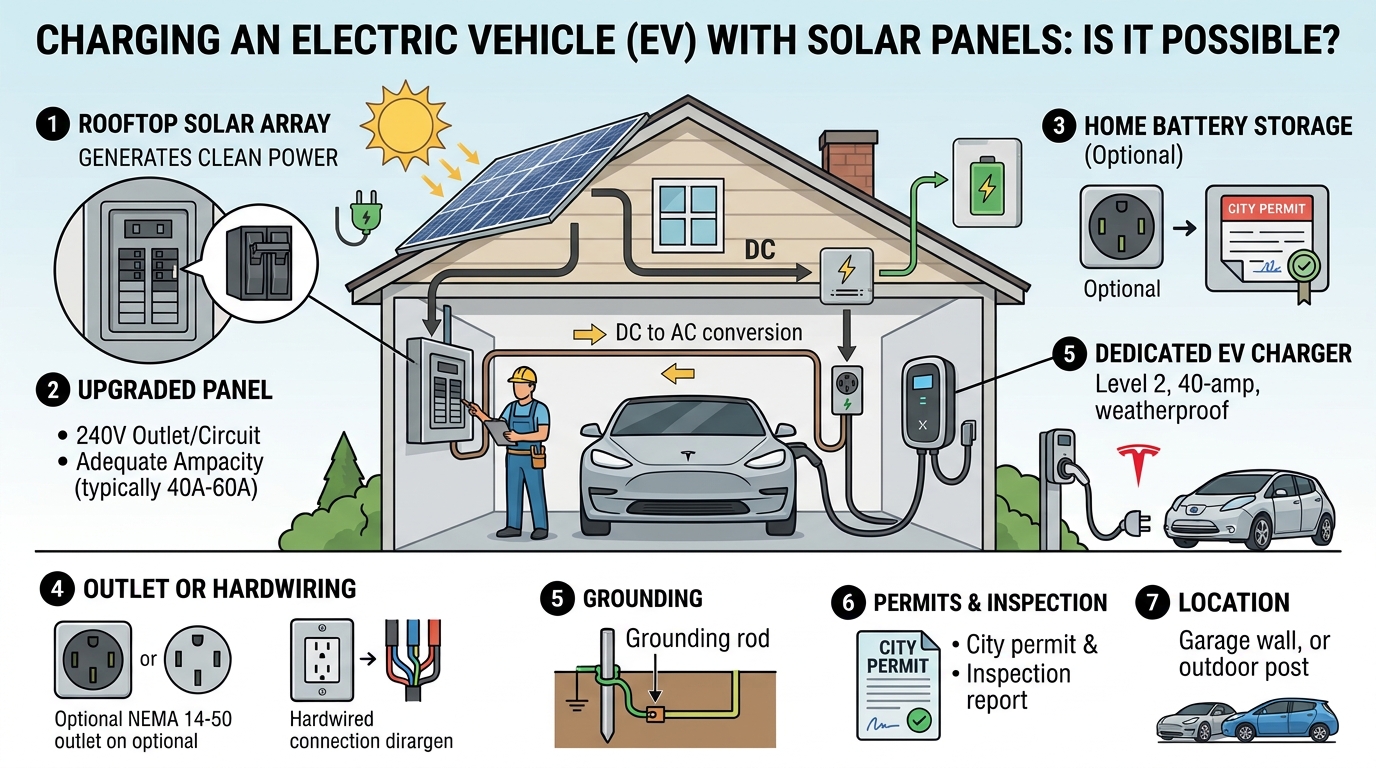
Pairing an electric vehicle (EV) with residential solar photovoltaics (PV) represents the ideal combination for clean, zero-emission personal transportation. Operating over high-voltage 240-volt single-phase branch circuits, installing a home Level 2 charging station provides 20 to 44 miles of driving range per hour. However, as prospective EV owners evaluate the long-term economics of home solar installations, a fundamental question frequently arises: Is it possible to charge an EV with solar panels?
The short answer is: yes, you can charge an electric vehicle using solar panels. EV charging with solar is accomplished by routing generated daytime solar power through your home inverter and electrical distribution panel directly into your Level 2 smart charger.
Under National Electrical Code (NEC Article 625 / Article 705) standards, integrating solar power with smart EV energy management systems allows homeowners to charge their vehicles for free, avoid rising utility time-of-use (TOU) rates, and reduce carbon emissions.
For complete hardware reviews, installer guides, and panel load calculators, visit EV Charger Advisor.
1. How Solar-Powered EV Charging Works
Solar panels generate DC (Direct Current) power when exposed to sunlight, while residential EV charging stations run on AC (Alternating Current) electricity. Connecting the two systems relies on a clean, integrated grid-tied flow:
SOLAR-TO-EV CHARGING ARCHITECTURE:
[Solar PV Array] ──► [Solar Inverter] ──► [Main Electrical Panel] ◄── [Level 2 EV Charger]
                                                    ▲
                                                    │
                                        [Smart CT Clamp Sensors]
A. The Power Flow Architecture
-
Solar Conversion: Rooftop PV panels generate DC power, which flows into a string inverter or microinverters to be converted into 240-volt AC electricity.
-
Panel Distribution: The AC power enters your main distribution panel, supplying active home appliances first.
-
EV Diversion: Excess solar power generated above household baseline consumption flows directly into your dedicated Level 2 EV branch circuit.
-
Grid Backup / Net Metering: If solar generation is insufficient (e.g., on cloudy days), your home seamlessly supplements power from the utility grid or a home battery backup system.
B. Smart Solar Matching & CT Clamp Sensors
To ensure your EV charges strictly on solar power without importing expensive grid electricity, smart chargers (such as the myenergi Zappi or Emporia Smart EVSE) use Current Transformer (CT) clamp sensors on main service lines. When the sensors detect daytime solar energy being exported to the grid, the wallbox automatically ramps up charging speed to match the exact solar surplus.
To learn more about how charger power levels and wire sizes compare, check out our guide on EV charging types.
2. How Many Solar Panels Are Needed to Charge an EV?
Calculating the number of solar panels required depends on your daily driving distance, vehicle battery efficiency, and geographical solar radiation:
-
Average Daily Driving: 30 miles per day.
-
Vehicle Efficiency: Standard EVs consume approximately 1 kWh per 3.5 miles (~8.6 kWh daily).
-
Solar Panel Output: A typical 400-Watt solar panel produces roughly 1.6 to 2.0 kWh per day (depending on peak sun hours).
-
Required Solar Capacity: Covering 30 miles of daily driving requires 5 to 7 dedicated solar panels (approx. $2.0 \text{ kW to } 2.8 \text{ kW}$ of solar array capacity).
To explore Wi-Fi-enabled smart wallboxes engineered with integrated load management features, read our guide on smart chargers.
Step-by-Step Mathematical Example: Solar Generation & EV Replenishment Math
Let us perform a technical calculation to determine the daily solar generation, net energy delivered to the vehicle, and driving range added when charging a Level 2 EV Charger ($32\text{A}$ continuous at $240\text{V}$ = $7.68\text{ kW}$ output) from a 7.0 kW Solar PV Array receiving 5.0 Peak Sun Hours daily at 85% system efficiency ($\eta = 0.85$).
Given Parameters:
-
Solar Array Peak Rating ($P_{\text{solar}}$): $7.0 \text{ kW}$
-
Peak Sun Hours ($H$): $5.0 \text{ Hours / Day}$
-
System Efficiency Factor ($\eta_{\text{system}}$): $85\% \quad (0.85)$
-
Household Baseline Daytime Draw ($E_{\text{house}}$): $10.0 \text{ kWh / Day}$
-
EV Efficiency Rating: $3.5 \text{ Miles per kWh}$
Calculation 1: Total Daily Solar Generation ($E_{\text{solar-gross}}$)
Calculation 2: Net Solar Surplus Available for EV Charging ($E_{\text{surplus}}$)
Subtracting daily essential household appliance consumption ($10.0\text{ kWh}$):
Calculation 3: Charging Session Duration in Solar Match Mode ($T_{\text{solar}}$)
Assuming a continuous adjusted solar charge rate of 4.80 kW ($20\text{A}$ continuous draw):
Calculation 4: Total Solar Driving Range Added ($R_{\text{added}}$)
Result Breakdown: A 7.0 kW solar array produces 29.75 kWh daily, leaving 19.75 kWh of net surplus energy after household loads to deliver 69.1 miles of completely free, clean driving range each day.
Comparison Table: EV Charging Power Source Comparison
| Parameter / Feature | Grid-Only Charging | Solar + Grid Charging | 100% Solar Surplus Charging |
| Fuel Cost per Mile | Standard Utility Electricity Rates | Reduced Off-Peak Rates | $0.00 (100% Free Energy) |
| Carbon Footprint | Dependent on Local Grid Mix | Reduced Operational Emissions | Zero Tailpipe & Grid Emissions |
| Hardware Required | Standard Level 2 EVSE | Smart EVSE + Solar Inverter | Smart EVSE with CT Sensor Clamps |
| Charging Flexibility | Charge Anytime (Day or Night) | Charge Anytime with Solar Offset | Daytime Charging or Battery Buffer |
| NEC Breaker Requirement | 125% Continuous Rule (NEC 625) | NEC 625 & 120% Rule (NEC 705) | NEC 625 & 120% Rule (NEC 705) |
Summary & Key Takeaways
-
Yes, Completely Feasible: You can charge an EV using solar panels by connecting the solar inverter and EV charger through your main electrical panel.
-
Requires 5 to 7 Panels for Daily Commuting: Covering an average 30-mile daily commute requires approximately 2.0 to 2.8 kW of solar capacity (~5 to 7 modern 400W panels).
-
Use Smart CT Sensors: Smart chargers equipped with CT clamp sensors monitor solar export in real time to match charging speed to live solar surplus.
-
Follow NEC 705 Busbar Rules: Ensure panel connections comply with the 120% busbar rule when adding solar inverter and EV charger supply breakers.













Leave a Reply