
Pairing electric vehicle (EV) charging with residential solar photovoltaics (PV) represents the gold standard for clean, cost-effective personal energy management. Delivering 20 to 44 miles of driving range per hour over a high-voltage 240-volt single-phase branch circuit, hardwiring a home Level 2 wallbox makes vehicle replenishment effortless. However, as utility companies reduce net-metering export credits and time-of-use (TOU) rates rise during evening hours, homeowners with existing grid-tied solar arrays often ask: Is it possible to add battery storage to an existing solar system?
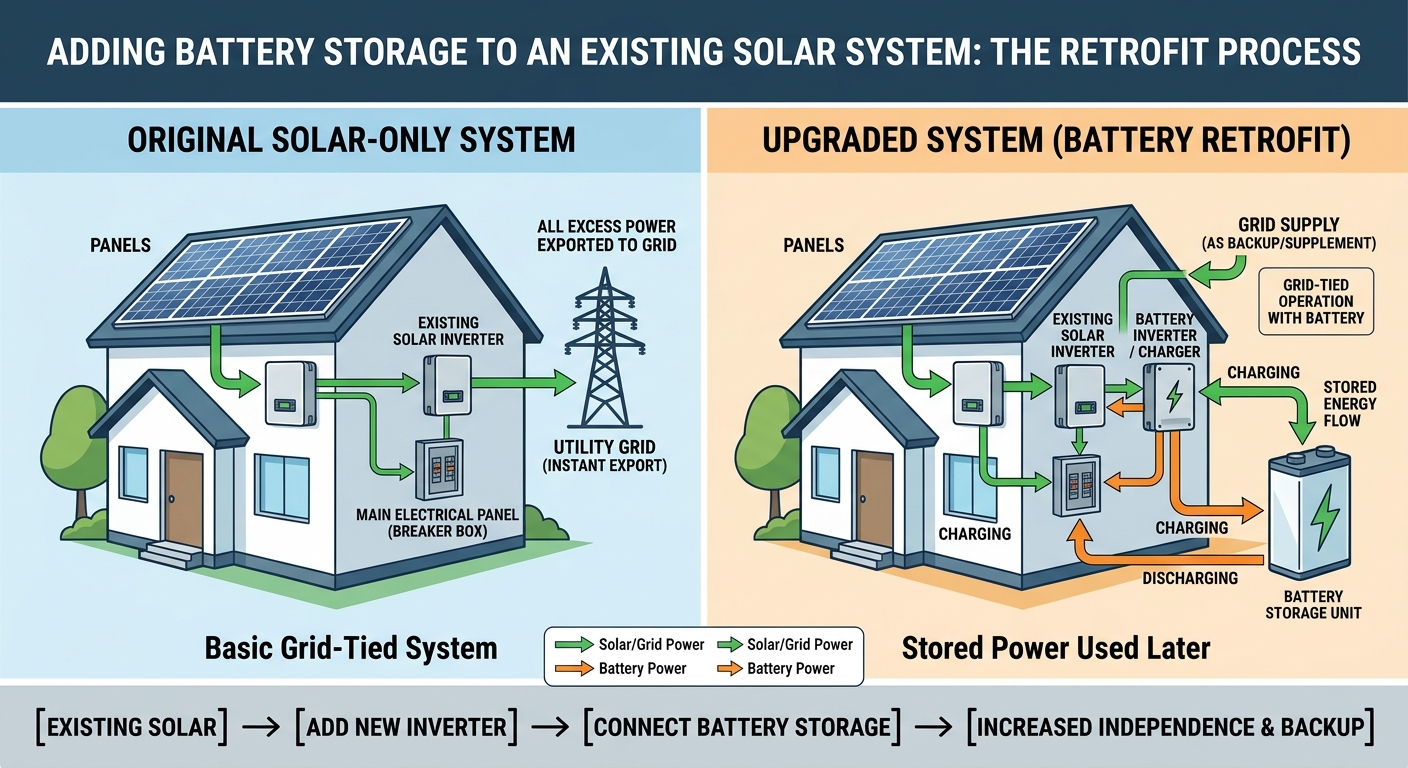
The short answer is: yes, you can add battery storage to an existing solar panel system in almost all cases. retrofitting a battery energy storage system (BESS) is accomplished using either AC-coupling (installing a standalone storage inverter) or DC-coupling (replacing the existing PV inverter with a hybrid inverter).
Under National Electrical Code (NEC Article 706 / Article 625) standards, retrofitting home battery storage allows you to store daytime solar production, power household loads during outages, and fuel your EV with clean solar energy 24 hours a day.
For complete hardware reviews, installer guides, and panel load calculators, visit EV Charger Advisor.
1. AC-Coupling vs. DC-Coupling Retrofit Architecture
When adding a battery to an existing solar system, installers choose between two distinct technological integration methods:
AC-COUPLED RETROFIT ARCHITECTURE (Most Common):
[Solar Panels] ──► [Existing Solar Inverter] ──► [AC Panel] ◄── [New Battery Inverter] ◄── [New Battery Bank]

DC-COUPLED RETROFIT ARCHITECTURE:
[Solar Panels] ──► [New Hybrid Inverter] ──► [New Battery Bank]
                         │
                         ▼
                    [AC Panel]
A. Method 1: AC-Coupled Storage Retrofit (Simplest & Most Common)
-
How It Works: The existing solar array and grid-tied solar inverter remain completely untouched. A secondary, dedicated storage inverter (or battery with integrated micro-inverters, such as the Tesla Powerwall 2/3 or Enphase IQ Battery) is wired into the main AC service panel.
-
Why Choose It: Highly flexible, universally compatible with any existing grid-tied solar system (string inverters or microinverters), and involves simpler permitting and lower labor costs.
B. Method 2: DC-Coupled Storage Retrofit
-
How It Works: The existing solar inverter is removed and replaced with a modern multi-port Hybrid Inverter (such as a SolarEdge Energy Hub or Sol-Ark). Both the solar panels and the new battery bank connect directly to the shared DC bus inside the hybrid inverter.
-
Why Choose It: Provides slightly higher overall round-trip efficiency (fewer AC/DC power conversion steps) and allows for higher DC solar overpaneling ratios.
To learn more about how charger power levels and wire sizes compare, check out our guide on EV charging types.
2. Electrical Sizing & Safety Rules (NEC 706 & NEC 625)
Integrating a retrofitted battery bank with an EV charger requires adhering to key electrical panel capacity rules:
-
NEC Article 706 Compliance: Stationary energy storage systems must include rapid shutdown controls, dedicated overcurrent protection, and physical clearance from garage door entryways.
-
Main Panel Busbar Limits (The 120% Rule – NEC 705.12): When feeding power from both solar inverters and battery storage inverters back into a main service panel, the sum of all supply breakers plus the main breaker rating cannot exceed 120% of the main panel busbar rating.
-
Protecting Battery Reserves from EV Drain: To prevent a high-amperage Level 2 EV charger (48A continuous / 11.52 kW) from rapidly draining the retrofitted battery overnight, install a dynamic Home Energy Management System (HEMS) or program a 30% to 50% backup reserve threshold in your battery software.
To explore Wi-Fi-enabled smart wallboxes engineered with integrated load management features, read our guide on smart chargers.
Step-by-Step Mathematical Example: Retrofit Battery Sizing & Solar EV Math
Let us calculate the net usable daily energy, system conversion efficiency, and nighttime EV charging capacity when retrofitting a 13.5 kWh AC-Coupled Battery Energy Storage System (BESS) to an existing 6.0 kW Solar Array to supply energy to a 32-Amp Level 2 EV Charger ($7.68\text{ kW}$ output at $240\text{V}$).
Given Parameters:
-
Retrofitted Battery Nameplate Capacity ($C_{\text{gross}}$): $13.5 \text{ kWh}$
-
Max Depth of Discharge (DoD) Limit: $90\% \quad (0.90)$
-
AC-Coupled Round-Trip Efficiency ($\eta_{\text{RTE}}$): $89\% \quad (0.89)$
-
Home Baseline Overnight Appliance Draw ($E_{\text{house}}$): $4.50 \text{ kWh}$
-
Continuous EV Charger Draw ($P_{\text{EV}}$): $32\text{A} \times 240\text{V} / 1000 = \mathbf{7.68 \text{ kW}}$
Calculation 1: Usable Stored Energy Available per Cycle ($E_{\text{usable}}$)
Calculation 2: Usable Stored Energy Remaining for Nighttime EV Charging ($E_{\text{EV-available}}$)
Subtracting essential household overnight consumption ($4.50\text{ kWh}$):
Calculation 3: Driving Range Added to EV Overnight
Assuming an EV efficiency of 3.5 Miles per kWh:
Calculation 4: Battery Discharge Duration at 32A Continuous Speed ($T_{\text{drain}}$)
Result Breakdown: An AC-coupled 13.5 kWh battery retrofit delivers 10.81 kWh net usable energy, covering 4.5 kWh of essential home loads while transferring 6.31 kWh of clean solar power (~22 miles of range) into an EV battery overnight.
Comparison Table: Storage Retrofit Coupling Methods
| Metric / Parameter | AC-Coupled Storage Retrofit | DC-Coupled Storage Retrofit |
| Primary Integration Point | Main AC Electrical Panel | Shared DC Bus on Hybrid Inverter |
| Existing Inverter Replacement? | NO (Keeps existing solar inverter) | YES (Replaces existing inverter) |
| System Compatibility | Universal (Works with String & Microinverters) | Limited to compatible hybrid inverters |
| Round-Trip Efficiency (RTE) | ~88% – 90% | ~92% – 94% (Slightly Higher) |
| Installation Complexity | Low to Moderate | Moderate to High |
| Best Suited For | Adding batteries to existing functioning solar systems | Older solar systems ready for inverter upgrade |
Summary & Key Takeaways
-
Yes, Fully Retrofittable: You can easily add battery storage to an existing solar panel system using AC-coupling or DC-coupling methods.
-
AC-Coupling Is Easiest: AC-coupled battery retrofits do not require replacing your existing solar inverter, making installation simpler and faster.
-
Follow NEC Busbar Rules: Ensure panel connections comply with NEC 705.12 (the 120% rule) when adding battery inverter supply breakers.
-
Protect Battery Capacity: Use HEMS software reserve limits to prevent a high-amperage Level 2 EV charger from completely depleting your home backup power.













Leave a Reply