
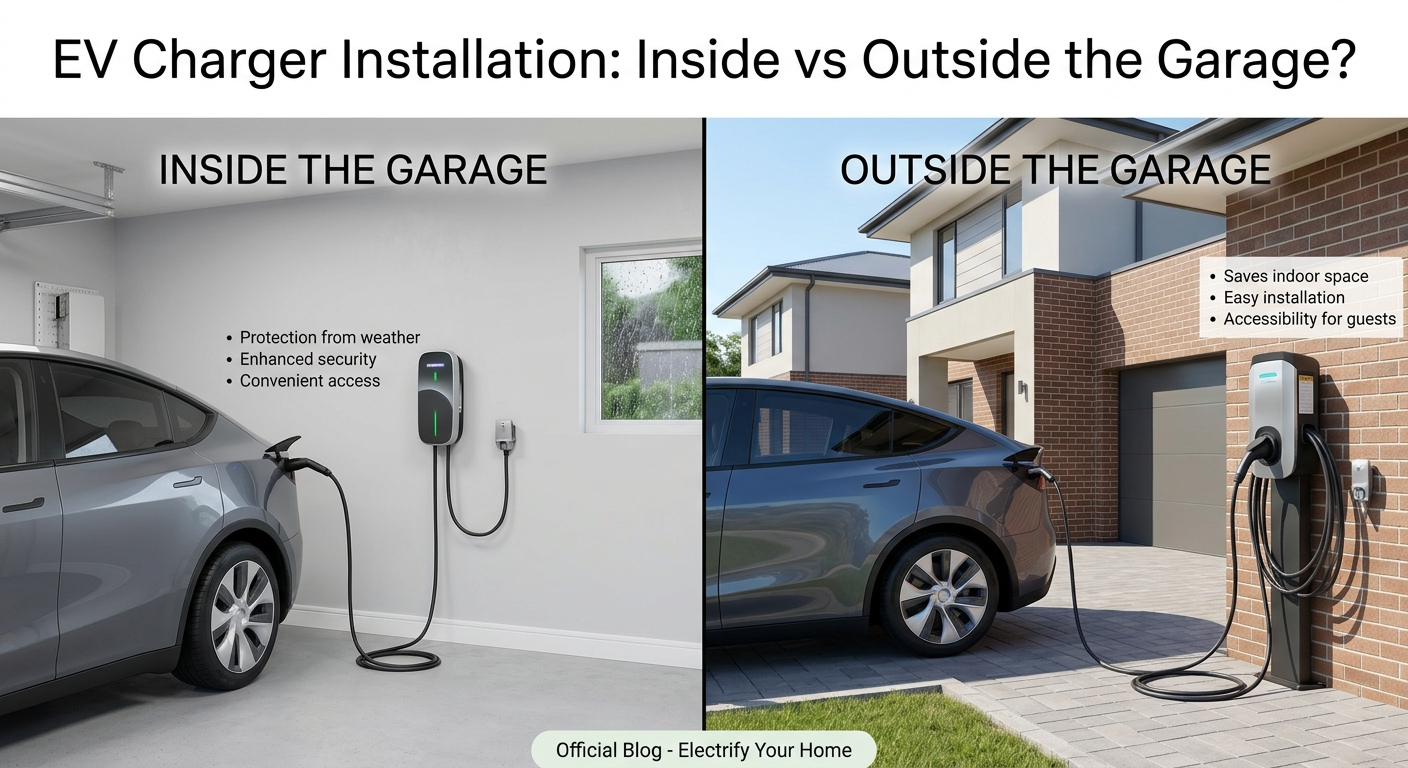
Upgrading to an electric vehicle (EV) brings substantial long-term fuel savings, quiet operation, and the convenience of starting every morning with a fully replenished battery. Operating on a high-voltage 240-volt single-phase supply, setting up a home Level 2 wallbox transforms daily vehicle charging into an effortless overnight routine, delivering 20 to 44 miles of driving range per hour. However, as homeowners plan hardware mounting locations, a fundamental practical question arises: Is it better to install an EV charger inside or outside the garage?
The short answer is: installing an EV charger inside the garage is generally better for most homeowners, as it shields the wallbox from harsh weather, prevents physical cable wear, protects against vandalism, and keeps battery temperatures stable during charging.
However, mounting an outdoor weatherproof unit (NEMA 4 / IP65 rated) along a private driveway is an excellent and equally safe alternative if garage space is limited or if you routinely park your vehicle outside.
For complete hardware reviews, installer guides, and panel load calculators, visit EV Charger Advisor.
1. Key Advantages: Indoor vs. Outdoor Mounting
Evaluating the pros and cons of each placement option helps identify the best choice for your property layout:
A. Advantages of Installing Inside the Garage (Recommended)
-
Superior Weather & Environmental Protection: Shields electronics, connectors, and flexible cords from direct rain, snow, freezing ice, and extreme thermal heat, extending equipment lifespan.
-
Optimized Battery Thermal Health: Lithium-ion batteries charge faster and more efficiently in climate-buffered indoor environments, minimizing energy wasted on pre-conditioning.
-
Cable Management & Security: Wall-mounted cable holsters keep heavy cables off the floor, eliminating driveway trip hazards and preventing cord damage from being driven over. It also prevents cable theft or unauthorized plug usage.
B. Advantages of Installing Outside on a Driveway Wall or Pedestal
-
Ideal for Outdoor Parking: Perfect if your garage is used for storage, converted into a living area, or if you regularly park in the driveway.
-
Flexible Vehicle Access: Allows easy charging for multiple household vehicles or visiting guests without needing to pull inside a tight garage stall.
To learn more about how charger power levels and wire sizes compare, check out our guide on EV charging types.
2. Mandatory NEC Code Requirements for Indoor & Outdoor Placement
Under NEC Article 625, specific safety rules govern both indoor and outdoor wallbox installations:
-
NEC Minimum Mounting Heights (NEC 625.102 / 625.30):
-
Indoor Garages: The bottom of the wallbox coupling/control unit must be mounted at least 18 inches ($450\text{ mm}$) above floor level to prevent igniting heavier-than-air combustible fumes.
-
Outdoor Driveways: The bottom of the unit must be mounted at least 24 inches ($600\text{ mm}$) above finished grade to protect hardware from standing water, splash-back, and snow accumulation.
-
-
Weatherproof NEMA / IP Ratings: Outdoor units must be certified with NEMA 3R, NEMA 4, or IP65 weatherproofing to resist driving rain and dust infiltration.
To explore Wi-Fi-enabled smart wallboxes engineered with weatherproof enclosures, read our guide on smart chargers.
Step-by-Step Mathematical Example: Cable Length & Voltage Drop Comparison
Let us evaluate the percentage voltage drop ($\Delta V$) for a 32-Amp Level 2 charger ($240\text{V}$ single-phase supply) comparing a short 20-foot indoor garage run versus a longer 85-foot outdoor driveway run using #8 AWG Copper Wire ($R = 0.000778 \Omega/\text{ft}$).
Given Parameters:
-
Continuous Current Draw ($I$): $32 \text{ Amps}$
-
Nominal Line Voltage ($V$): $240 \text{ Volts}$
-
Conductor Resistance ($R_{\text{wire}}$): $0.000778 \Omega \text{ per foot}$
Calculation 1: Indoor Garage Run (20 Feet / $6.09\text{ m}$)
Calculation 2: Outdoor Driveway Run (85 Feet / $25.9\text{ m}$)
Result Breakdown: While both cable runs stay safely below the 3% maximum NEC threshold limit, the 20-foot indoor run yields a minimal 0.41% voltage drop, maximizing energy efficiency and reducing heat loss.
Comparison Table: Inside vs. Outside Charger Installation
| Feature / Criteria | Inside Garage Installation | Outside Driveway Installation |
| Weather Protection | Maximum (Enclosed shelter) | Requires NEMA 3R / NEMA 4 / IP65 enclosure |
| NEC Mounting Height | Minimum 18 inches above floor | Minimum 24 inches above ground |
| Security & Theft Protection | High (Behind locked doors) | Requires lockable plug or app access control |
| Voltage Drop Efficiency | Higher (Shorter cable runs) | Moderate (Longer cable conduit runs) |
Summary & Key Takeaways
-
Inside Is Generally Better: Mounting an EV charger inside the garage provides superior weather protection, prevents physical cord damage, and keeps charging hardware secure.
-
Outside Works for Outdoor Parking: Installing outdoors is a great alternative if garage space is limited, provided you select a NEMA 4 or IP65 weatherproof wallbox.
-
Follow NEC Mounting Rules: Mount wallboxes at least 18 inches high indoors and at least 24 inches high outdoors per NEC 625 safety standards.
-
Consider Cable Efficiency: Shorter indoor wiring runs reduce installation complexity and lower circuit voltage drop.













Leave a Reply