
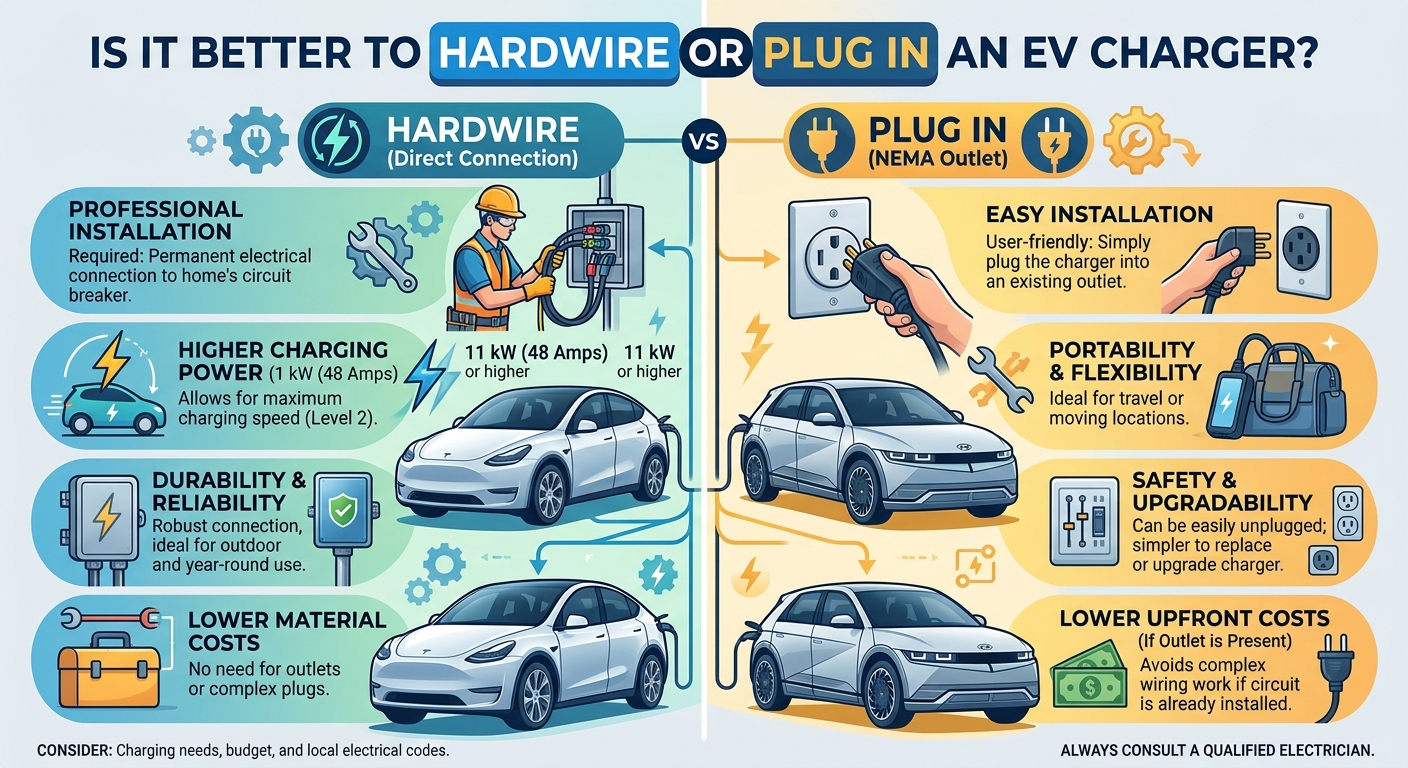
Upgrading to an electric vehicle (EV) delivers immediate savings on routine fuel costs, quiet operation, and zero local tailpipe emissions. Delivering 20 to 44 miles of driving range per hour over a high-voltage 240-volt single-phase branch circuit, home Level 2 wallboxes transform vehicle replenishment into an effortless overnight routine. However, as prospective EV owners plan their electrical installations, a fundamental technical decision arises: Is it better to hardwire or plug in an EV charger?
The short answer is: hardwiring is generally better for long-term homeowners who want maximum charging speed (up to 48A / 11.5 kW), permanent outdoor reliability, and lower risk of thermal socket wear, while plugging in via a NEMA 14-50 receptacle is better if you need portability, plan to relocate soon, or prefer easy DIY hardware replacement.
Evaluating long-term plans, National Electrical Code (NEC Article 625) requirements, circuit breaker costs, and charging performance helps determine the ideal approach for your property.
For complete hardware reviews, installer guides, and panel load calculators, visit EV Charger Advisor.
1. Hardwired vs. Plug-In: Core Differences & Capabilities
Understanding which setup best fits your lifestyle comes down to comparing installation complexity and power limits:
A. Hardwired Installation (Recommended for Homeowners)
-
How It Works: Conductor wires are connected directly from your main panel into the terminal block inside the wallbox housing.
-
Maximum Output: Up to 48 Amps continuous ($11.52\text{ kW}$) on a dedicated 60-Amp circuit breaker.
-
Primary Advantage: Eliminates wall outlet prongs, resists weather infiltration on outdoor walls, and avoids double-GFCI circuit breaker trips.
B. Plug-In Installation (Recommended for Renters & Mobility)
-
How It Works: A heavy-duty 240V NEMA 14-50 receptacle is installed on the wall, and the charger’s flexible power cord plugs into the socket.
-
Maximum Output: Capped at 40 Amps continuous ($9.6\text{ kW}$) on a 50-Amp circuit breaker under the NEC 80% continuous load rule.
-
Primary Advantage: Easy hardware swaps without calling an electrician, and the ability to unplug the wallbox and take it with you when moving homes.
To learn more about how charger power levels and wire sizes compare, check out our guide on EV charging types.
2. Four Key Reasons Hardwiring Is Superior Long-Term
While plug-in chargers provide immediate removal flexibility, direct hardwiring delivers four distinct technical advantages:
-
Unlocks 20% Faster Daily Speeds: Plug-in units on a NEMA 14-50 outlet max out at 40A ($9.6\text{ kW}$). Hardwiring to a 60A breaker allows full 48A output ($11.52\text{ kW}$), cutting full recharge times down significantly.
-
Eliminates Socket Thermal Degradation: High continuous amperage drawn for 6 to 8 hours overnight can loosen wall receptacle prongs over time, creating resistance heat and melting risks. Hardwiring creates a permanent, secure copper-to-terminal clamping bond.
-
Avoids GFCI Nuisance Breaker Trips: NEC codes mandate that 240V plug receptacles carry GFCI circuit breaker protection. Because smart wallboxes feature internal CCID ground-fault safety units, double-GFCI plug setups frequently trigger false circuit trips. Hardwired wallboxes do not require external GFCI breakers.
-
Saves on Initial Hardware Installation Costs: Hardwiring eliminates the need for expensive industrial-grade NEMA 14-50 sockets ($50–$100) and pricey 240V GFCI circuit breakers ($120–$250), often making total electrician installation cheaper.
To explore Wi-Fi-enabled smart wallboxes engineered with integrated GFCI safety mechanisms, read our guide on smart chargers.
Step-by-Step Mathematical Example: Hardwired vs. Plug-In Charging Output & Speed Math
Let us analyze the charging speed and time required to replenish 72 kWh of energy into an EV battery using a Hardwired Charger (48A output) versus a Plug-In Charger (40A output) on a single-phase $240\text{V}$ residential branch circuit.
Given Parameters:
-
Energy Target ($E$): $72 \text{ kWh}$
-
Nominal Line Voltage ($V$): $240 \text{ Volts}$
-
Hardwired Continuous Current ($I_{\text{hardwire}}$): $48 \text{ Amps}$
-
Plug-In Continuous Current ($I_{\text{plugin}}$): $40 \text{ Amps}$
Calculation 1: Power Output Comparison ($P = V \times I$)
Calculation 2: Total Charging Time for 72 kWh Replenishment
Calculation 3: Net Time Saved
Result Breakdown: Hardwiring a 48A wallbox delivers 11.52 kW of continuous power, finishing a 72 kWh recharge 1 hour and 15 minutes faster than a 40A plug-in charger.
Comparison Table: Hardwired vs. Plug-In EV Charger Decision Matrix
| Feature / Criteria | Hardwired EV Charger | Plug-In EV Charger (NEMA 14-50) |
| Max Continuous Amperage | 48 Amps (60A Breaker) | 40 Amps (50A Breaker) |
| Maximum Power Output | 11.52 kW | 9.60 kW |
| Added Range per Hour | 38 to 44 miles/hr | 30 to 37 miles/hr |
| GFCI Breaker Requirement | Not Required (Uses internal CCID) | Mandatory by NEC |
| Ideal For | Long-term homeowners & outdoor mounting | Renters, temporary homes & travel units |
Summary & Key Takeaways
-
Hardwiring Is Better for Homeowners: Direct hardwiring offers faster 48A charging speeds, superior weatherproofing, and maximum long-term electrical safety.
-
Plug-In Is Better for Flexibility: Using a NEMA 14-50 wall socket is ideal if you rent your home, plan to move, or want to swap charging hardware easily.
-
Avoid Socket Overheating: Hardwiring removes wall socket contacts, eliminating thermal loosening and prong melting risks under high continuous loads.
-
Follow NEC 125% Breaker Rules: A 48A hardwired charger requires a 60A double-pole breaker and #6 AWG copper conductor wire.













Leave a Reply