
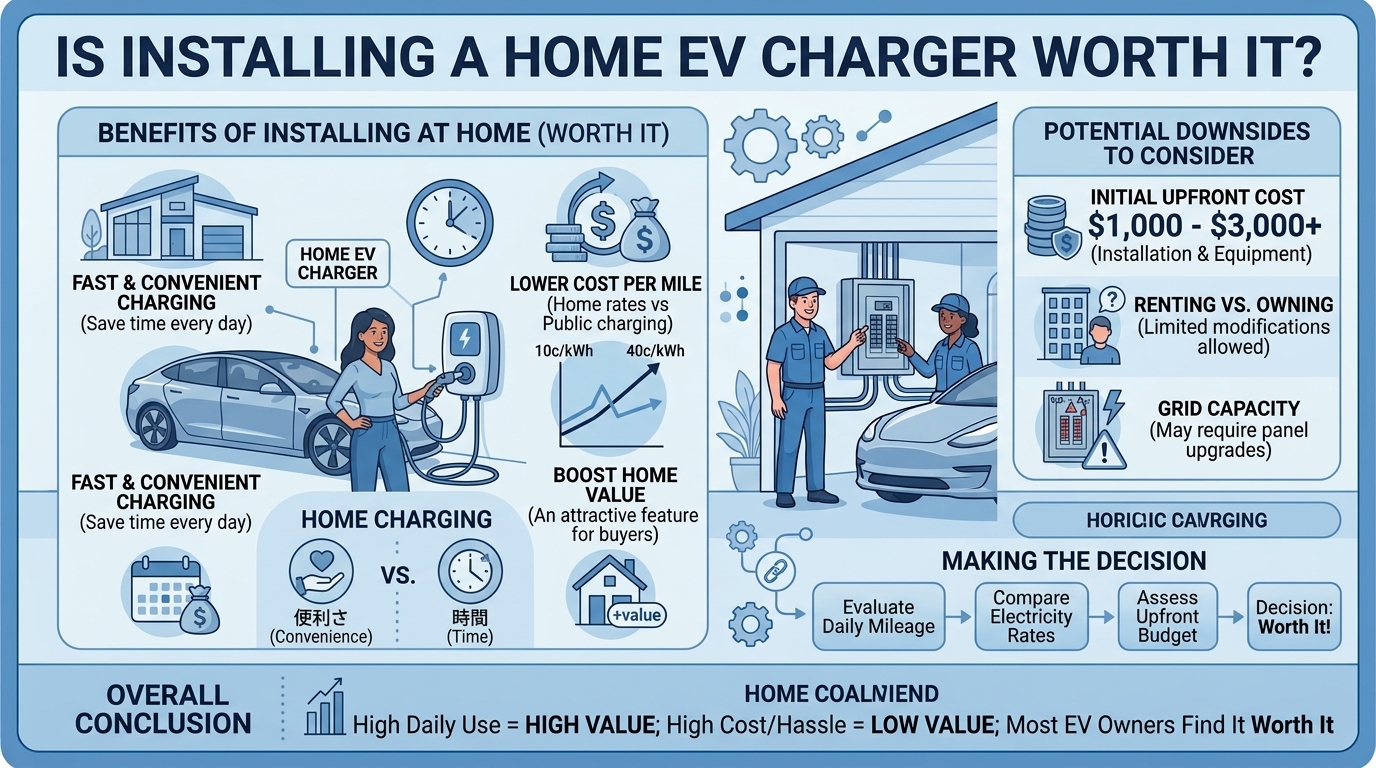
Transitioning from a traditional gasoline vehicle to an electric vehicle (EV) changes how you refuel your car. Instead of stopping at gas stations or hunting down public chargers, EV owners can simply plug in at home and wake up every morning with a full battery. However, facing the initial investment for equipment and installation leads many drivers to ask: Is installing a home EV charger worth it?
The short answer is yes, installing a home EV charger is almost always worth it if you drive regularly, have off-street parking, and want to save significantly on fuel and public charging costs.
While plugging into a standard 120V household wall outlet (Level 1) is free, upgrading to a dedicated 240V Level 2 home charger provides unmatched charging speed, daily convenience, long-term energy savings, and battery protection.
For detailed hardware reviews and home installation guides, visit EV Charger Advisor.
4 Key Reasons Why a Home Level 2 Charger Is Worth the Investment
Investing in a dedicated Level 2 wallbox offers distinct financial and practical advantages over relying on public stations or standard wall sockets.
1. Substantial Energy & Fuel Cost Savings
Public DC fast chargers (DCFC) operate as commercial businesses and charge premium rates, often ranging from $0.35 to $0.60+ per kWh (or PKR 40 to PKR 160 per kWh at public stations). By comparison, residential electricity rates are significantly cheaper, averaging $0.15 to $0.17 per kWh in North America. Taking advantage of overnight off-peak utility tariffs can drive your charging costs down by 50% to 70%, saving thousands of dollars compared to gas or public charging.
2. Daily Convenience & Time Savings
Relying exclusively on public fast chargers requires driving out of your way, waiting in station queues, and sitting in parking lots for 30 to 45 minutes. A Level 2 home charger adds 25 to 37 miles of range per hour, allowing you to recharge overnight while you sleep without wasting time.
3. Preservation of Long-Term Battery Health
Frequent reliance on high-power public DC fast chargers subjects traction battery cells to high temperatures, accelerating thermal degradation over time. Gentle, controlled Level 2 AC home charging produces far less heat, preserving your EV’s battery life and resale value.
4. Increased Property Value & Home Convenience
Electric vehicle charging infrastructure is rapidly becoming a sought-after feature in residential real estate. Installing a dedicated Level 2 charger enhances your property’s electrical infrastructure and appeals to future home buyers.
To learn more about how charger power levels compare, check out our guide on EV charging types.
Step-by-Step Mathematical Example: Calculating Your Home Charger ROI
To determine how quickly a Level 2 home charger pays for itself, let us calculate the Return on Investment (ROI) and payback period for a driver who commutes 1,200 miles per month in an EV averaging 3.3 miles per kWh.
Given Parameters:
-
Monthly Driving Distance: $1,200 \text{ miles}$
-
Monthly Energy Consumption: $\frac{1,200\text{ miles}}{3.3\text{ miles/kWh}} \approx 363.6 \text{ kWh}$
-
Public Fast Charging Rate (Average): $\$0.45 \text{ per kWh}$
-
Home Off-Peak Electricity Rate: $\$0.12 \text{ per kWh}$
-
Level 2 Charger Unit + Installation Cost (Gross): $\$1,500$
-
IRS Section 30C Tax Credit (30%): $-\$450$
-
Net Upfront Installation Investment: $\$1,500 – \$450 = \mathbf{\$1,050}$
Calculation 1: Monthly Cost Using Public Fast Chargers
Calculation 2: Monthly Cost Using Home Level 2 Charger
Calculation 3: Payback Period & 5-Year Savings
Result Breakdown: In this scenario, the Level 2 home EV charger completely pays for itself in less than 9 months. Over 5 years, the driver achieves net savings of over $6,100 compared to public fast charging.
When Might a Home EV Charger NOT Be Worth It?
While home chargers offer tremendous value for most drivers, there are a few scenarios where skipping a Level 2 installation makes sense:
1. Very Low Daily Mileage
If you drive fewer than 15 to 20 miles per day, a standard 120V household wall outlet (Level 1 trickle charging) can easily restore your daily commute overnight ($3 \text{ to } 5 \text{ miles of range per hour}$) without spending any money on electrical upgrades.
2. Renters & Temporary Living Situations
If you rent an apartment or house without landlord permission to modify the main breaker panel, spending money to hardwire equipment on a property you do not own may not be practical.
3. Access to Free Workplace Charging
If your employer provides free Level 2 AC charging at work, you can power your vehicle during work hours for free, eliminating the need for private home equipment.
To explore Wi-Fi-enabled smart chargers that support off-peak scheduling, read our guide on smart chargers.
Comparison Table: Home Level 2 Charger vs. Alternatives
| Feature | Level 1 Wall Outlet (120V) | Level 2 Home Charger (240V) | Public DC Fast Charger |
| Upfront Installation | $0 | $1,000 – $3,000 | $0 |
| Charging Speed | $3 – 5 \text{ miles/hr}$ | $25 – 37 \text{ miles/hr}$ | $100 – 300+ \text{ miles/hr}$ |
| Cost per kWh | $0.12 – $0.17 | $0.05 – $0.17 | $0.35 – $0.60+ |
| Convenience | Low (Slow charging) | Maximum (Overnight) | Moderate (Requires waiting) |
| Payback Period | Immediate | 8 – 18 Months | Never (Recurring cost) |
Summary & Key Takeaways
-
Fast Financial Return: Most daily EV commuters recoup their installation investment within 8 to 18 months.
-
Cheaper Energy: Residential off-peak electricity is 3x to 4x cheaper per kWh than commercial public DC fast chargers.
-
Daily Convenience: Wake up every morning with a full battery without waiting in line at public stations.
-
Protects Battery Longevity: Nightly Level 2 AC charging reduces thermal stress on battery chemistry compared to frequent high-power DC fast charging.













Leave a Reply