
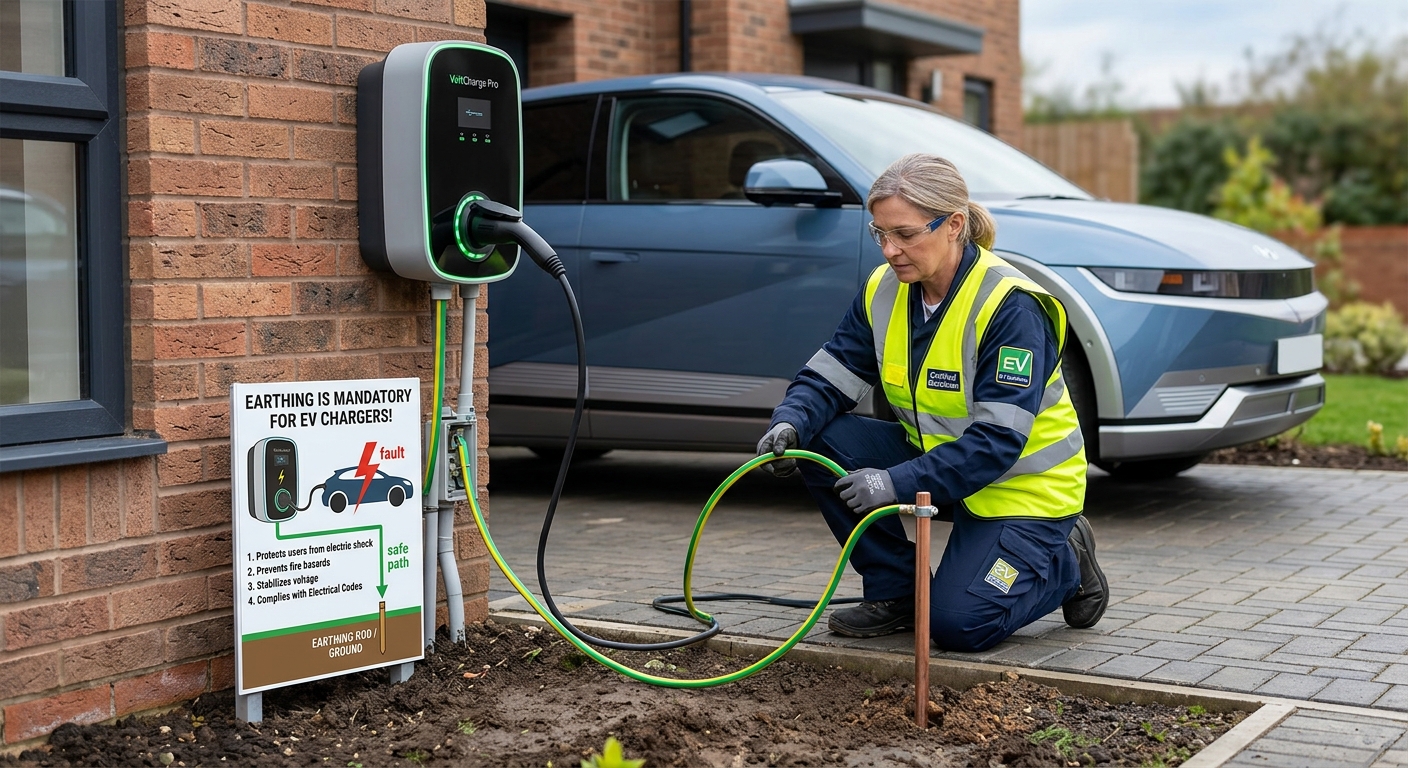
Setting up a dedicated Level 2 home electric vehicle (EV) charger is the standard way to ensure reliable overnight battery replenishment. Delivering 20 to 44 miles of driving range per hour over a high-voltage 240-volt circuit, a wallbox transforms your daily driving routine. However, during pre-installation assessments and electrician quotes, property owners frequently ask: Is earthing necessary for EV charger installation?
The short answer is: yes, proper earthing (grounding) is strictly necessary for an EV charger installation. In fact, it is a mandatory safety requirement under the National Electrical Code (NEC Article 625) and international standards (IEC 60364-7-722).
Because EV chargers operate under continuous high-power loads for hours at a time, a robust earthing system protects against lethal electric shocks, prevents vehicle chassis electrification, stabilizes supply voltage, and guards sensitive onboard electronics against surge damage.
For complete hardware reviews, installer guides, and panel load calculators, visit EV Charger Advisor.
1. Why Proper Earthing Is Mandatory for EV Chargers
An earthing (or grounding) connection provides a low-resistance path for fault currents to safely return to the Earth or main distribution board, triggering protective devices like breakers or RCDs instantly.
A. Prevention of Touch Voltage Hazards (Chassis Shock Protection)
If internal wire insulation inside the wallbox or vehicle charger degrades and contacts the metallic car body, a missing ground connection causes the entire vehicle frame to become energized at high voltage ($240\text{V}$). Proper earthing keeps touch voltage at safe levels and trips the circuit breaker before anyone receives an electric shock upon touching the door handle.
B. Ground Fault Interruption (GFCI / CCID Functional Requirements)
Under NEC 625.54, EV chargers must incorporate integrated Charge Circuit Interrupting Devices (CCID) or Ground Fault Circuit Interrupters (GFCI). These sensors continuously compare current flowing through line and neutral conductors. Without a clean, continuous ground reference path, internal safety monitoring circuits cannot operate correctly, causing the charger to fault out or refuse to initiate a session.
C. Surge & Lightning Protection
Electric vehicle battery management systems (BMS) contain sensitive microprocessors and AC-to-DC onboard inverters. Proper grounding bonded to a Surge Protection Device (SPD) channels atmospheric voltage spikes and grid transients safely into the earth, preventing costly inverter damage.
To learn more about how charger power levels and wire sizes compare, check out our guide on EV charging types.
2. Grounding Standards & Earthing Types (TN-S, TN-C-S & TT Systems)
Depending on local utility grid configurations, electrical contractors implement specific earthing strategies:
-
Equipment Grounding Conductor (EGC): In standard North American split-phase setups ($120\text{V}/240\text{V}$), a dedicated green or bare copper Equipment Grounding Conductor is run alongside line conductors from the main service panel to the wallbox enclosure.
-
Dedicated Earth Electrode (Grounding Rod / Pit): In TT grid supply systems or outdoor charging installations, a dedicated copper-bonded grounding rod (or earth pit) is driven into the soil to achieve low earth resistance ($R_{\text{earth}} < 10 \Omega$ or $25 \Omega$ per code standards).
-
PEN Fault Protection (Open NE Neutral Monitoring): In PME/TN-C-S systems, an open neutral fault on the supply grid can cause dangerous voltages on grounded metalwork. Modern smart wallboxes feature integrated PEN fault detection to automatically isolate all live conductors and ground connections if grid neutral failure is detected.
To explore Wi-Fi-enabled smart wallboxes with built-in grounding monitors, read our guide on smart chargers.
Step-by-Step Mathematical Example: Earth Fault Current & Disconnect Time
Let us calculate the earth fault loop impedance ($Z_s$) and resulting short-circuit fault current ($I_f$) during a phase-to-ground short circuit on a 240V / 40A Level 2 EV circuit to prove how earthing trips the circuit breaker.
Given Parameters:
-
Line-to-Ground Voltage ($V_0$): $120 \text{ Volts}$ (Single line to ground in $120\text{V}/240\text{V}$ split-phase)
-
Total Earth Loop Impedance ($Z_s$): $0.30 \Omega$
-
Magnetic Trip Multiplier for 50A Breaker ($I_m$): $10 \times \text{Rating} = 500 \text{ Amps}$
Calculation 1: Fault Current ($I_f$) Math
Calculation 2: Verifying Low Earth Resistance for Rapid Disconnect
To achieve instantaneous breaker tripping ($<0.1\text{ seconds}$ for a 50A breaker needing $500\text{A}$ magnetic trip current), let us calculate the maximum allowable earth loop impedance ($Z_{\text{max}}$):
Result Breakdown: If earth loop resistance is low ($0.24 \Omega$ or less), a phase-to-ground fault generates massive fault current that trips the breaker instantaneously. Conversely, if earthing is missing or high-resistance, fault current drops to safe-looking but dangerous levels (e.g., $15\text{A}$), failing to trip a 50A breaker while energizing the car chassis continuously.
Comparison Table: Earthing Requirements by Charger Installation Method
| Feature / Standard | Standard EGC (Main Panel Ground) | Dedicated Earth Rod / Pit |
| Primary Use Case | Indoor Garage / Short Runs | Outdoor Driveways / Detached Carports |
| Conductor Sizing | Sized per NEC Table 250.122 (#10 to #6 AWG) | Dedicated 8ft/10ft Grounding Rod |
| Max Recommended Resistance | $< 1 \Omega$ (Bonded to main panel) | $< 10 \Omega – 25 \Omega$ Target |
| Touch Voltage Protection | Excellent (Immediate breaker trip) | Excellent (Requires RCD/GFCI pairing) |
| GFCI / CCID Compatibility | 100% Required | 100% Required |
Summary & Key Takeaways
-
Strictly Mandatory: Earthing is essential for every home and commercial EV charger installation to protect against electrocution and equipment fire.
-
Protects Vehicle Chassis: Proper grounding prevents dangerous line voltages from energizing the vehicle body during internal component short circuits.
-
Required for GFCI Operation: Integrated CCID and GFCI safety circuits inside EV chargers rely on continuous ground monitoring to authorize charging sessions.
-
Always Test Ground Resistance: Certified electricians must verify earth loop impedance with a ground resistance meter prior to commissioning the wallbox.













Leave a Reply