
Switching to an electric vehicle (EV) unlocks immediate savings on daily fuel costs, smooth vehicle performance, and zero local tailpipe emissions. Operating on a high-voltage 240-volt single-phase branch circuit, dedicated home charging hardware transforms battery replenishment into an effortless overnight routine, delivering 20 to 44 miles of driving range per hour. However, as new vehicle owners evaluate equipment options and electrician quotes, a fundamental practical question arises: Is a Tesla charger hardwired or plug-in?
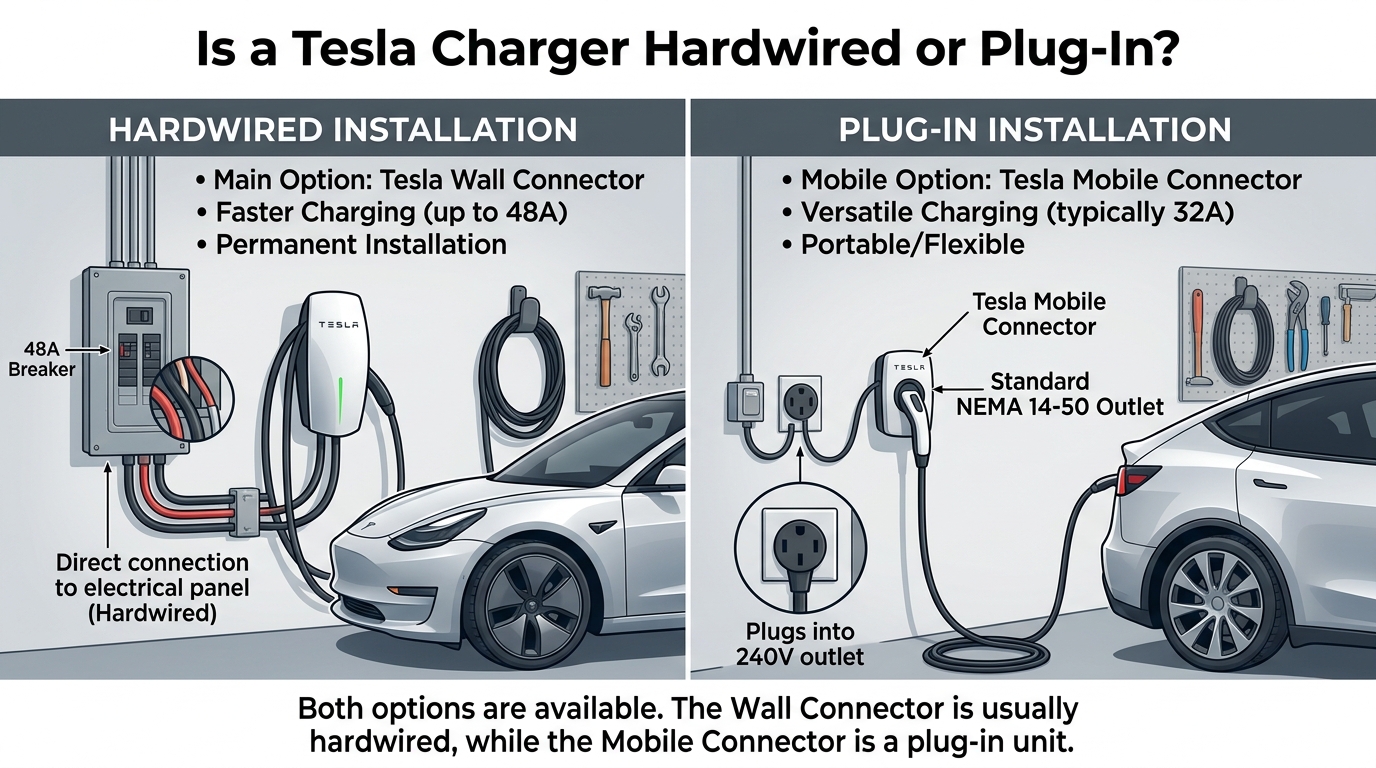
The short answer is: Tesla offers both hardwired and plug-in charging options. The flagship Tesla Wall Connector is a hardwired wallbox designed for maximum speeds (up to 48A / 11.5 kW), while the Tesla Mobile Connector is a plug-in portable solution designed for standard 120V outlets or 240V NEMA 14-50 wall receptacles (capped at 32A / 7.7 kW).
Choosing between a hardwired wallbox and a portable plug-in adapter depends on your desired charging speed, daily mileage needs, building permit preferences, and budget constraints under National Electrical Code (NEC Article 625) standards.
For complete hardware reviews, installer guides, and panel load calculators, visit EV Charger Advisor.
1. Comparing Tesla’s Charging Options
Tesla divides its residential charging line into two primary hardware categories:
A. The Hardwired Option: Tesla Wall Connector (Gen 3 & Universal)
-
Electrical Connection: Hardwired directly into a dedicated branch circuit junction box.
-
Maximum Output Speed: Up to 48 Amps continuous ($11.52\text{ kW}$) on a dedicated 60-Amp circuit breaker.
-
Added Range per Hour: Restores 36 to 44 miles per hour.
-
Key Advantage: Direct hardwiring eliminates socket degradation, supports power sharing across multiple wallboxes on a single panel, and features built-in CCID ground-fault protection that eliminates the need for expensive exterior GFCI breakers.
B. The Plug-In Option: Tesla Mobile Connector
-
Electrical Connection: Plugs directly into an existing wall socket. Includes adapters for standard 120V NEMA 5-15 outlets (Level 1) or 240V NEMA 14-50 heavy-duty receptacles (Level 2).
-
Maximum Output Speed: Capped at 32 Amps continuous ($7.68\text{ kW}$) when using the NEMA 14-50 adapter on a 40A/50A breaker.
-
Added Range per Hour: Restores 20 to 30 miles per hour.
-
Key Advantage: Portability. You can easily unplug the unit, pack it in your trunk for road trips, or take it with you if you move to a rental property.
To learn more about how charger power levels and wire sizes compare, check out our guide on EV charging types.
2. Why Hardwiring Delivers Superior Performance & Safety
While plug-in chargers offer quick mobility, hardwiring a Wall Connector provides four significant technical advantages:
-
Unlocks 20% Faster Charging Speeds: Under NEC rules, NEMA 14-50 plug receptacles are capped at 40A continuous output on a 50A circuit. Hardwiring directly to a 60A breaker allows full 48-Amp continuous delivery.
-
Eliminates Plug Thermal Failure Points: High-amperage continuous loads across wall sockets can cause terminal loosening and plug overheating over time. Hardwiring creates a permanent, secure copper connection.
-
Avoids GFCI Nuisance Tripping: NEC standards mandate that 240V wall sockets be protected by GFCI circuit breakers. Because smart wallboxes feature internal ground-fault monitoring, double-GFCI plug-in setups often trigger false breaker trips. Hardwired setups do not require external GFCI breakers.
-
Clean, Weatherproof Aesthetics: Hardwiring allows conduit to enter cleanly through the rear of the wallbox housing, hiding external wiring and improving outdoor weather sealing.
To explore Wi-Fi-enabled smart wallboxes engineered with integrated GFCI safety mechanisms, read our guide on smart chargers.
Step-by-Step Mathematical Example: Hardwired vs. Plug-In Charging Output & Speed Math
Let us compare the charging time to replenish 60 kWh of energy into a vehicle battery using a Hardwired Wall Connector (48A output) versus a Plug-in Mobile Connector (32A output) on a single-phase $240\text{V}$ residential supply.
Given Parameters:
-
Required Energy Replenishment ($E$): $60 \text{ kWh}$
-
Nominal Line Voltage ($V$): $240 \text{ Volts}$
-
Hardwired Charger Draw ($I_{\text{hardwire}}$): $48 \text{ Amps}$
-
Plug-In Charger Draw ($I_{\text{plugin}}$): $32 \text{ Amps}$
Calculation 1: Power Output Comparison ($P = V \times I$)
Calculation 2: Total Charging Time for 60 kWh Replenishment
Calculation 3: Net Time Saved
Result Breakdown: Hardwiring a 48A Wall Connector delivers 11.52 kW of continuous power, saving 2 hours and 36 minutes on a 60 kWh recharge compared to a 32A plug-in Mobile Connector.
Comparison Table: Tesla Wall Connector (Hardwired) vs. Mobile Connector (Plug-in)
| Feature / Criteria | Tesla Wall Connector (Hardwired) | Tesla Mobile Connector (Plug-In) |
| Electrical Connection | Dedicated hardwired junction box | NEMA 14-50 or 5-15 wall socket |
| Max Continuous Amperage | 48 Amps (60A Breaker) | 32 Amps (50A Breaker) |
| Maximum Power Output | 11.52 kW | 7.68 kW |
| Added Range per Hour | 36 to 44 miles/hr | 20 to 30 miles/hr |
| Portability | Fixed installation | Portable (Stays in trunk) |
Summary & Key Takeaways
-
Both Options Exist: Tesla provides the hardwired Wall Connector for permanent home mounting and the plug-in Mobile Connector for portable use.
-
Hardwired Is 20% Faster: Hardwiring supports 48A continuous draw (11.52 kW), while plug-in sockets are limited to 32A (7.68 kW).
-
Plug-In Offers Portability: The Mobile Connector is ideal for renters or drivers who want a travel charger to keep in their trunk.
-
Hardwiring Improves Safety: Direct hardwiring avoids socket thermal degradation, prevents false GFCI trips, and creates a sleek installation.













Leave a Reply