
Adopting an electric vehicle (EV) brings rapid daily fuel savings, smooth silent operation, and zero local tailpipe emissions. While setting up home battery replenishment transforms your garage or driveway into a private fueling hub, navigating electrical terminology can raise practical questions. As homeowners inspect 240-volt wall receptacles and mobile charging cords, a common technical question arises: Is a NEMA 14-50 outlet considered Level 2 EV charging?
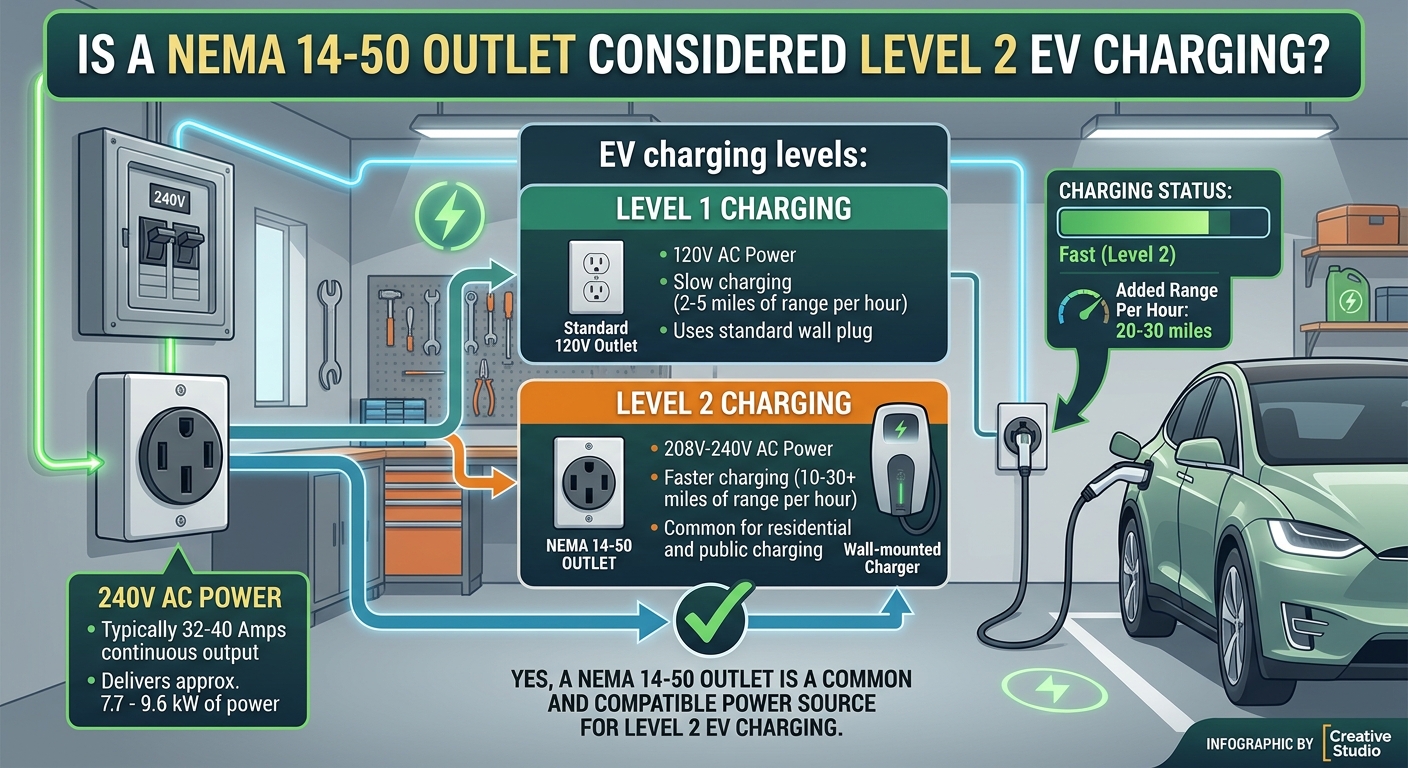
The short answer is: yes, a NEMA 14-50 outlet is considered Level 2 EV charging when paired with a compatible 240-volt mobile connector or plug-in wallbox, delivering between 32 Amps ($7.68\text{ kW}$) and 40 Amps ($9.60\text{ kW}$) of continuous power to restore 25 to 37 miles of driving range per hour.
Understanding how the NEMA 14-50 receptacle provides the standard 240V AC power supply required for high-speed home charging helps ensure your setup is code-compliant, safe, and efficient.
For complete hardware reviews, installer guides, and panel load calculators, visit EV Charger Advisor.
1. Why a NEMA 14-50 Outlet Enables Level 2 Charging
Electric vehicle charging is categorized into three standardized levels based on electrical supply voltage and power delivery:
A. Level 1 Charging (120-Volt AC Standard Household Outlets)
Standard 120V NEMA 5-15 wall outlets supply 1.2 kW to 1.4 kW of trickle power, adding only 3 to 5 miles of range per hour. It takes upwards of 35 to 45 hours to fully recharge a depleted battery electric vehicle (BEV).
B. Level 2 Charging (208V to 240-Volt AC High-Voltage Circuits)
Level 2 charging includes any residential or commercial charging setup operating on a single-phase 208V to 240V AC supply. Because a NEMA 14-50 receptacle supplies 240 Volts on a dedicated 50-Amp circuit breaker, plugging a Level 2 mobile charging cable or wallbox into this outlet qualifies directly as Level 2 charging.
C. Level 3 / DC Fast Charging (400V to 800-Volt Direct Current)
Commercial DC fast chargers (50 kW to 350 kW) bypass the car’s onboard AC/DC converter to deliver rapid energy directly to the battery pack, replenishing 10% to 80% range in 15 to 30 minutes.
To learn more about how charger power levels and wire sizes compare, check out our guide on EV charging types.
2. Power Output Differences: NEMA 14-50 Plug-In vs. Hardwired Level 2
While a NEMA 14-50 outlet provides Level 2 speeds, understanding continuous load limits under National Electrical Code (NEC Article 625) is essential:
-
Plug-In Level 2 via NEMA 14-50 Outlet (Capped at 32A or 40A): Under the NEC 80% continuous duty safety rule, a 50A breaker feeding a NEMA 14-50 socket allows a continuous draw of 40 Amps ($9.60\text{ kW}$). Many portable travel chargers included with vehicles draw 32 Amps ($7.68\text{ kW}$).
-
Hardwired Level 2 Charger (Unlocks Maximum 48A / 11.52 kW): Direct hardwiring from the panel to a wallbox allows installation on a dedicated 60A double-pole breaker, unlocking full 48-Amp continuous output for 20% faster charging without relying on a wall socket.
-
Mandatory Industrial-Grade Receptacles: Continuous 40A drawing across cheap builder-grade 14-50 range outlets can cause contact jaw loosening and faceplate melting. Always specify industrial-grade receptacles (such as Hubbell or Bryant) paired with a 50A double-pole GFCI breaker.
To explore Wi-Fi-enabled smart wallboxes engineered with integrated GFCI safety mechanisms, read our guide on smart chargers.
Step-by-Step Mathematical Example: NEMA 14-50 Level 2 Recharge Time Math
Let us calculate the total charging time required to restore 50 kWh of usable energy into an EV battery using a 32-Amp portable Level 2 charger plugged into a NEMA 14-50 outlet ($240\text{V}$ single-phase supply) operating at 90% onboard AC/DC conversion efficiency.
Given Parameters:
-
Required Energy Replenishment ($E_{\text{net}}$): $50 \text{ kWh}$
-
Nominal Line Voltage ($V$): $240 \text{ Volts}$
-
Continuous Current Draw ($I$): $32 \text{ Amps}$
-
Onboard AC/DC Conversion Efficiency ($\eta$): $90\% \quad (0.90)$
Calculation 1: Gross Power Output ($P_{\text{gross}}$)
Calculation 2: Net Power Delivered to Battery Pack ($P_{\text{net}}$)
Calculation 3: Required Recharge Time ($T$)
Result Breakdown: Plugging a 32-Amp portable charger into a 240V NEMA 14-50 outlet provides 7.68 kW of Level 2 gross power, restoring 50 kWh of usable range in 7 hours and 14 minutes overnight.
Comparison Table: Level 1 vs. NEMA 14-50 Level 2 vs. Hardwired Level 2
| Feature / Criteria | Standard 120V Outlet (Level 1) | NEMA 14-50 Outlet (Level 2) | Hardwired Wallbox (Level 2) |
| Supply Voltage | 120V Single-Phase | 240V Single-Phase | 240V Single-Phase |
| Circuit Breaker Size | 15A or 20A Single-Pole | 50A Double-Pole | 60A Double-Pole |
| Max Continuous Amperage | 12 Amps | 32A to 40 Amps | 48 Amps |
| Gross Power Output | 1.44 kW | 7.68 kW – 9.60 kW | 11.52 kW |
| Added Range per Hour | $3 – 5 \text{ miles/hr}$ | $25 – 37 \text{ miles/hr}$ | $38 – 44 \text{ miles/hr}$ |
Summary & Key Takeaways
-
Yes, It Is Level 2: A NEMA 14-50 outlet provides 240V single-phase electricity, making it a standard Level 2 charging option.
-
Restores 25 to 37 Miles per Hour: Delivering 7.68 kW to 9.60 kW of power, a 14-50 outlet easily fully replenishes an EV battery overnight.
-
Respect the 80% Continuous Rule: On a 50A circuit breaker, maximum continuous draw is strictly limited to 40 Amps under NEC 625.
-
Use Industrial-Grade Hardware: Ensure your installer fits a heavy-duty industrial receptacle (Hubbell/Bryant) and a 50A GFCI circuit breaker to prevent overheating.













Leave a Reply