
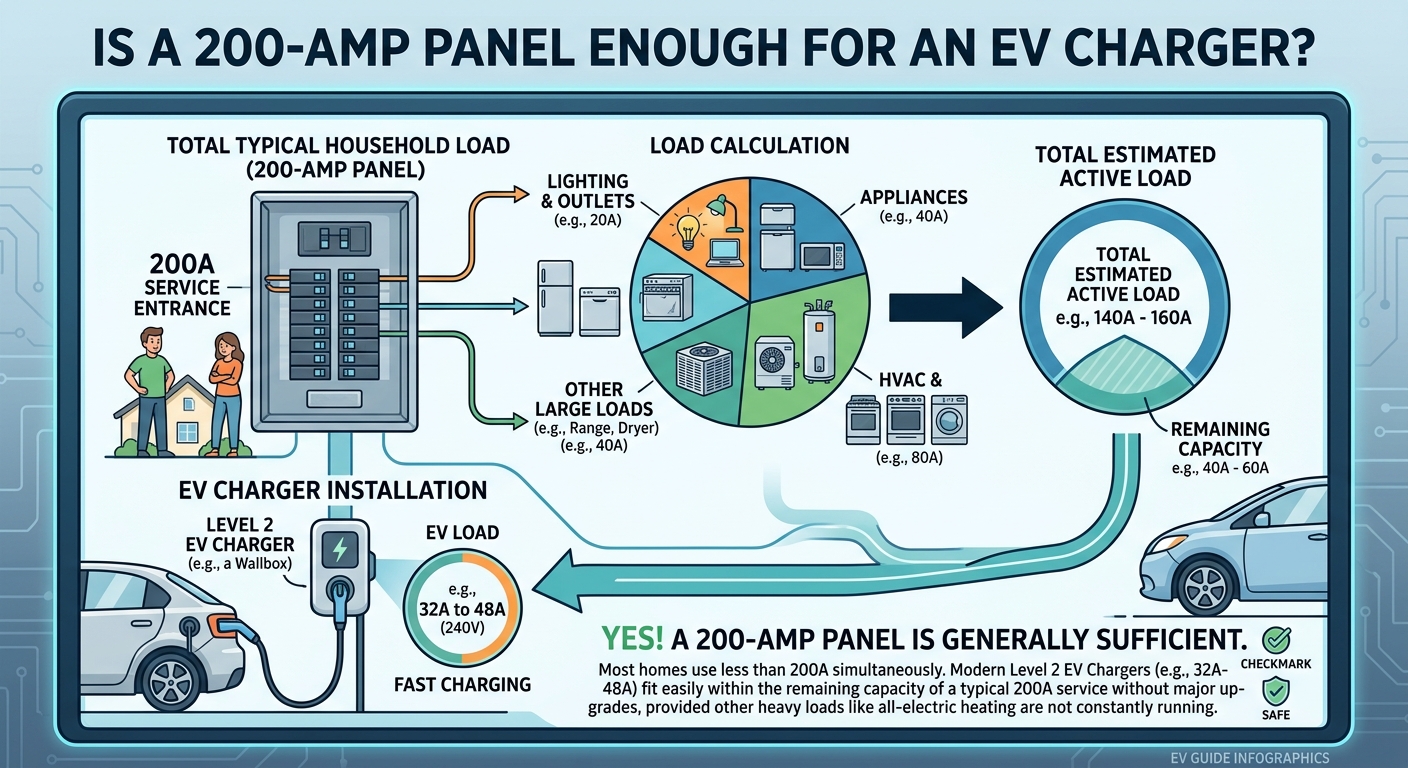
Upgrading to an electric vehicle brings the convenience of home charging, where you can easily replenish your battery pack while you sleep. Installing a high-power Level 2 EV charger requires a dedicated 240-volt branch circuit that can pull continuous current for hours at a time. For homeowners evaluating their electrical service, a primary question arises: Is a 200-amp panel enough for an EV charger?
The short answer is: yes, a 200-amp electrical panel is more than enough for almost all modern homes to run a high-speed Level 2 EV charger, even while powering standard central air conditioning, electric appliances, and household electronics simultaneously.
A 200-amp service panel provides ample electrical capacity ($48\text{ kW}$ total potential power), making it the gold standard for modern home electrification and multi-vehicle charging setups under the National Electrical Code (NEC).
For detailed hardware reviews, panel load calculators, and installer guides, visit EV Charger Advisor.
Why a 200-Amp Panel Provides Ideal Capacity for EV Charging
Electrical panel capacity is measured by the total continuous amperage it can deliver across a single-phase $240\text{-Volt}$ main power supply:
Under NEC Article 625, electric vehicle charging is legally classified as a continuous load (drawing 100% capacity for 3 hours or longer). Consequently, branch circuits and circuit breakers must be oversized by 125% of the charger’s continuous draw (or conversely, the charger can only draw up to 80% of the breaker’s total rating):
-
48-Amp Continuous Charger ($11.5\text{ kW}$): Requires a dedicated 60-Amp double-pole circuit breaker.
-
40-Amp Continuous Charger ($9.6\text{ kW}$): Requires a dedicated 50-Amp double-pole circuit breaker.
-
32-Amp Continuous Charger ($7.7\text{ kW}$): Requires a dedicated 40-Amp double-pole circuit breaker.
Even when installing a maximum-speed residential Level 2 wallbox drawing $48\text{ Amps}$ continuous ($11.5\text{ kW}$), a 200-amp panel still retains over $36.5\text{ kW}$ ($152\text{ Amps}$) of capacity to run the rest of your home.
To learn more about how charger power levels and wire sizes compare, check out our guide on EV charging types.
Step-by-Step Mathematical Example: Panel Load Calculation (NEC Article 220)
To demonstrate why a 200-amp panel handles an EV charger so comfortably, let us perform a sample load calculation according to NEC Article 220 for a fully equipped modern home.
Given Household Parameters:
-
Main Panel Rating: $200 \text{ Amps @ 240V} = 48,000 \text{ Watts}$
-
Max Continuous Safety Margin (80% Continuous Limit): $160 \text{ Amps} = 38,400 \text{ Watts}$
-
Existing Household Baseline Load:
-
Central AC System ($4\text{ Ton}$): $5,000 \text{ Watts } (20.8\text{A})$
-
Electric Water Heater: $4,500 \text{ Watts } (18.75\text{A})$
-
Electric Clothes Dryer: $5,000 \text{ Watts } (20.8\text{A})$
-
Electric Range / Oven: $6,000 \text{ Watts } (25\text{A})$
-
General Lighting & Small Appliances: $4,500 \text{ Watts } (18.75\text{A})$
-
Calculation 1: Calculating Total Existing Household Demand
Calculation 2: Adding a 48-Amp Continuous Level 2 Charger ($60\text{A}$ Breaker / $11.52\text{ kW}$ Draw)
Calculation 3: Safety Capacity Margin Check
Result Breakdown: Even in a heavy all-electric home operating central AC, water heating, drying, and cooking simultaneously, adding a maximum-output 48-Amp Level 2 EV charger keeps total demand ($152.17\text{A}$) safely under the 200A panel’s $160\text{A}$ continuous limit.
To explore Wi-Fi-enabled smart wallboxes that support energy tracking, read our guide on smart chargers.
Can a 200-Amp Panel Support TWO EV Chargers?
As families transition to multi-EV households, running two Level 2 chargers on a single 200-amp service panel becomes an essential consideration.
1. Dual Independent 48A Circuits ($120\text{A}$ Breakers Total)
Running two independent 48A chargers ($96\text{A}$ continuous combined draw) on separate 60A breakers can strain a 200A panel if other high-power all-electric appliances operate simultaneously.
2. Dual Chargers with Smart Load Sharing
Many modern Level 2 chargers support Power Sharing (Dynamic Load Balancing). Two wallboxes communicate over Wi-Fi or hardwired data lines, sharing a single 50-Amp or 60-Amp circuit breaker:
-
When one vehicle is plugged in, it charges at full speed ($48\text{ Amps} / 11.5\text{ kW}$).
-
When two vehicles plug in, the chargers automatically split the available current ($24\text{ Amps}$ each), returning both to full power as each vehicle finishes charging.
Comparison Table: Panel Capacities & EV Charging Limits
| Electrical Panel Rating | Safe Continuous Limit (80% Rule) | Maximum EV Charger Allowed | Added Range per Hour | Multi-EV Capable? |
| 100-Amp Panel | $80 \text{ Amps } (19.2\text{ kW})$ | 16A – 24A (Or Dynamic EVEMS) | $12 – 22 \text{ miles/hr}$ | No |
| 150-Amp Panel | $120 \text{ Amps } (28.8\text{ kW})$ | 32A – 40A | $22 – 34 \text{ miles/hr}$ | Limited |
| 200-Amp Panel | 160 Amps ($38.4\text{ kW}$) | 48A ($11.52\text{ kW}$ on 60A Breaker) | 36 – 44 miles/hr | Yes (With Load Sharing) |
| 400-Amp Panel | 320 Amps ($76.8\text{ kW}$) | Dual 80A Chargers ($38.4\text{ kW}$ Total) | $60+ \text{ miles/hr}$ per car | Yes (Unrestricted) |
Summary & Key Takeaways
-
More Than Sufficient: A 200-amp electrical panel provides $48\text{ kW}$ of total power, making it completely sufficient for running high-speed Level 2 EV charging.
-
Handles Full 48A Charging: A 200A panel effortlessly supports a hardwired 48A charger ($11.5\text{ kW}$) on a 60-amp double-pole breaker.
-
Multi-EV Ready: A 200A panel can easily support two electric vehicles using smart power-sharing chargers on a shared circuit.
-
Future-Proof Standard: Upgrading to or maintaining a 200A panel ensures long-term compatibility with home solar, battery storage, and complete electrification.













Leave a Reply