
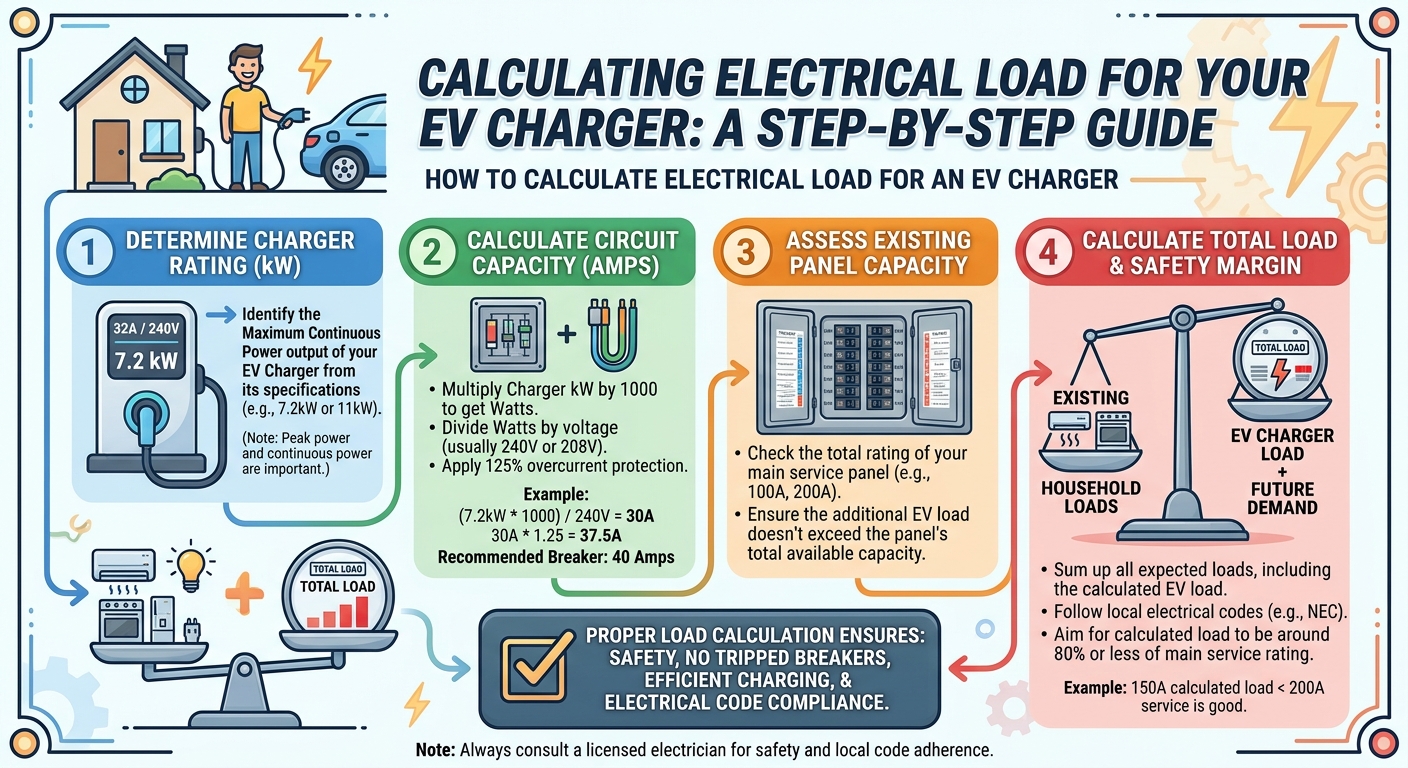
Upgrading your home for electric vehicle (EV) charging delivers immediate fuel savings, whisper-quiet vehicle operation, and the ultimate convenience of starting each morning with a fully replenished battery. Operating on a dedicated high-voltage 240-volt single-phase branch circuit, installing a Level 2 wallbox provides 20 to 44 miles of driving range per hour. However, before installing a new high-amperage circuit breaker, a fundamental electrical safety question must be answered: How do you calculate electrical load for an EV charger?
The short answer is: to calculate the electrical load for an EV charger, apply the National Electrical Code (NEC Article 220) load calculation method to determine your home’s existing continuous and non-continuous demand, then add 125% of the EV charger’s output rating (under NEC Article 625) to verify your main panel has adequate headroom.
Calculating panel capacity prevents severe main circuit breaker trips, voltage drop, and electrical fire hazards, ensuring your home charging setup remains safe and fully code-compliant.
For complete hardware reviews, installer guides, and panel load calculators, visit EV Charger Advisor.
1. The NEC Method for EV Charger Load Calculations
Calculating total electrical demand requires evaluating your existing household loads alongside the continuous draw of electric vehicle supply equipment (EVSE):
A. Step 1: Calculate Existing Household General Loads (NEC 220.83 Standard Demand)
-
General Lighting & Receptacles: 3 Watts per square foot of living space.
-
Small Appliance & Laundry Circuits: 1,500 Watts per circuit (minimum 2 small appliance circuits + 1 laundry circuit = 4,500W).
-
Fixed Nameplate Appliances: Sum the exact wattage of all fixed appliances (electric oven/range, dishwasher, garbage disposal, water heater).
-
Apply Demand Factors: The first 10,000 Watts of general loads are calculated at 100%, while the remaining balance above 10,000 Watts is calculated at 40%.
B. Step 2: Add HVAC Heating & Cooling Loads
-
Compare total Air Conditioning wattage against Electric Heating wattage. Under NEC rules, take 100% of the larger load (since heating and cooling do not run simultaneously at maximum output).
C. Step 3: Apply the NEC 625 Continuous Duty Rule (125%) to the EV Charger
EV charging is defined as a continuous load (drawing maximum current for 3 hours or more).
-
The 125% Breaker & Load Rule: Sizing for an EV charger requires multiplying the continuous charging amperage by 1.25.
-
Formula: $I_{\text{load}} = I_{\text{charger}} \times 1.25$.
-
Example (48A Charger Output): $48\text{A} \times 1.25 = \mathbf{60 \text{ Amps}}$ ($14.40\text{ kVA}$ panel allocation at $240\text{V}$).
To learn more about how charger power levels and wire sizes compare, check out our guide on EV charging types.
2. Panel Headroom & Load Management Alternatives
Once total calculated kVA demand is established, compare it against your main panel’s service rating:
-
Calculating Available Panel Headroom: Subtract your total calculated load (in Amps) from your main breaker rating (e.g., 100A, 150A, or 200A). The remaining difference represents your safe spare capacity.
-
What If Your Panel Lacks Capacity?
-
Option A (Main Service Panel Upgrade): Upgrade your service panel from 100A to 200A ($1,500 to $4,000+).
-
Option B (Software Amperage De-rating): Lower the charger’s continuous output via software commissioning (e.g., set a Wall Connector to 32A or 24A output).
-
Option C (Dynamic Load Management / EVEMS): Install a smart current-monitoring module (CT clamps) that automatically throttles EV charging speed whenever household appliances cycle on, satisfying NEC 625.42 without requiring a service upgrade.
-
To explore Wi-Fi-enabled smart wallboxes engineered with integrated load management features, read our guide on smart chargers.
Step-by-Step Mathematical Example: Complete NEC Home Load Calculation
Let us perform a complete NEC 220.83 Existing Dwelling Load Calculation for a 2,000 sq. ft. home with a 100-Amp Main Panel ($240\text{V}$ single-phase supply = $24,000\text{ VA}$ capacity) evaluating the addition of a 40-Amp continuous EV Charger ($9.60\text{ kW}$ output).
Given Household Specs:
-
Living Area: $2,000 \text{ sq. ft.}$
-
Circuits: 2 Small Appliance ($3,000\text{W}$) + 1 Laundry ($1,500\text{W}$)
-
Appliances: Electric Range ($9,000\text{W}$), Water Heater ($4,500\text{W}$), Clothes Dryer ($5,000\text{W}$)
-
HVAC: Central A/C Unit ($6,000\text{W}$)
-
Proposed EV Charger: $40 \text{ Amps continuous output}$
Calculation 1: General Raw Household Load (NEC 220.83)
Calculation 2: Apply NEC General Demand Factor
Calculation 3: Add HVAC & EV Charger Loads (125% Rule)
Calculation 4: Total Panel Amperage & Headroom Verification
Result Breakdown: The calculated total load of 148.33 Amps exceeds the existing 100-Amp main panel rating. Installing a 40A charger directly on this panel violates NEC safety codes. The homeowner must either:
-
Upgrade to a 200-Amp main service panel,
-
De-rate the EV charger continuous output to 16 Amps (20A breaker), or
-
Install an EVEMS Dynamic Load Management system.
Comparison Table: EV Charger Panel Headroom Requirements
| EV Charger Output | Breaker Sizing (125%) | Power Output (240V) | Panel Demand Addition | Minimum Recommended Service |
| 48 Amps | 60 Amps | 11.52 kW | 14.40 kVA | 200-Amp Panel Service |
| 40 Amps | 50 Amps | 9.60 kW | 12.00 kVA | 150A – 200A Panel Service |
| 32 Amps | 40 Amps | 7.68 kW | 9.60 kVA | 100A (With Load Space) – 150A |
| 24 Amps | 30 Amps | 5.76 kW | 7.20 kVA | 100-Amp Panel Service |
| 16 Amps | 20 Amps | 3.84 kW | 4.80 kVA | 100-Amp Panel Service |
Summary & Key Takeaways
-
Apply NEC Article 220 & 625: Sum general household loads with demand factors, then add 125% of the EV charger’s continuous current draw.
-
Never Exceed Main Panel Rating: Total calculated demand in Amps must remain below the main service breaker capacity (e.g., 100A or 200A).
-
Continuous Loads Sized at 125%: A 48A continuous charging output requires a 60A breaker allocation (14.4 kVA panel demand).
-
Load Management Avoids Upgrades: If total load exceeds panel capacity, dynamic EVEMS hardware allows high-speed charging without expensive panel upgrades.













Leave a Reply