
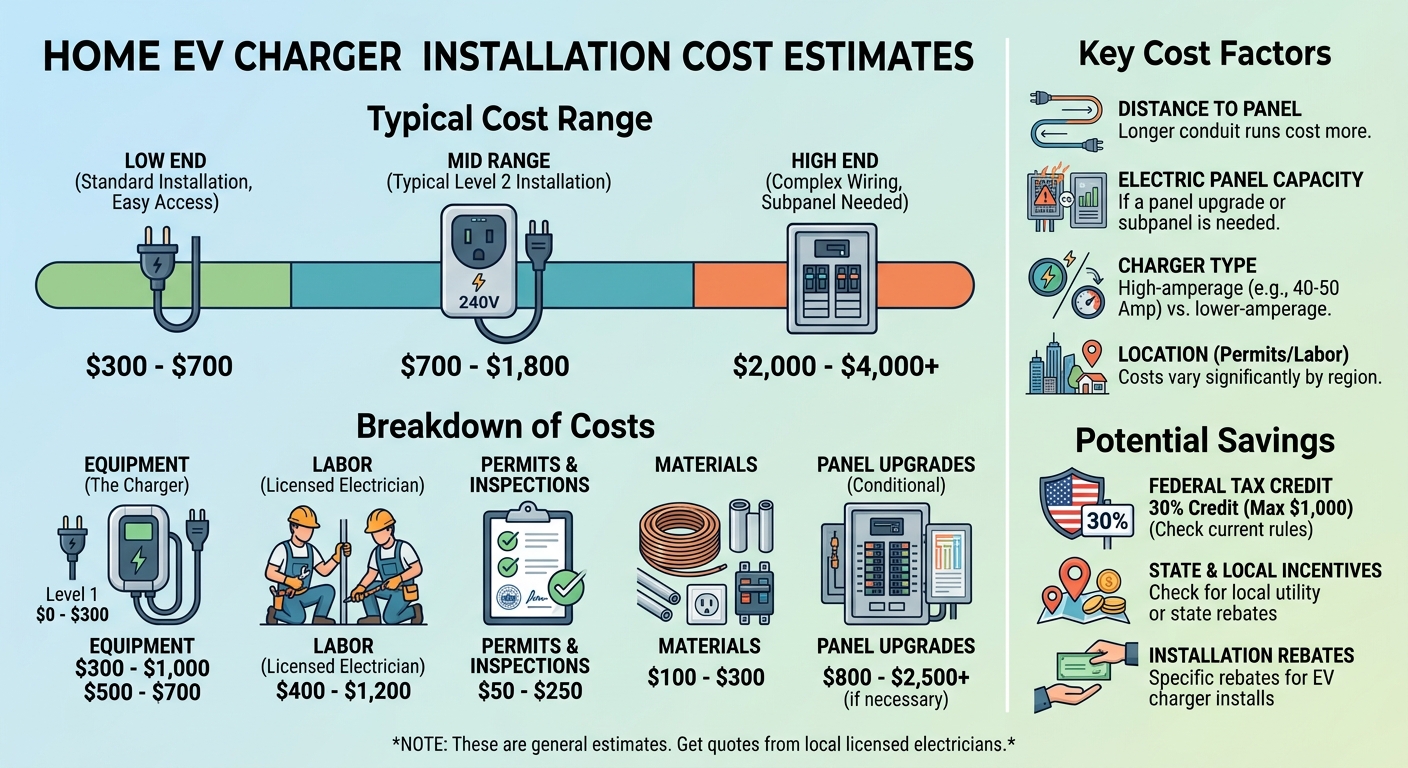
Installing a dedicated Level 2 home electric vehicle (EV) charger is the ultimate upgrade for convenient daily driving. Operating on a 240-volt single-phase branch circuit, a Level 2 wallbox adds 20 to 44 miles of driving range per hour (or 30 to 60 km of range per hour), allowing you to wake up to a fully charged battery every morning. However, when evaluating the upfront financial commitment, prospective EV owners frequently ask: How much should it cost to install an EV charger at home?
The short answer is: installing a home EV charger typically costs between $350 and $600 USD for a standard residential installation (combining the charger unit, general setup, and basic wiring), or between $800 and $2,200 USD for premium smart wallboxes or complex long-conduit runs. If your home requires a heavy-duty 200A service or three-phase meter upgrade, total costs can scale up to $3,500+.
Understanding how hardware specifications, electrician labor rates, wiring distance, and electrical panel capacity dictate final installation pricing helps you budget effectively while maximizing return on investment through fuel savings.
For complete hardware breakdowns, installer guides, and panel load calculators, visit EV Charger Advisor.
1. Major Cost Components Breakdown
To plan an accurate budget for setting up a home Level 2 wallbox, it helps to break down project expenses into four primary categories:
A. Wallbox Charger Hardware ($200 – $500)
Hardware pricing depends heavily on output wattage and smart capabilities:
-
7.4 kW Single-Phase Wallbox: Ideal for standard residential setups, delivering 25 to 30 km of range per hour.
-
11 kW / 22 kW Three-Phase Wallbox: Designed for dual-port or fast three-phase AC home charging setups delivering 40 to 65 km of range per hour.
B. Electrical Wiring & Raw Materials ($50 – $150)
Heavy copper conductor cables (such as #6 AWG THHN in conduit or 10mm² / 16mm² copper lines) are priced per meter or linear foot. Running heavy conduit over long distances across lawns, carports, or multi-story homes increases material costs.
C. Certified Electrician Labor & Breakers ($50 – $150)
Hiring a certified electrician to install dedicated double-pole or 4-pole breakers, proper grounding/earthing pits, and industrial terminal connections ensures NEC and local utility safety compliance.
D. Panel Service / Three-Phase Grid Upgrades (Optional: $500 – $2,000+)
If an NEC Article 220 load calculation reveals your home’s main panel lacks capacity headroom, upgrading to a 200A service or installing a three-phase meter setup adds to the overall project budget.
To learn more about how charger power levels and wire sizes compare, check out our guide on EV charging types.
Step-by-Step Mathematical Example: Installation Cost Breakdown & ROI
Let us analyze a typical residential installation of a 7.4 kW Smart Level 2 Wallbox mounted 10 meters from the main distribution panel on a standard home grid.
Given Project Cost Parameters (Standard USD Benchmark):
-
7.4 kW Smart Type-2 Wallbox Unit: $\$320$
-
Dedicated 40A Breaker + SPD (Surge Protection): $\$30$
-
10 Meters of Heavy Copper Cable & PVC Conduit: $\$60$
-
Grounding Pit / Earthing Validation: $\$30$
-
Professional Installer Labor: $\$60$
Calculation 1: Total Installation Cost Math
Calculation 2: Payback Period via Fuel Savings (vs. Petrol)
Assuming an annual commute of 15,000 km (approx. 9,300 miles):
-
Gasoline Car Expense ($12 \text{ km/L}$ @ $\$1.00/\text{L}$): $\frac{15,000}{12} \times 1.00 = \mathbf{\$1,250 \text{ per year}}$
-
EV Home Charging Expense ($0.15 \text{ kWh/km}$ @ $\$0.18/\text{kWh}$): $15,000 \times 0.15 \times 0.18 = \mathbf{\$405 \text{ per year}}$
Result Breakdown: Although spending $500 USD upfront requires an initial outlay, massive fuel savings pay off the entire installation expense in under 8 months.
To explore Wi-Fi-enabled smart wallboxes that support automated off-peak scheduling, read our guide on smart chargers.
Comparison Table: EV Charger Installation Cost Tiers
| Setup Tier | Physical Scope | Estimated Cost (USD) | Key Factors |
| Basic Plug-In | Plug mobile unit into existing 240V socket | $150 – $300 | Uses existing heavy-duty receptacle |
| Standard Wallbox | New 40A/50A circuit (< 15m run, ample panel room) | $350 – $600 | Most common turnkey home setup |
| Long Wiring Run | Extended conduit path (30m+ or trenching) | $800 – $1,800 | High cable & labor material costs |
| Panel Service Upgrade | 100A to 200A service panel or 3-phase upgrade | $1,500 – $3,500+ | Includes panel, meter & utility fees |
Summary & Key Takeaways
-
Standard Cost Expectation: Most standard home EV charger installations cost between $350 and $600 USD total.
-
Fast Return on Investment: Substantial fuel savings compared to petrol recoup the full cost of home charging in 7 to 12 months.
-
Proper Grounding Is Mandatory: Always verify that your installer incorporates a dedicated earthing pit and surge protection to safeguard sensitive vehicle electronics against grid fluctuations.
-
Schedule Off-Peak Charging: Utilizing smart app timers to charge late at night takes advantage of lower off-peak electricity tariffs, further accelerating your ROI.













Leave a Reply