
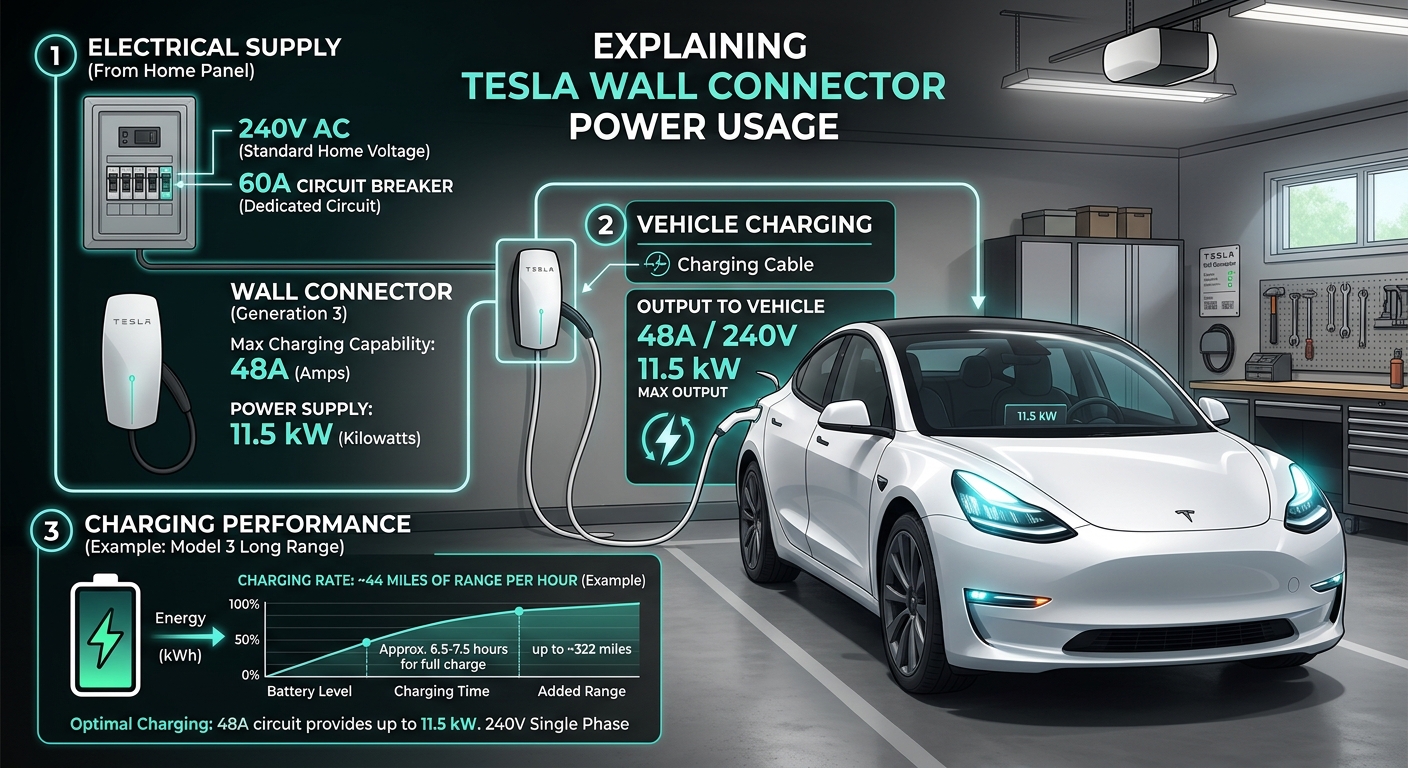
Installing a home electric vehicle (EV) charger is the single most convenient upgrade for EV owners, delivering low overnight charging rates and daily driving readiness. Operating on a dedicated high-voltage 240-volt single-phase supply, the Tesla Wall Connector (Gen 3 and Universal versions) stands as one of the most reliable Level 2 wallboxes available. However, as homeowners calculate monthly electric bills and electrical panel loads, a primary technical question arises: How much power does a Tesla Wall Connector use?
The short answer is: a Tesla Wall Connector uses up to 11.5 kW (11,500 watts) of electric power when operating at its maximum 48-Amp continuous output setting on a 60-Amp circuit breaker.
Because the Tesla Wall Connector features adjustable internal power settings, it can also be configured during installation to operate at lower power levels—ranging from 3.8 kW (16A) up to 11.5 kW (48A)—to match your home’s existing electrical panel capacity under National Electrical Code (NEC Article 625) standards.
For complete hardware reviews, installer guides, and panel load calculators, visit EV Charger Advisor.
1. Tesla Wall Connector Power Output Breakdown
The exact power consumption (measured in kilowatts, $\text{kW}$) depends on the physical continuous amperage set during commissioning:
A. Maximum Power Output: 48 Amps (11.52 kW)
-
Circuit Requirement: Dedicated 60-Amp double-pole circuit breaker paired with #6 AWG copper conductor wire.
-
Power Draw: $11.52\text{ kW}$ ($240\text{V} \times 48\text{A} = 11,520\text{ Watts}$).
-
Added Driving Range: Restores 36 to 44 miles of range per hour depending on vehicle energy efficiency.
B. De-rated & Lower Power Settings
If your main electrical service panel cannot accommodate a 60A breaker without an upgrade, the Wall Connector can be adjusted via software commissioning:
-
40-Amp Output (50A Breaker): Consumes $9.60\text{ kW}$ ($240\text{V} \times 40\text{A}$), adding ~30 to 37 miles/hr.
-
32-Amp Output (40A Breaker): Consumes $7.68\text{ kW}$ ($240\text{V} \times 32\text{A}$), adding ~22 to 30 miles/hr.
-
24-Amp Output (30A Breaker): Consumes $5.76\text{ kW}$ ($240\text{V} \times 24\text{A}$), adding ~15 to 22 miles/hr.
To learn more about how charger power levels and wire sizes compare, check out our guide on EV charging types.
2. Standby Power Consumption & Efficiency
Beyond active charging draw, homeowners often ask about standby phantom power draw:
-
Idle Standby Draw: When not actively charging a vehicle, the Tesla Wall Connector uses approximately 2 to 4 Watts of standby power to maintain Wi-Fi connectivity, cellular app communications, status LED illumination, and over-the-air firmware updates.
-
Charging Efficiency: Modern AC-to-DC onboard charging systems in Tesla vehicles operate at approximately 88% to 92% energy efficiency. Only 8% to 12% of total power consumed from the wall grid is converted into minimal heat loss during transfer.
To explore Wi-Fi-enabled smart wallboxes engineered with integrated GFCI safety mechanisms, read our guide on smart chargers.
Step-by-Step Mathematical Example: Daily Power Draw & Electricity Cost Math
Let us calculate the total daily power consumption in kilowatt-hours ($\text{kWh}$) and total daily charging cost for a Tesla owner adding 40 kWh of net energy to their vehicle battery using a Wall Connector running at full 48-Amp output ($11.52\text{ kW}$) at an 89% conversion efficiency on a $0.14\text{ per kWh}$ residential utility rate.
Given Parameters:
-
Target Energy to Battery ($E_{\text{net}}$): $40 \text{ kWh}$
-
Continuous Wall Connector Power ($P_{\text{wall}}$): $11.52 \text{ kW} \quad (240\text{V} \times 48\text{A})$
-
Onboard Charger Efficiency ($\eta$): $89\% \quad (0.89)$
-
Electricity Tariff Rate ($R$): $\$0.14 \text{ per kWh}$
Calculation 1: Total Power Consumed from Utility Grid ($E_{\text{grid}}$)
Calculation 2: Total Active Charging Duration ($T$)
Calculation 3: Total Daily Charging Cost ($C$)
Result Breakdown: Adding 40 kWh of net range draws 11.52 kW continuously for 3 hours and 54 minutes, consuming 44.94 kWh total from the grid for a total cost of $6.29.
Comparison Table: Tesla Wall Connector Power Ratings by Breaker Size
| Circuit Breaker Size | Max Continuous Draw | Continuous Power Output | Continuous Current (NEC 80%) | Added Range per Hour |
| 60 Amps | 48 Amps | 11.52 kW (11,520W) | 48A | 36 to 44 miles/hr |
| 50 Amps | 40 Amps | 9.60 kW (9,600W) | 40A | 30 to 37 miles/hr |
| 40 Amps | 32 Amps | 7.68 kW (7,680W) | 32A | 22 to 30 miles/hr |
| 30 Amps | 24 Amps | 5.76 kW (5,760W) | 24A | 15 to 22 miles/hr |
Summary & Key Takeaways
-
Maxes Out at 11.5 kW: Operating on a 60A circuit breaker at full 48A draw, the Tesla Wall Connector uses 11.52 kW (11,520 Watts).
-
Configurable Output: Amperage can be de-rated to fit smaller panel capacities (down to 15A/2.8 kW).
-
Respects NEC 125% Rule: A 48A continuous power draw requires a dedicated 60A double-pole breaker and #6 AWG copper wire.
-
Negligible Standby Draw: Standby power consumption averages only 2 to 4 Watts when not actively charging.













Leave a Reply