
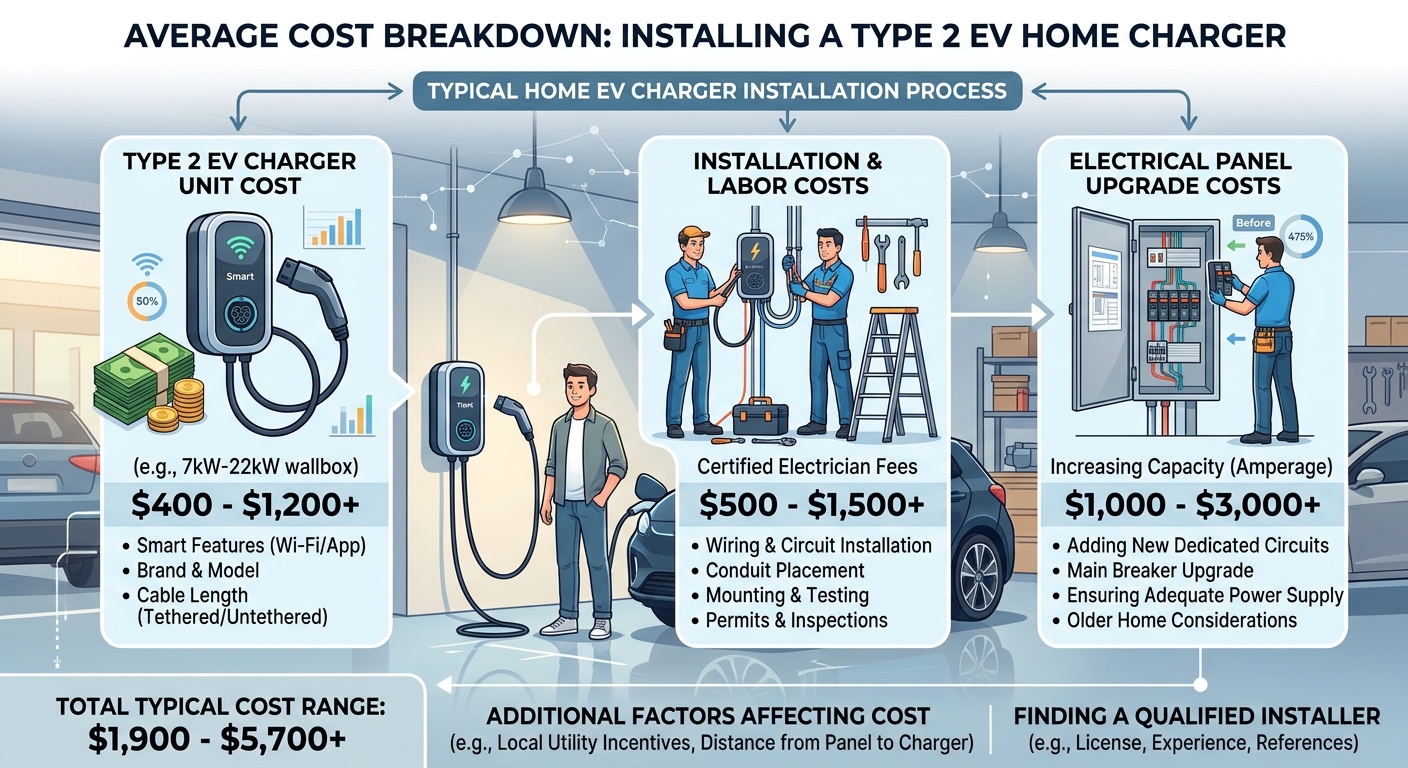
Installing a residential Type 2 (Level 2) electric vehicle (EV) charging station turns your home garage or driveway into an efficient refueling hub, delivering 20 to 44 miles of driving range per hour over a high-voltage 240-volt single-phase or 400-volt three-phase branch circuit. While transitioning to electric mobility provides significant fuel savings over time, evaluating the upfront investment requires analyzing hardware costs, electrician labor, raw materials, and potential electrical panel upgrades.
The average total cost to install a Type 2 (Level 2) EV charger at home ranges from $800 to $2,500 globally (typically PKR 350,000 to PKR 650,000 in Pakistan depending on regional pricing, single-phase vs. three-phase supply, and distance from the main electrical panel).
Under National Electrical Code (NEC Article 625) standards, applying continuous load safety rules and assessing panel capacity ensures your installation budget reflects a safe, fully compliant, and future-proof setup.
For complete hardware reviews, installer guides, and panel load calculators, visit EV Charger Advisor.
1. Breakdown of Core Installation Expenses
Calculating the total cost of installing a Type 2 wallbox involves five distinct cost categories:
A. Type 2 Charger Unit Hardware: $400 – $800
-
Standard Type 2 Wallboxes ($400–$550): Entry-level 7kW single-phase units providing reliable plug-and-charge functionality without advanced networking.
-
Smart Type 2 Wallboxes ($550–$800+): Feature-rich Wi-Fi/Bluetooth chargers supporting app controls, automated time-of-use (TOU) scheduling, real-time power tracking, and solar surplus integration.
B. Licensed Electrician Labor: $300 – $1,200
-
Standard Installations ($300–$600): Service panel located inside the garage adjacent to the wallbox mounting location, requiring a short conduit run.
-
Complex Installations ($800–$1,200+): Extended wiring distances, drilling through finished walls, subpanel installations, exterior trenching, or detached garage runs.
C. Electrical Wiring & Circuit Materials: $100 – $350
-
Conductor Wire Gauges (NEC 125% Continuous Load Rule): Pursuant to NEC 625.42, continuous loads require circuit protection sized to 125% of charger output:
-
48A Continuous Charger (60A Breaker): Requires #6 AWG copper conductors.
-
32A Continuous Charger (40A Breaker): Requires #8 AWG copper conductors.
-
-
Additional Circuit Hardware: Industrial-grade 2-pole circuit breaker, heavy-duty conduit (EMT or PVC), mounting hardware, and industrial Type 2 socket components.
To learn more about how charger power levels and wire sizes compare, check out our guide on EV charging types.
2. Service Panel Upgrades & Load Management Alternatives
Main electrical panel headroom represents the largest single cost variable in home EV charger installations:
PANEL CAPACITY EVALUATION & COST PATHWAY:
[Main Electrical Panel] ──► [Perform NEC Article 220 Load Check]
                                     │
         ┌───────────────────────────┴───────────────────────────┐
         ▼                                                       ▼
[Sufficient Capacity]                                [Panel Constrained]
         │                                                       │
         ▼                                                       ▼
[Standard Circuit Install]                           [Panel Upgrade: $1,800–$4,000]
 (Breaker + Wire Only)                                           OR
                                                     [Install EVEMS: $800–$1,200]
                                                     (Bypasses full panel replacement)
-
Main Electrical Panel Upgrade ($1,800 – $4,000): Older homes with 100A or 150A main service panels may lack sufficient headroom for a dedicated 40A or 60A double-pole breaker. Upgrading to a modern 200A main panel adds substantial labor, utility coordination, and equipment costs.
-
EVEMS Smart Load Management ($800 – $1,200): Installing an Electric Vehicle Energy Management System (EVEMS) under NEC 625.42 monitors live household electricity draw and automatically throttles charger current during peak appliance usage, bypassing an expensive panel replacement.
To explore Wi-Fi-enabled smart wallboxes engineered with integrated load management features, read our guide on smart chargers.
3. Regional & Site-Specific Variables
Key factors that influence final Type 2 charger installation costs include:
-
Single-Phase (230V) vs. Three-Phase (400V): Installing a 7kW single-phase wallbox requires standard 2-pole wiring, whereas a 22kW three-phase Type 2 setup requires 4-pole breakers and heavier multi-conductor cables, increasing material costs.
-
Rooftop Solar PV Integration: Connecting a smart Type 2 charger to solar inverters using CT clamp sensors adds minor wiring labor but reduces long-term operating costs by using free daytime solar energy.
-
Permitting & Municipal Inspection Fees ($50 – $200): Most local jurisdictions require an official electrical permit and post-installation inspection to maintain insurance and warranty coverage.
Comparison Table: Type 2 EV Charger Installation Cost Scenarios
| Cost Parameter | Basic Adjacent Setup | Extended Run Setup | Full Panel Upgrade Setup |
| Type 2 Hardware Unit | $450 | $650 | $650 |
| Electrician Labor | $350 | $950 | $800 |
| Wiring & Conductor Materials | $100 | $300 | $180 |
| Service Panel Upgrade | $0 (Not Needed) | $0 (Not Needed) | $2,500 (100A → 200A) |
| Permits & Fees | $100 | $100 | $170 |
| Estimated Total Cost | $1,000 | $2,000 | $4,300 |
Summary & Key Takeaways
-
Average Global Cost: Installing a home Type 2 EV charger typically ranges from $800 to $2,500 depending on site conditions.
-
Proximity Savings: Mounting the wallbox near your main electrical panel significantly reduces wiring material and labor costs.
-
Adhere to the NEC 125% Rule: EV charging circuits require breakers and #6 AWG copper conductors sized to 125% of maximum continuous load.
-
Utilize EVEMS to Avoid Panel Replacement: Installing dynamic load management hardware helps avoid costly main service panel replacements.













Leave a Reply