
Installing a dedicated home charger is the ultimate upgrade for any electric vehicle owner, offering unmatched daily convenience and significant savings over commercial fast chargers. Delivering up to 44 miles of driving range per hour over a high-voltage 240-volt single-phase branch circuit, the Tesla Wall Connector (available in both NACS and Universal versions with Magic Dock) stands as one of the most reliable Level 2 wallboxes on the market. However, as prospective buyers prepare their budgets, a critical financial question arises: How much does it cost to install a Tesla Wall Connector?
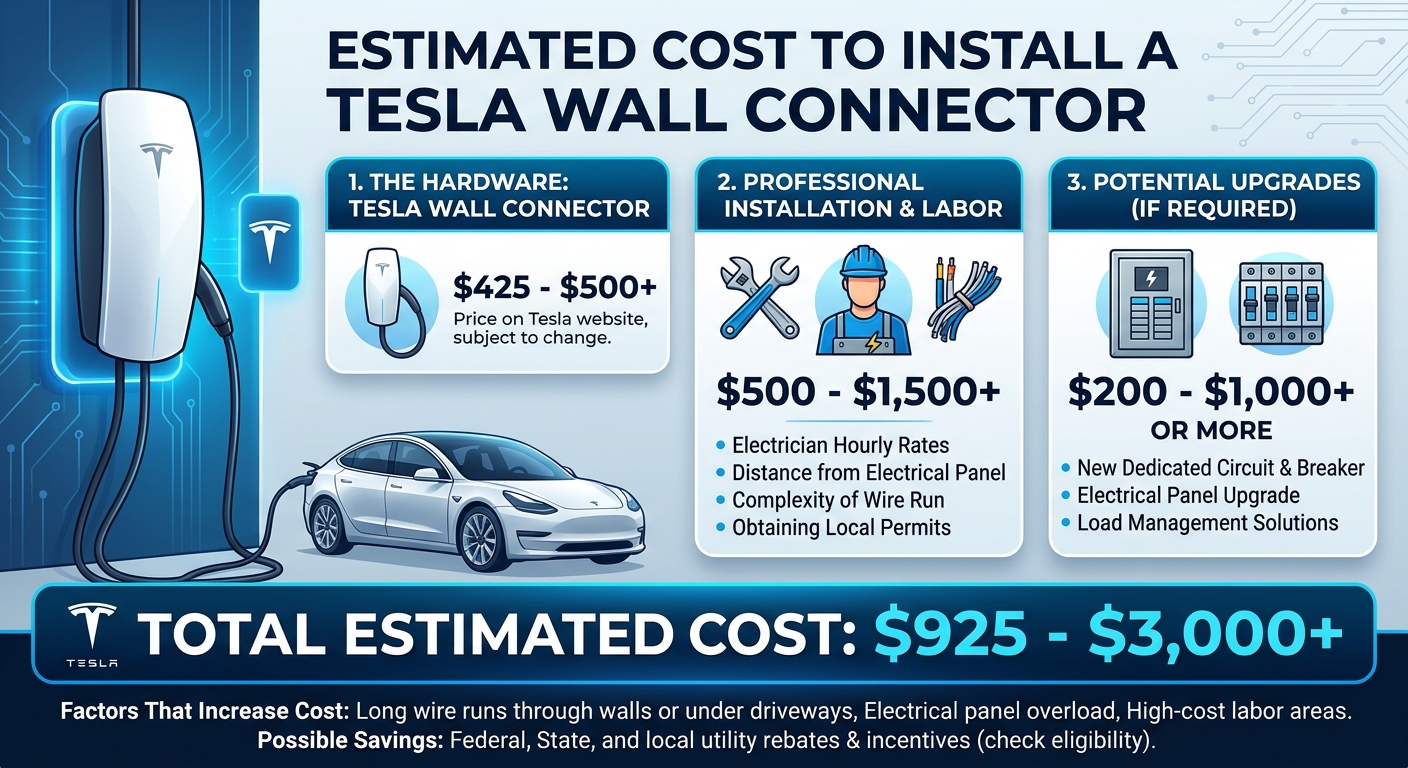
The short answer is: the total cost to install a Tesla Wall Connector typically ranges between $1,200 and $3,000. This includes $450 to $580 for the Wall Connector hardware unit itself, plus $750 to $2,500+ for licensed electrician labor, electrical permits, materials, and potential electrical panel upgrades.
Understanding the breakdown of hardware costs, electrician labor rates, and physical site variables allows you to accurately budget for your installation while maintaining strict safety under National Electrical Code (NEC Article 625) standards.
For complete hardware reviews, installer guides, and panel load calculators, visit EV Charger Advisor.
1. Cost Breakdown: Hardware, Labor, & Permits
To evaluate your total investment, it helps to break down the total installation bill into three primary categories:
A. Tesla Hardware Costs ($450 – $580)
-
Standard Tesla Wall Connector (NACS / J3400): $450
-
Tesla Universal Wall Connector (NACS + Integrated J1772 Magic Dock): $580
-
Both models deliver up to 48 Amps continuous ($11.52\text{ kW}$) output when hardwired to a dedicated 60A circuit breaker.
B. Licensed Electrician Labor & Materials ($500 – $1,500)
-
Basic Installation: Short wire runs (under 15 feet) from an existing electrical panel with adequate spare capacity cost between $500 and $900.
-
Complex Wire Runs: Longer conductor runs (50–100+ feet) through attics, crawlspaces, or conduit runs along exterior walls increase labor and heavy copper wire materials (#6 AWG copper) to $1,000–$1,800.
C. Permits, Inspections & Electrical Panel Upgrades ($200 – $3,000)
-
Local Building & Electrical Permits: Typically cost $100 to $300 depending on your municipality.
-
Electrical Panel Upgrade (100A to 200A): If your home’s existing main service panel lacks the power capacity to support a new 60A double-pole breaker, a panel upgrade adds $1,500 to $3,000 to the total project cost.
To learn more about how charger power levels and wire sizes compare, check out our guide on EV charging types.
2. Key Factors That Drive Installation Costs
Several physical and electrical conditions influence whether your installation falls on the lower or higher end of the price spectrum:
-
Distance to Electrical Panel: Heavy copper conductors (#6 AWG) are expensive. The further your charger is mounted from your main breaker panel, the higher the material and conduit costs.
-
Main Service Panel Capacity: Operating a 48A charger requires applying the NEC 125% continuous duty rule ($48\text{A} \times 1.25 = 60\text{A}$ breaker). If your electrical panel is maxed out, you may need a panel upgrade or a smart Load Management Device to dynamically share power.
-
Indoor Garage vs. Outdoor Driveway Trenching: Surface mounting inside a garage is simple. Mounting on a detached post or exterior wall requiring underground trenching increases labor costs substantially.
-
Hardwiring vs. GFCI Breakers: Hardwiring the Wall Connector directly eliminates the need for expensive industrial NEMA 14-50 outlets ($50–$100) and pricey 240V GFCI circuit breakers ($120–$250), reducing net installation costs compared to plug-in setups.
To explore Wi-Fi-enabled smart wallboxes engineered with integrated load management features, read our guide on smart chargers.
Step-by-Step Mathematical Example: Payback Period & Cost Savings Math
Let us calculate the net payback period for a Tesla owner spending $1,600 total ($450 hardware + $1,150 installation) who drives 13,500 miles per year at an efficiency of 3.8 Miles per kWh ($3,552.63\text{ kWh/year}$ consumed).
Given Parameters:
-
Total Installation Cost: $\$1,600.00$
-
Annual Energy Consumed ($E_{\text{annual}}$): $13,500 / 3.8 = \mathbf{3,552.63 \text{ kWh / year}}$
-
Public Commercial Supercharger Rate: $\$0.42 \text{ per kWh}$
-
Home Residential Off-Peak Rate: $\$0.13 \text{ per kWh}$
Calculation 1: Annual Cost Using Commercial Superchargers ($C_{\text{public}}$)
Calculation 2: Annual Cost Using Home Level 2 Wall Connector ($C_{\text{home}}$)
Calculation 3: Net Annual Savings ($\Delta C$)
Calculation 4: Payback Period Calculation
Result Breakdown: Charging at home saves $1,030.26 annually in fuel costs, allowing a $1,600 Tesla Wall Connector installation to achieve a complete 100% financial payback in under 19 months.
Comparison Table: Tesla Wall Connector Installation Cost Scenarios
| Installation Scenario | Distance to Panel | Panel Upgrade Needed? | Estimated Total Cost |
| Basic Garage Mount | Under 15 Feet | No (Panel has spare 60A capacity) | $1,200 – $1,500 |
| Standard Long Run | 30 to 60 Feet | No (Panel supports 60A load) | $1,600 – $2,200 |
| Complex / Panel Upgrade | 50+ Feet | Yes (100A to 200A upgrade required) | $3,000 – $4,500+ |
Summary & Key Takeaways
-
Average Investment: Most Tesla Wall Connector installations cost between $1,200 and $3,000 total, including hardware, labor, and permits.
-
Hardwiring Saves Money: Direct hardwiring avoids purchasing expensive industrial NEMA 14-50 wall sockets and 240V GFCI circuit breakers.
-
Rapid Payback: Home charging savings compared to public Superchargers allow the full equipment and installation cost to pay for itself in 1.5 to 2 years.
-
Follow NEC 125% Breaker Sizing: Operating at full 48A continuous output requires a dedicated 60A double-pole breaker and #6 AWG copper wire.













Leave a Reply