
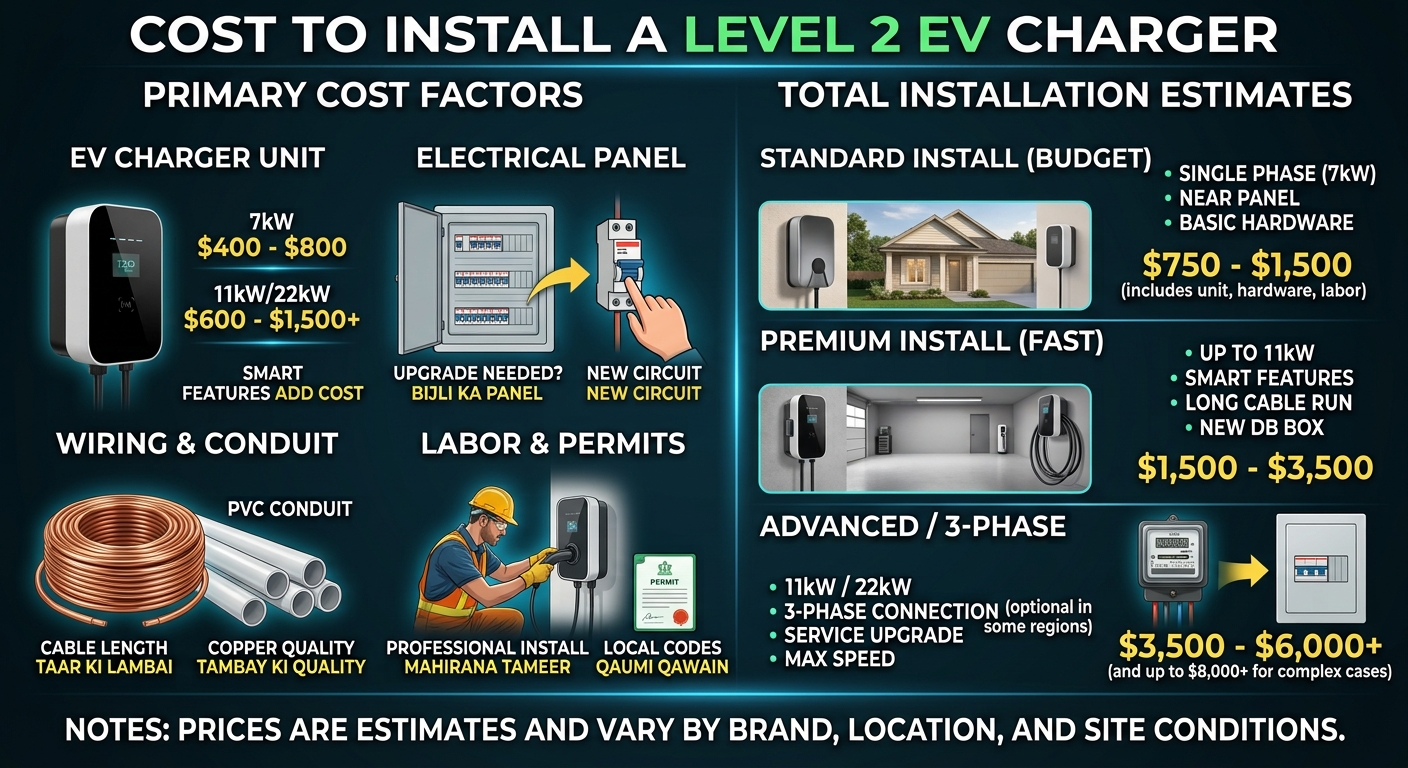
Installing a dedicated Level 2 home electric vehicle (EV) charger is one of the most practical investments an EV owner can make. Operating on a $240\text{-volt}$ branch circuit, a Level 2 wallbox replenishes battery capacity up to 8 times faster than a standard Level 1 trickle charger, adding 20 to 44 miles of driving range per hour. However, during project planning, estimating total expenses can be confusing. Homeowners frequently ask: How much does it cost to install a Level 2 EV charger?
The short answer is: a typical Level 2 EV charger installation costs between $800 and $2,500 all-in, with most homeowners paying an average of roughly $1,500 to $1,700 for a standard installation. However, if your home’s electrical panel is at max capacity and requires a heavy-duty service upgrade, the overall project cost can climb sharply to anywhere between $3,000 and $7,000+.
Understanding how hardware selection, electrical labor, wiring distance, and main panel capacity influence overall installation pricing allows you to budget effectively and take advantage of utility rebates and federal tax incentives.
For complete hardware reviews, installer guides, and panel load calculators, visit EV Charger Advisor.
1. Major Cost Components Breakdown
To understand where your money goes when setting up home charging, it helps to break down the installation budget into four distinct categories:
A. Level 2 EV Charger Hardware ($350 – $900)
The wallbox hardware itself is purchased separately from installation labor. Entry-level 32A plug-in chargers start around $350 to $450, while feature-rich 48A smart wallboxes with Wi-Fi scheduling, energy tracking, and dynamic load sharing range between $550 and $900 (e.g., Tesla Wall Connector, ChargePoint Home Flex, or Emporia).
B. Electrician Labor & Permit Fees ($400 – $1,200)
Hiring a licensed electrician to pull municipal permits, run 240V copper wiring, install a dedicated double-pole breaker, and torque all connections properly typically accounts for $400 to $1,200 for a simple installation near the main panel.
C. Wiring & Material Costs ($100 – $500+)
Heavy-gauge copper conductors (such as #6 AWG THHN in conduit or #6 AWG Romex) are priced per linear foot. A charger mounted right next to the panel requires minimal cable, whereas running conduit across a finished garage or outdoors to a detached carport increases material and labor costs significantly.
D. Panel Service Upgrades ($1,500 – $4,500+)
If an NEC Article 220 load calculation shows your 100A or 125A panel lacks sufficient capacity headroom to support a continuous $40\text{A}$ or $48\text{A}$ load, upgrading your main service panel to 200A will add $2,000 to $4,500 to the total project cost.
To learn more about how charger power levels and wire sizes compare, check out our guide on EV charging types.
Step-by-Step Mathematical Example: Project Cost Scenarios
Let us perform a cost breakdown comparing a Standard Installation (Existing 200A Panel) versus a Complex Installation (Requiring 100A to 200A Panel Upgrade) for a hardwired 48A Level 2 wallbox ($11.52\text{ kW}$ output).
Scenario A: Standard Installation (Short Wiring Run, Adequate Capacity)
-
48A Smart Wallbox Hardware: $550
-
Dedicated 60A Double-Pole Breaker: $30
-
15 ft. of #6 AWG THHN Copper Wire & PVC Conduit: $80
-
Municipal Permit & Inspection Fee: $120
-
Electrician Labor (3 Hours @ $125/hr): $375
Scenario B: Complex Installation (Panel Service Upgrade + Long Cable Run)
-
48A Smart Wallbox Hardware: $600
-
100A to 200A Main Panel Upgrade (Materials & Utility Disconnect): $3,200
-
75 ft. of Metal Conduit & Cable Run Across Garage: $450
-
Municipal Permit & Inspection Sign-Off: $200
-
Electrician Labor (Panel Upgrade + Wire Pull): $1,200
Result Breakdown: While a basic installation next to an adequate electrical panel keeps total costs around $1,155, needing a 200A service upgrade and an extended cable run increases the overall investment to over $5,600.
To explore Wi-Fi-enabled smart wallboxes that support dynamic app management, read our guide on smart chargers.
How to Reduce Your Installation Costs
If your home’s electrical panel capacity is tight, you can avoid costly panel upgrades using smart alternatives:
1. Install an EVEMS Load Balancer or Smart Splitter
Installing an Electric Vehicle Energy Management System (EVEMS) or dynamic load balancer ($500–$800) monitors household consumption live and throttles charger output during peak demand, avoiding a full $3,000+ panel upgrade.
2. De-Rate Your Wallbox Amperage
Setting your wallbox to 24 Amps continuous draw ($5.76\text{ kW}$ on a 30A breaker) often fits into existing 100A panels without triggering overload limits, saving thousands while still delivering complete overnight battery charging.
3. Utilize Tax Credits & Local Utility Rebates
-
Federal Tax Incentives: Under the Alternative Fuel Vehicle Refueling Property Credit (Section 30C), qualifying homeowners can claim a 30% tax credit on hardware and installation costs (up to $1,000).
-
Utility Company Rebates: Many electric utilities offer $500 to $1,500 in instant rebates or bill credits for installing smart Level 2 charging equipment.
Comparison Table: Level 2 EV Charger Installation Cost Tiers
| Installation Tier | Typical Hardware | Electrical Scope | Average Total Cost |
| Basic / Plug-In | 32A Mobile Charger ($350) | Existing 240V Outlet / Short Run | $600 – $900 |
| Standard Hardwired | 48A Smart Charger ($550) | New 60A Circuit (< 20 ft run) | $1,100 – $1,800 |
| Long Wiring Run | 48A Smart Charger ($600) | Long Conduit Run (50ft – 100ft) | $2,000 – $2,800 |
| Panel Upgrade Required | 48A Smart Charger ($600) | 100A to 200A Panel Service Upgrade | $3,500 – $7,000+ |
Summary & Key Takeaways
-
Average Investment: Most homeowners pay between $1,500 and $1,700 total for a turnkey Level 2 installation.
-
Key Cost Drivers: Wiring distance, wallbox smart features, and main panel capacity are the primary factors affecting price.
-
Panel Upgrades Increase Price: If your panel lacks capacity, upgrading to 200A pushes total costs into the $3,000 to $7,000+ range.
-
Offset Costs with Rebates: Software de-rating, EVEMS units, 30% federal tax credits, and local utility rebates significantly lower your out-of-pocket expenses.













Leave a Reply