
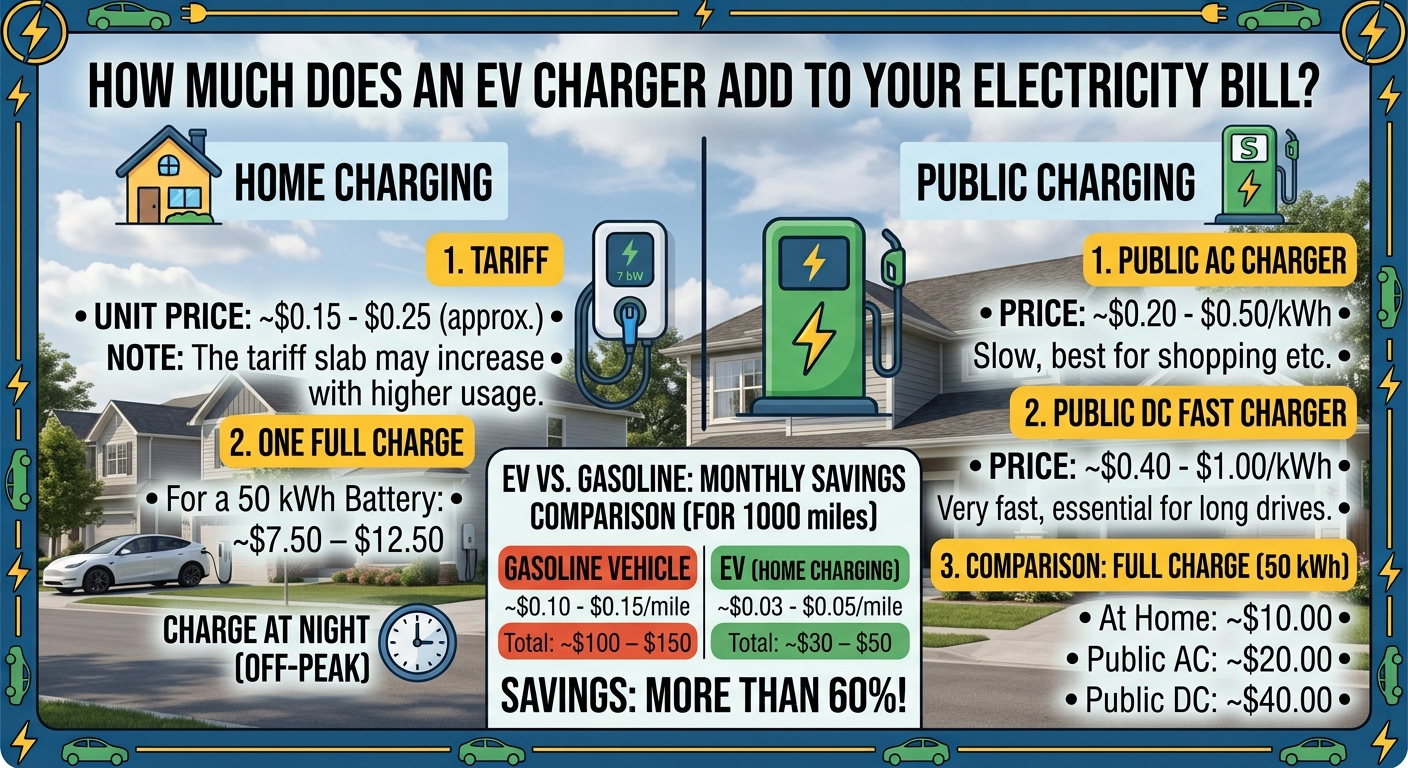
Transitioning from a gasoline vehicle to an electric vehicle (EV) changes how you manage your monthly transportation expenses. Instead of making weekly stops at gas stations, you plug in overnight at home. However, powering an electric car from your home’s electrical grid naturally leads to a key financial question: How much does an EV charger add to your electric bill?
For the average driver, adding an electric vehicle (EV) charger to your home increases your monthly electric bill by $25 to $70. While this bumps up your utility statement, home charging is highly efficient and typically saves you $100 to $200 per month compared to what you would have spent on gasoline.
Understanding the math behind your home charger’s power consumption helps you predict your monthly utility bill and optimize your charging schedule for maximum financial savings.
For comprehensive hardware reviews, installer guides, and home setup resources, visit EV Charger Advisor.
The Core Variables That Control Your Electric Bill Increase
Your monthly electricity bill increase is determined by how much energy your vehicle consumes, not the physical charging station itself. Three main factors dictate your exact costs:
1. Kilowatt-Hour Electricity Tariff Rates ($/kWh)
Electricity providers bill residential customers per kilowatt-hour (kWh). In North America, national average electricity rates sit around $0.15 to $0.17 per kWh. Enrolling in utility off-peak programs can lower overnight rates to $0.06 to $0.09 per kWh.
2. Vehicle Efficiency Ratings (Miles per kWh)
Just like gasoline cars are measured in miles per gallon (MPG), electric vehicles are measured in miles per kWh:
-
Efficient Sedans: Achieve roughly $3.5 \text{ to } 4.2 \text{ miles per kWh}$.
-
Midsize Crossovers & SUVs: Achieve roughly $3.0 \text{ to } 3.4 \text{ miles per kWh}$.
-
Heavy Trucks & Performance EVs: Achieve roughly $2.0 \text{ to } 2.5 \text{ miles per kWh}$.
3. Monthly Driving Distance
The total distance you drive each month dictates how many total kilowatt-hours your Level 2 wallbox must transfer into the vehicle’s battery pack.
To learn more about how charger power outputs perform, check out our guide on EV charging types.
Step-by-Step Mathematical Example: Calculating Monthly Power Bill Increase
To see how driving habits translate into real-world numbers on your power bill, let us calculate the monthly cost increase for a driver covering 1,000 miles per month in an EV averaging 3.3 miles per kWh.
Given Parameters:
-
Monthly Driving Distance: $1,000 \text{ miles}$
-
Vehicle Efficiency: $3.3 \text{ miles per kWh}$
-
Standard Residential Electricity Rate: $\$0.16 \text{ per kWh}$
-
Discounted Off-Peak Electricity Rate: $\$0.08 \text{ per kWh}$
-
Baseline Gas Car Expense (30 MPG at $3.50/gal): $\$116.66 \text{ per month}$
Calculation 1: Total Monthly Energy Required
Calculation 2: Electric Bill Increase at Standard Rates
Calculation 3: Electric Bill Increase at Discounted Off-Peak Rates
Calculation 4: Net Savings Compared to Gasoline
Result Breakdown: Charging at off-peak rates adds just $24.24 to your monthly power bill. Over a full year, replacing gasoline with home charging puts over $1,100 back into your pocket.
Actionable Tips to Keep Your EV Charging Bill Low
You can minimize the financial impact on your utility statement by using smart energy management tools:
1. Take Advantage of Time-of-Use (TOU) Rates
Most electric utility companies offer Time-of-Use (TOU) rate structures that lower electricity prices during late-night and early-morning hours (typically 11:00 PM to 6:00 AM) when demand across the power grid is lowest.
2. Program Smart Charger Scheduling
Modern Wi-Fi-enabled Level 2 chargers allow you to schedule automatic charging windows using your smartphone. You can plug your car in as soon as you park in the garage, but the charger won’t begin drawing power until your utility’s off-peak window opens.
3. Pair Home Charging with Solar PV Panels
If your home has rooftop solar panels, charging your vehicle during daylight hours allows you to capture clean, self-generated energy, further offsetting your grid electricity purchases.
To explore Wi-Fi-enabled wallboxes that support automated energy scheduling, read our guide on smart chargers.
Cost Comparison Table: Home EV Charging vs. Gas vs. Public Fast Charging
| Energy Source | Unit Cost Metric | Monthly Expense (1,000 Miles) | Annual Fuel Cost |
| Home EV Charger (Off-Peak TOU) | $0.08 / kWh | $24 – $35 | $288 – $420 |
| Home EV Charger (Standard Rate) | $0.16 / kWh | $48 – $70 | $576 – $840 |
| Public Commercial DC Fast Charger | $0.45 / kWh | $135 – $160 | $1,620 – $1,920 |
| Gasoline SUV (28 MPG) | $3.50 / Gallon | $125 – $150 | $1,500 – $1,800 |
Summary & Key Takeaways
-
Predictable Increase: Expect your monthly home electric bill to increase by $25 to $70 under normal daily driving habits.
-
Significant Net Savings: The added $25 to $70 on your power bill replaces a much higher $120 to $200+ monthly gas expense.
-
Off-Peak Savings: Charging overnight using TOU rate plans can cut your added electric bill costs in half.
-
Cheaper Than Public Charging: Home charging is roughly 3x to 4x cheaper per kWh than commercial public DC fast chargers.













Leave a Reply