
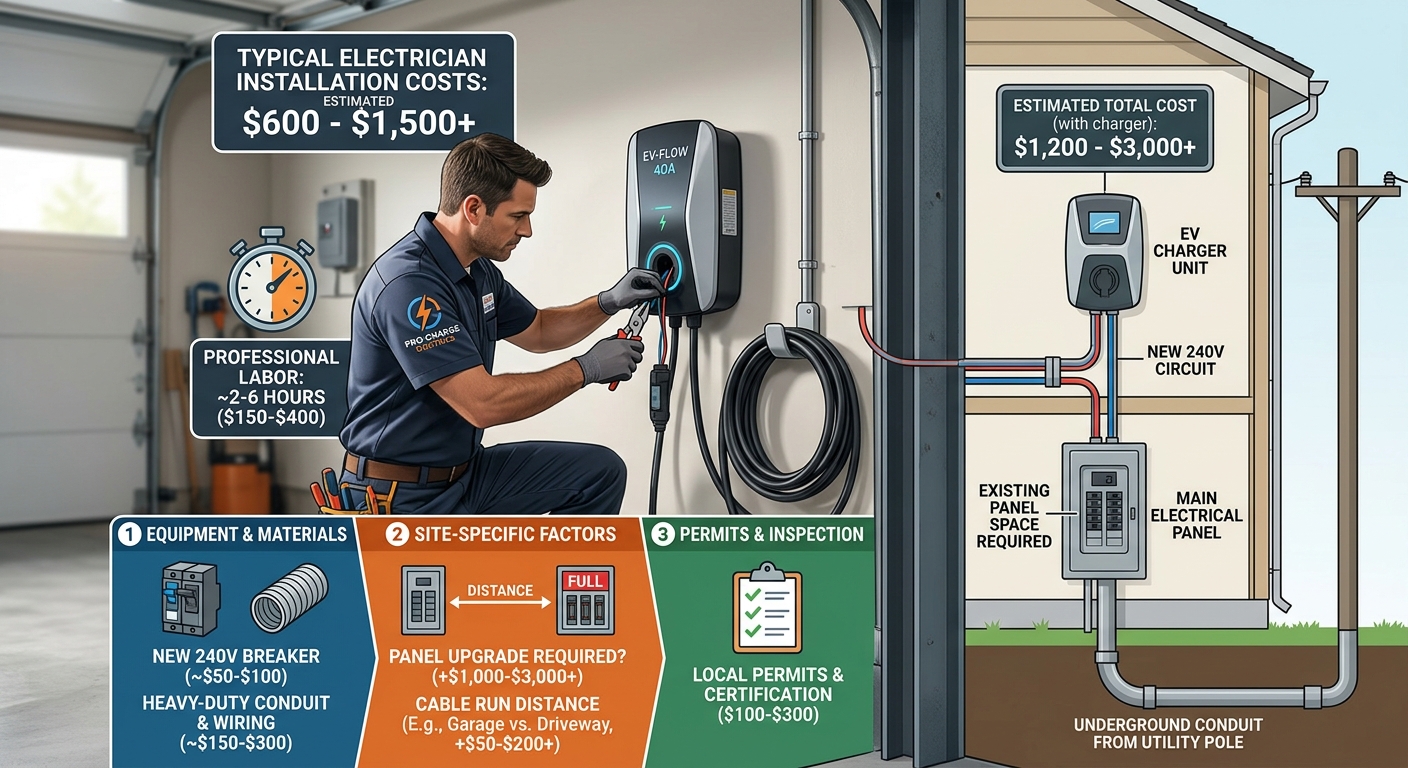
Installing a Level 2 home EV charger is the most effective way to ensure your electric vehicle (EV) is fully charged and ready every morning. By running on a 240-volt dedicated circuit, a Level 2 wallbox charges 5 to 10 times faster than a standard 120V household wall outlet. However, because high-voltage electrical wiring is involved, hiring a licensed professional is essential.
The average cost for an electrician to install a Level 2 (240V) home EV charger typically ranges from $500 to $1,500 for labor and materials, assuming your home’s electrical panel has enough capacity. When you factor in the cost of the charger hardware ($300 to $800) and local permits ($100 to $300), the total average project cost ranges between $1,000 and $2,200.
Understanding what factors influence electrician rates helps you obtain accurate quotes and budget effectively for your home charging setup.
For comprehensive hardware reviews, installer guides, and home setup resources, visit EV Charger Advisor.
Key Factors That Impact Electrician Labor Charges
Electricians charge for home EV charger installations based on hourly rates, material costs, and site complexity. The primary factors driving labor charges include:
1. Distance Between Electrical Panel and Charger Location
The distance between your main circuit breaker panel and your vehicle’s parking spot is the single largest cost variable. Short wire runs (under 10 feet) inside an attached garage keep labor and heavy copper wire costs low ($500 to $800). Long wire runs across finished basements, attics, or exterior walls increase labor time and material expenses significantly ($1,000 to $1,800+).
2. Electrical Panel Amperage & Upgrades
A Level 2 charger requires a dedicated 40-Amp to 60-Amp circuit breaker. If your home’s existing panel has spare capacity, the installation is straightforward. However, if your panel is maxed out or operates on an older 100-Amp main service, upgrading to a 200-Amp main panel adds $1,500 to $3,500 in electrician labor and equipment.
3. Hardwired vs. Plug-In (NEMA 14-50) Connection
-
Plug-In (NEMA 14-50): Requires installing an industrial 240V socket ($75 – $150) and a dedicated GFCI circuit breaker ($100+).
-
Hardwired: Direct connection into the wallbox terminals, which skips expensive GFCI breakers and outlet hardware while supporting faster charging speeds.
4. Local Municipal Permits & Inspection Fees
Most city and county building departments mandate electrical permits for installing new 240V dedicated branch circuits. Electricians usually pull these permits on your behalf and pass along the $100 to $300 fee in their final invoice.
To learn more about how charger power outputs and connection styles compare, explore our guide on EV charging types.
Step-by-Step Mathematical Example: Project Cost Breakdown & Tax Incentives
To see how labor, materials, hardware, and tax credits work together, let us calculate the net cost for a standard garage Level 2 charger installation featuring a 25-foot wire run.
Given Project Costs:
-
Smart Level 2 Charger Hardware (48A): $600
-
Electrician Labor & Materials (25 ft run + 60A breaker): $850
-
City Electrical Permit & Inspection Fee: $150
-
Gross Total Project Cost: $\$600 + \$850 + \$150 = \mathbf{\$1,600}$
Calculation 1: Federal IRS Section 30C Tax Credit (30% Discount)
Under federal tax incentive programs, qualifying home charger installations receive a 30% tax credit on total equipment and labor expenses:
Calculation 2: Net Out-of-Pocket Cost
Result Breakdown: Claiming the 30% IRS Section 30C federal tax credit reduces a gross $1,600 installation down to a net out-of-pocket investment of $1,120.
How Electricians Quote EV Charger Installations
Electricians generally use two pricing structures when bidding on EV charger projects:
1. Fixed Flat-Rate Packages ($500 – $1,200)
Many electrical contractors offer standardized flat-rate pricing for “simple” installations where the charger is mounted within 10 to 15 feet of an unblocked electrical panel inside a garage.
2. Time and Materials (T&M) Pricing ($80 – $150 per hour + materials)
For complex jobs requiring wire fishing through finished walls, subpanel installations, or outdoor underground trenching, electricians quote based on actual hourly labor rates plus marked-up copper wire and conduit materials.
To explore Wi-Fi-enabled wallboxes that support automated off-peak energy scheduling, read our guide on smart chargers.
Cost Breakdown Table: Electrician Installation Scenarios
| Installation Complexity | Hardware Cost | Electrician Labor & Materials | Permit Fees | Net Out-of-Pocket (After 30% Credit) |
| Basic Setup (Adjacent to panel) | $300 – $500 | $500 – $800 | $100 | $630 – $980 |
| Standard Setup (20-30 ft wire run) | $500 – $700 | $800 – $1,200 | $150 | $1,015 – $1,435 |
| Extended Setup (Long run / finished wall) | $600 – $800 | $1,200 – $1,800 | $200 | $1,400 – $1,960 |
| Complex Setup (Panel upgrade needed) | $600 – $800 | $2,500 – $4,500 | $300 | $2,380 – $3,920 |
Summary & Key Takeaways
-
Average Labor Cost: Expect an electrician to charge $500 to $1,500 for labor and materials on a standard home Level 2 charger installation.
-
Total Project Range: Combined with hardware ($300–$800) and permits ($100–$300), total project costs average $1,000 to $2,200.
-
Hardwiring Saves Material Costs: Hardwiring directly to the wallbox avoids purchasing expensive GFCI circuit breakers and industrial NEMA 14-50 receptacles.
-
Leverage Tax Credits: The federal 30% IRS Section 30C tax credit applies to both electrician labor and charger hardware costs.













Leave a Reply