
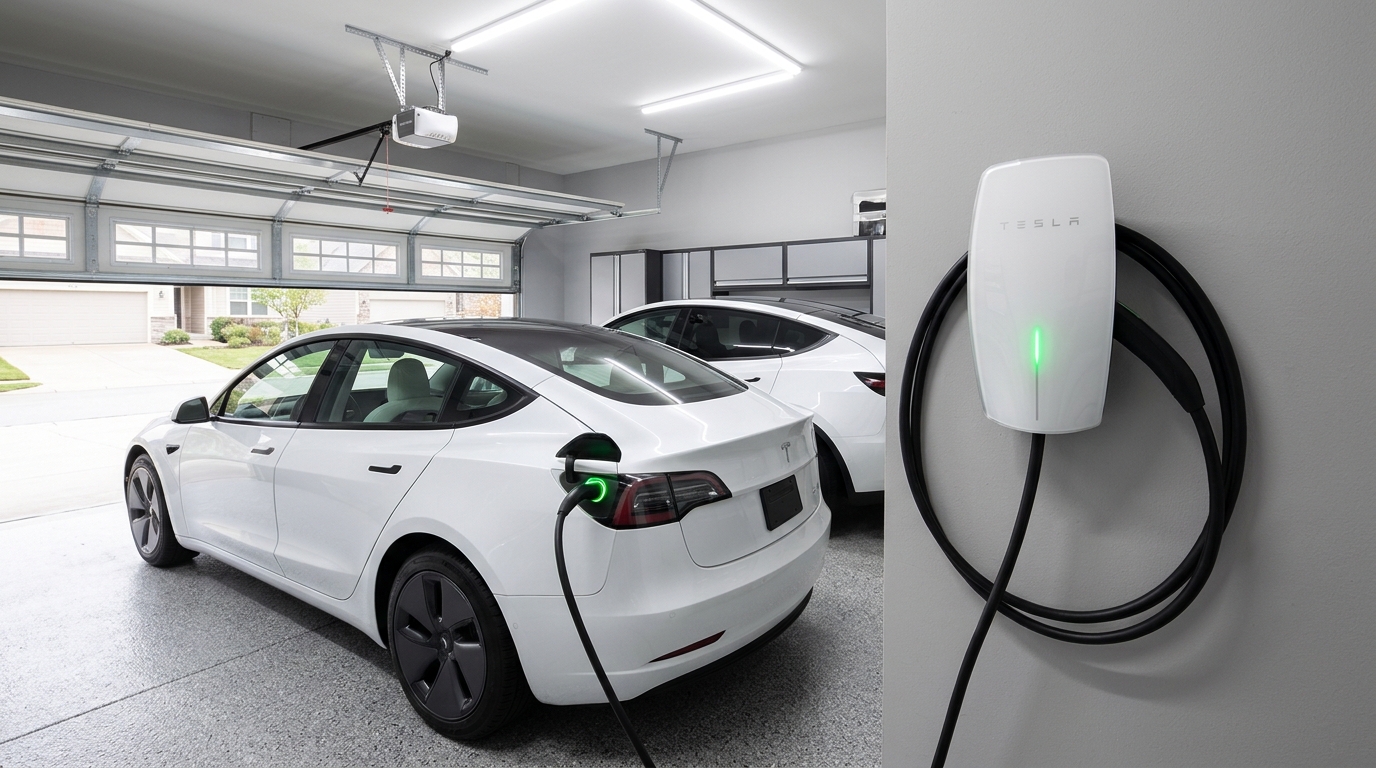
Upgrading your electric vehicle (EV) charging routine to a high-voltage 240-volt single-phase branch circuit delivers unmatched convenience, restoring 20 to 44 miles of driving range per hour right from your garage or driveway. Whether you choose to hardwire a dedicated Tesla Wall Connector or plug in via a heavy-duty NEMA 14-50 wall receptacle, setting up a 240V Level 2 charging system is the standard for fast overnight battery replenishment. However, as new Tesla owners begin budgeting, a fundamental financial question arises: How much does a 240V Tesla home charging setup cost?
The short answer is: the total cost for a complete 240V Tesla home charging setup typically ranges between $1,000 and $3,000 all-in. This total covers $300 to $580 for the charging hardware, plus $500 to $2,500+ for licensed electrician labor, electrical permits, wiring materials, and optional main panel upgrades.
Understanding hardware options, installation complexity, and potential electrical infrastructure upgrades allows you to plan an accurate budget compliant with National Electrical Code (NEC Article 625) standards.
For complete hardware reviews, installer guides, and panel load calculators, visit EV Charger Advisor.
1. Detailed Cost Breakdown: Hardware, Labor, & Permits
To see where your money goes, it helps to break down a typical installation bill into three core categories:
A. Tesla Charging Hardware ($300 – $580)
-
Tesla Mobile Connector ($300): A versatile portable Level 2 cable kit featuring a NEMA 14-50 adapter plug, capable of delivering 32 Amps continuous ($7.68\text{ kW}$) output.
-
Standard Tesla Wall Connector ($450): Hardwired NACS (J3400) wallbox delivering maximum 48 Amps continuous ($11.52\text{ kW}$) output.
-
Tesla Universal Wall Connector ($580): Hardwired wallbox featuring an integrated J1772 Magic Dock adapter handle, providing universal compatibility for Teslas and other EV brands alike.
B. Licensed Electrician Labor & Wiring Materials ($500 – $1,500)
-
Simple Install (Panel Adjacent to Parking Spot): Short wire runs under 15 feet requiring minimal conduit materials cost $500 to $900 in total labor.
-
Complex/Long Conductor Runs: Conduit runs extending 30 to 70+ feet through garage walls, attics, or exterior crawlspaces raise material costs (#6 AWG copper) and labor hours to $1,000–$1,800.
C. Municipal Permits, Inspections & Panel Upgrades ($100 – $3,000)
-
Electrical Permits & Local Inspections: Local building departments typically charge $100 to $300 to issue electrical permits and sign off on inspections.
-
Main Electrical Panel Upgrade (100A to 200A): If your home’s existing service panel lacks spare capacity for a dedicated 60A breaker, a panel upgrade adds $1,500 to $3,000 to the total invoice.
To learn more about how charger power levels and wire sizes compare, check out our guide on EV charging types.
2. Four Key Factors That Influence Your Installation Price
Your final total invoice will depend heavily on physical site conditions and electrical capacity:
-
Distance to Electrical Panel: Heavy copper conductors (#6 AWG) represent a significant material expense. The closer your parking space is to the main electrical panel, the lower the installation price.
-
Main Panel Service Capacity: Operating a 48A hardwired charger requires applying the NEC 125% continuous load rule ($48\text{A} \times 1.25 = 60\text{A}$ breaker). If your main panel is maxed out, you may need a service upgrade or a smart Load Management Device.
-
Hardwired vs. NEMA 14-50 Plug-In: Hardwiring directly eliminates the need for expensive industrial-grade NEMA 14-50 receptacles ($50–$100) and pricey 240V GFCI circuit breakers ($120–$250), making total electrician labor for hardwiring very cost-effective.
-
Indoor Garage vs. Trenching for Outdoor Posts: Mounting inside a garage is simple. Trenching underground conduits for detached garages or outdoor posts increases labor and excavation costs significantly.
To explore Wi-Fi-enabled smart wallboxes engineered with integrated load management features, read our guide on smart chargers.
Step-by-Step Mathematical Example: Tesla Home Charging Financial ROI & Payback Math
Let us calculate the net financial payback period for a homeowner spending $1,600 total ($450 Wall Connector + $1,150 installation and permitting) who drives 14,000 miles per year at an average vehicle efficiency of 3.6 Miles per kWh ($3,888.89\text{ kWh/year}$ consumed).
Given Parameters:
-
Total 240V Setup Investment: $\$1,600.00$
-
Annual Energy Consumed ($E_{\text{annual}}$): $14,000 / 3.6 = \mathbf{3,888.89 \text{ kWh / year}}$
-
Public DC Supercharger Rate: $\$0.44 \text{ per kWh}$
-
Home Overnight Utility Off-Peak Rate: $\$0.14 \text{ per kWh}$
Calculation 1: Annual Cost Charging Exclusively on Public Superchargers ($C_{\text{public}}$)
Calculation 2: Annual Cost Charging at Home via 240V Setup ($C_{\text{home}}$)
Calculation 3: Net Annual Fuel Savings ($\Delta C$)
Calculation 4: Payback Period Calculation
Result Breakdown: Charging at home saves $1,166.67 annually in fuel costs compared to public fast chargers, allowing a complete $1,600 home charging installation to achieve 100% financial payback in under 17 months.
Comparison Table: 240V Tesla Charging Setup Price Matrix
| Installation Scenario | Distance to Panel | Panel Upgrade Required? | Estimated Total Cost |
| Basic Garage Install | Under 15 Feet | No (Panel has spare 60A capacity) | $1,000 – $1,400 |
| Standard Long Run | 30 to 60 Feet | No (Panel supports 60A load) | $1,500 – $2,200 |
| Complex / Panel Upgrade | 50+ Feet | Yes (100A to 200A service upgrade) | $2,800 – $4,500+ |
Summary & Key Takeaways
-
Typical Budget ($1,000 – $3,000): Most homeowners spend between $1,000 and $3,000 all-in for hardware, labor, and permits.
-
Hardware Costs $300 to $580: The Tesla Mobile Connector is $300, while hardwired Wall Connectors run $450 to $580.
-
Hardwiring Saves Extra Hardware Expenses: Hardwiring directly avoids buying pricey industrial NEMA 14-50 wall outlets and 240V GFCI circuit breakers.
-
Fast Financial Payback: Lower home overnight electricity rates allow your installation setup to pay for itself in under 1.5 years.













Leave a Reply