
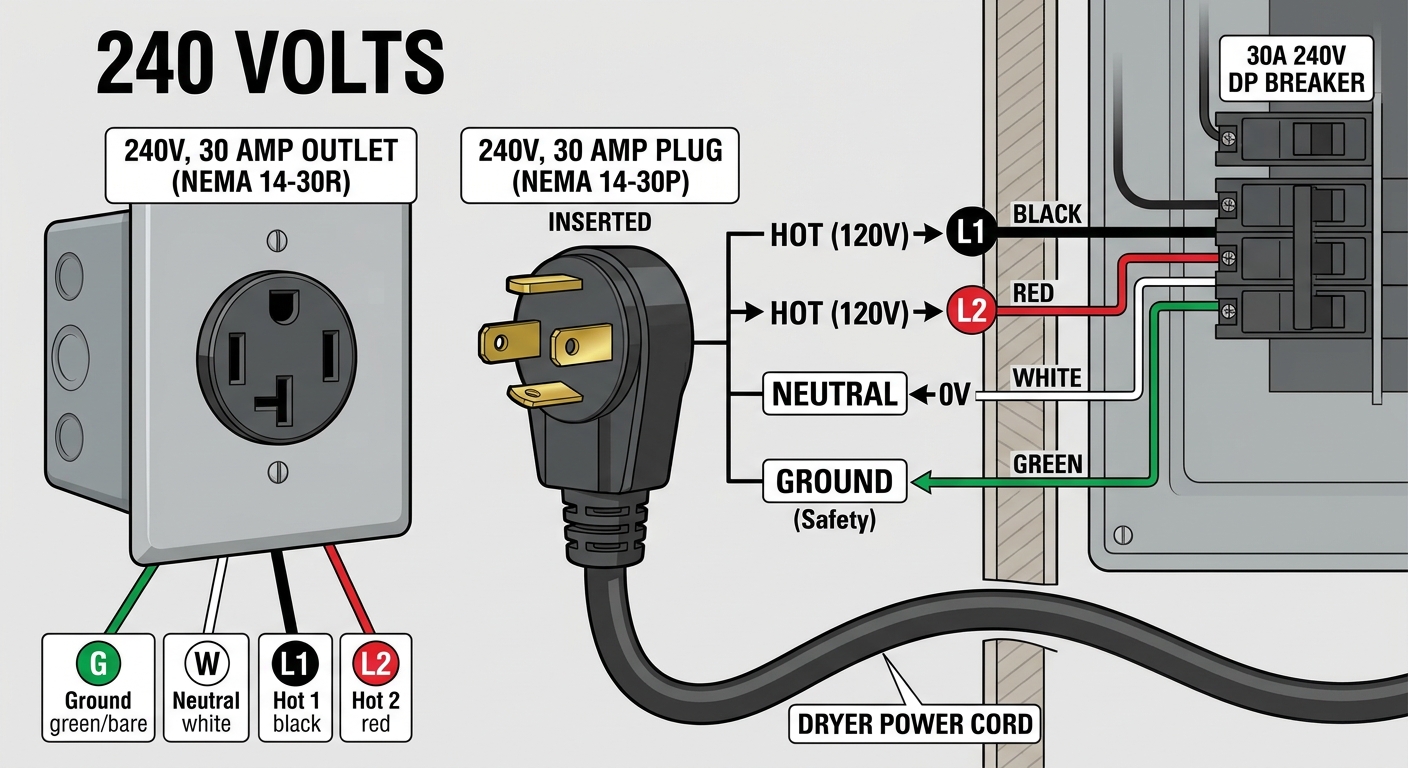
Upgrading residential electrical infrastructure for heavy household appliances requires a thorough understanding of circuit voltage, receptacle configuration, and continuous load limits. Homeowners often evaluate existing 240-volt high-amperage outlets—such as clothes dryer circuits—to assess their capability for heavy electrical demands or Level 2 electric vehicle (EV) charging. Understanding the precise voltage and wiring of these receptacles is essential for safe operation.
An electric dryer plug typically operates on a 240-volt circuit (utilizing a split-phase 120/240-volt supply), whereas a gas dryer uses a standard 120-volt wall outlet to power its internal drum motor and electronic controls.
Under National Electrical Code (NEC Article 250 & Article 625) standards, understanding the technical differences between 3-prong (NEMA 10-30) and 4-prong (NEMA 14-30) dryer receptacles ensures electrical safety, proper grounding, and code compliance.
For complete hardware reviews, installer guides, and panel load calculators, visit EV Charger Advisor.
1. Electric Dryer vs. Gas Dryer Voltage Specifications
The voltage requirements of a clothes dryer depend entirely on its fuel source and mechanical design:
A. Electric Dryers (240 Volts / 30 Amps)
-
Circuit Voltage: Connected to a dedicated 120/240-volt split-phase circuit. The heavy heating element operates at 240 volts to generate thermal energy, while internal timers, lights, and drum motors draw 120 volts from one hot leg to neutral.
-
Breaker Rating: Sized on a 30-Amp double-pole circuit breaker.
-
Continuous Load Rating: Pursuant to the NEC 80% continuous duty rule, continuous loads connected to a 30A dryer circuit are capped at 24 Amps (5.76 kW output).
B. Gas Dryers (120 Volts / 15 Amps)
-
Circuit Voltage: Plugs directly into a standard 120-volt household receptacle (NEMA 5-15).
-
Purpose: Gas burners provide the heating element, so electricity is only needed to rotate the drum and power digital displays.
To learn more about how charger power levels and wire sizes compare, check out our guide on EV charging types.
2. Receptacle Configurations: NEMA 10-30 vs. NEMA 14-30
Residential electric dryer outlets feature two distinct physical configurations based on the installation date:
3-PRONG LEGACY OUTLET (NEMA 10-30):
[Hot 1 (120V)] ── [Hot 2 (120V)] ── [Combined Neutral/Ground]

4-PRONG MODERN OUTLET (NEMA 14-30):
[Hot 1 (120V)] ── [Hot 2 (120V)] ── [Dedicated Neutral] ── [Dedicated Ground]
A. Legacy 3-Prong Outlet (NEMA 10-30)
-
Wiring: Features two hot wires and a shared neutral/ground conductor (uninsulated).
-
Code Status: Commonly installed in homes built prior to 1996. NEC standards updated in 1996 banned 3-prong installations for new construction due to potential shock hazards if the neutral connection breaks.
B. Modern 4-Prong Outlet (NEMA 14-30)
-
Wiring: Features two hot wires, one dedicated neutral conductor, and one dedicated equipment grounding conductor.
-
Code Status: Current NEC standard for all modern 240V dryer receptacle installations, ensuring full electrical safety and fault protection.
To explore Wi-Fi-enabled smart wallboxes engineered with integrated load management features, read our guide on smart chargers.
3. Using a Dryer Outlet for EV Charging
Homeowners frequently consider utilizing an existing 240V dryer outlet for Level 2 EV charging. While fully functional, key safety guidelines must be observed:
-
Observe the 80% Rule: A 30A dryer circuit supports a maximum continuous EV charging current of 24 Amps (5.76 kW), adding 18 to 22 miles of range per hour.
-
Use Industrial-Grade Receptacles or Smart Splitters: Standard dryer outlets are not engineered for daily plugging and unplugging. Frequent cycles can cause spring tension loss and thermal degradation. Installing a UL-listed smart dryer splitter allows an EV charger and dryer to share the circuit safely without manual swapping.
-
Hardwiring Upgrades: For higher speeds (48A / 11.52 kW), installing a dedicated 60-amp circuit with hardwired wallbox connections remains the ideal long-term solution.
Comparison Table: Dryer Receptacle Specifications
| Feature / Metric | Gas Dryer Outlet (NEMA 5-15) | Legacy Electric Dryer (NEMA 10-30) | Modern Electric Dryer (NEMA 14-30) |
| Supply Voltage | 120V Single-Phase | 120/240V Split-Phase | 120/240V Split-Phase |
| Circuit Breaker | 15A or 20A Single-Pole | 30A Double-Pole | 30A Double-Pole |
| Max Continuous Draw | 12 Amps | 24 Amps (80% Rule) | 24 Amps (80% Rule) |
| Continuous Power | 1.44 kW | 5.76 kW | 5.76 kW |
| Pin / Wire Count | 3 Pins (Hot, Neutral, Ground) | 3 Pins (2 Hots, Combined Neutral) | 4 Pins (2 Hots, Neutral, Ground) |
| NEC Installation Status | Standard Current Code | Legacy (Pre-1996 Homes) | Current NEC Requirement |
Summary & Key Takeaways
-
240V vs. 120V Standard: Electric dryers require a 240-volt split-phase circuit, while gas dryers operate on a standard 120-volt outlet.
-
3-Prong vs. 4-Prong Outlets: Older homes utilize 3-prong NEMA 10-30 receptacles, whereas modern installations require 4-prong NEMA 14-30 outlets with dedicated ground conductors.
-
24-Amp Continuous Capacity: Electric dryer circuits on 30A breakers support up to 24 Amps of continuous load (5.76 kW) under NEC 80% continuous duty rules.
-
EV Charging Compatibility: Existing dryer outlets can power Level 2 EV chargers at 24A output when using appropriate smart splitters or industrial-grade receptacles.













Leave a Reply