
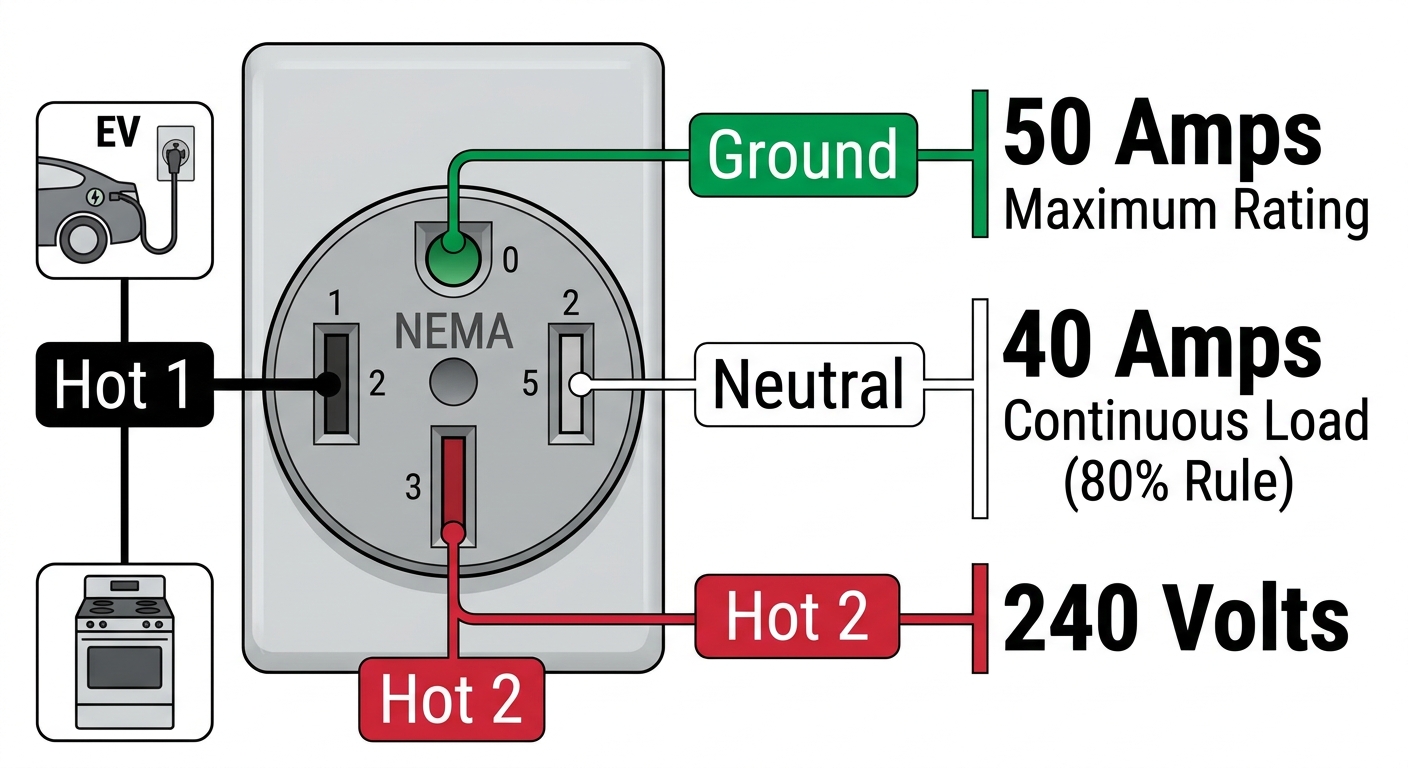
Transitioning to an electric vehicle (EV) unlocks immediate fuel savings, smooth vehicle performance, and the daily convenience of waking up every morning to a fully replenished battery. Delivering 20 to 44 miles of driving range per hour over a high-voltage 240-volt single-phase supply, plug-in Level 2 wallboxes and portable mobile connectors represent a popular home charging solution. However, as homeowners evaluate circuit breakers, outlet installation, and charging speeds, a fundamental electrical question arises: How many amps can a NEMA 14-50 outlet handle?
The short answer is: a NEMA 14-50 outlet is rated for a maximum peak capacity of 50 Amps at 240 Volts (12.0 kW peak), but under National Electrical Code (NEC Article 625) continuous load rules, it can safely handle a maximum continuous charging load of 40 Amps (9.6 kW).
Because electric vehicle charging draws maximum current continuously for hours at a time, applying the NEC 80% continuous safety rule prevents circuit breaker tripping, terminal overheating, and socket faceplate melting.
For complete hardware reviews, installer guides, and panel load calculators, visit EV Charger Advisor.
1. The 80% Rule: Peak Rating vs. Continuous EV Charging Amperage
Understanding the distinction between peak current ratings and continuous EV charging limits requires looking at electrical safety codes:
A. Peak / Non-Continuous Capacity (50 Amps)
The NEMA 14-50 designation indicates a 4-prong heavy-duty receptacle engineered for a maximum rated current of 50 Amps at 120/240 Volts. This peak capacity applies to intermittent household loads (such as electric ranges, ovens, or RV power pedestals) that draw full current for brief periods.
B. Continuous Load Capacity (40 Amps under NEC 80% Rule)
Under NEC Article 625.42, any electrical load that operates continuously at maximum draw for 3 hours or more is classified as a continuous load.
-
The 80% Safety Margin Formula: A circuit breaker and outlet must be derated to 80% of its maximum rating for continuous duty.
-
The Math: $50 \text{ Amps Maximum Rating} \times 0.80 = \mathbf{40 \text{ Amps Continuous Maximum Draw}}$.
-
Maximum Continuous Power Output: $240 \text{ Volts} \times 40 \text{ Amps} = \mathbf{9.60 \text{ kW}}$.
Important Note: Setting a plug-in EV charger to draw 48 Amps on a NEMA 14-50 receptacle violates electrical code, overloads the 50A breaker, and causes severe thermal degradation.
To learn more about how charger power levels and wire sizes compare, check out our guide on EV charging types.
2. Hardware & Wiring Requirements for NEMA 14-50 Outlets
Installing a reliable, code-compliant NEMA 14-50 receptacle for daily high-amperage charging requires specific components:
-
Industrial-Grade Receptacles vs. Standard Hardware Store Outlets: Cheap builder-grade NEMA 14-50 sockets ($10–$15 intended for range stoves) feature weak internal clamping jaws. Subjecting them to continuous 40A draw causes terminal loosening and outlet melting. Always specify industrial-grade receptacles (such as Hubbell or Bryant) engineered for heavy EV charging.
-
Correct Conductor Gauge (NEC Table 310.16): A 50-Amp circuit feeding a NEMA 14-50 receptacle requires a minimum of #6 AWG Copper Wire (or #4 AWG Aluminum) rated for 75°C terminal temperature limits.
-
Mandatory GFCI Circuit Breaker: Under current NEC standards, all 240V receptacles installed in residential garages or exterior walls must be protected by a 50A Double-Pole GFCI Breaker.
To explore Wi-Fi-enabled smart wallboxes engineered with built-in GFCI safety mechanisms, read our guide on smart chargers.
Step-by-Step Mathematical Example: Continuous Load & Voltage Drop Math
Let us calculate the required breaker sizing, continuous power output, and percentage voltage drop ($\Delta V$) for a 40-Amp continuous EV charger ($240\text{V}$ single-phase supply) running 45 feet ($13.72\text{ m}$) to a NEMA 14-50 outlet using #6 AWG Copper Wire ($R = 0.000491 \Omega/\text{ft}$).
Given Parameters:
-
Continuous Charging Draw ($I_{\text{continuous}}$): $40 \text{ Amps}$
-
Nominal Line Voltage ($V$): $240 \text{ Volts}$
-
One-Way Cable Distance ($L$): $45 \text{ feet}$
-
Conductor Resistance ($R_{\text{wire}}$): $0.000491 \Omega \text{ per foot}$
Calculation 1: Minimum Circuit Breaker Rating (125% Rule)
Calculation 2: Continuous Power Delivery Output ($P$)
Calculation 3: Voltage Drop ($\Delta V$) Math
For a single-phase $240\text{V}$ circuit ($2 \times L = 90\text{ ft}$ total conductor path):
Calculation 4: Percentage Voltage Drop (%)
Result Breakdown: Operating at a 0.74% voltage drop, a 40-Amp continuous draw on a 50A circuit with #6 AWG copper wire stays well below the 3% maximum NEC threshold limit, delivering 9.60 kW of continuous power safely and efficiently.
Comparison Table: NEMA 14-50 Amperage Rules
| Parameter / Configuration | Peak / Non-Continuous | Continuous EV Charging (NEC 80%) |
| Maximum Amperage Rating | 50 Amps | 40 Amps |
| Maximum Power Output | 12.0 kW ($240\text{V} \times 50\text{A}$) | 9.60 kW ($240\text{V} \times 40\text{A}$) |
| Required Circuit Breaker | 50A Double-Pole | 50A Double-Pole (50A x 80% = 40A) |
| Minimum Conductor Gauge | #6 AWG Copper | #6 AWG Copper |
| Added Range per Hour | N/A (Peak surge) | 30 to 37 miles per hour |
Summary & Key Takeaways
-
50A Peak vs. 40A Continuous: A NEMA 14-50 outlet is rated for 50A peak, but handles a maximum continuous EV charging load of 40A (9.6 kW).
-
Apply the NEC 80% Rule: Continuous loads operating over 3 hours must not exceed 80% of the circuit breaker’s rated capacity.
-
Use Industrial-Grade Outlets: Install heavy-duty industrial sockets (Hubbell/Bryant) to prevent thermal degradation and outlet faceplate melting.
-
Wire with #6 AWG Copper: Always pair a 50A circuit and NEMA 14-50 receptacle with #6 AWG copper conductors and a 50A double-pole GFCI breaker.













Leave a Reply